How to File a Claim After a Car Accident in Myrtle Beach (2026 Guide)
A car accident can turn an ordinary drive into a stressful experience. One moment, you may be traveling along Highway […]

A car accident can turn an ordinary drive into a stressful experience. One moment, you may be traveling along Highway 17 or heading toward the beach. The next, you’re dealing with vehicle damage, possible injuries, and questions about insurance coverage. How to File
Knowing what to do after a collision can make the claims process easier to manage.
If you are wondering how to file a claim after a car accident in Myrtle Beach, understanding South Carolina’s insurance requirements, accident reporting rules, and legal deadlines is essential.
Whether you’re a local resident, visiting from another state, or driving a rental vehicle, documenting the accident and taking appropriate action can help protect your interests.
This guide explains the claims process step by step, including reporting requirements, collecting evidence, communicating with insurers, calculating potential losses, and finding professional legal assistance.
Understanding Car Accident Claims in Myrtle Beach

A car accident claim is a request for compensation or insurance benefits following a vehicle collision.
Depending on the circumstances, you may submit a claim through your own insurer or the insurance company covering another driver.
Claims can involve property damage, medical expenses, lost income, and other qualifying losses. How to File
South Carolina Is an At-Fault State
South Carolina follows a fault-based insurance system.
Generally, the person legally responsible for causing an accident may be liable for resulting damages.
However, insurance liability depends on the evidence, applicable law, available coverage, and circumstances of the collision.
An insurance company’s initial determination does not necessarily resolve legal responsibility. How to File
Step 1: Check for Injuries and Move to Safety

Your first priority after a collision should be protecting yourself and others.
Assess whether anyone needs emergency medical assistance.
Call 911 immediately if someone is injured or the situation presents an immediate danger.
Avoid Additional Roadway Hazards
If vehicles can be moved safely and doing so is appropriate under the circumstances, follow law enforcement instructions about clearing traffic.
Do not attempt to move someone with a suspected serious injury unless necessary to prevent immediate danger.
Stay away from leaking fluids, unstable vehicles, and moving traffic.
Safety always comes before photographs or insurance paperwork. How to File
Step 2: Report the Accident to Law Enforcement
South Carolina law requires immediate notification to the appropriate law enforcement agency when a collision causes injury or death.
For crashes within a municipality, notice goes to local police. Outside municipalities, the county sheriff or South Carolina Highway Patrol may be appropriate.
What If Police Don’t Investigate?
Under South Carolina Code Section 56-5-1270, an operator or owner generally must submit a report when a collision is not investigated by law enforcement and causes injury, death, or apparent total property damage of $1,000 or more.
The report must be submitted within 15 days.
The South Carolina Department of Motor Vehicles provides Form FR-309 for these circumstances.
This reporting requirement is separate from notifying your insurance company.
Obtain Your Collision Report
When an officer investigates, request the incident information needed to locate the official report.
The SCDMV allows eligible individuals to obtain collision reports online or through Form FR-50.
An official report can help document the parties, location, and circumstances of the crash. How to File
Step 3: Collect Evidence at the Accident Scene
Evidence can become difficult to obtain once vehicles are removed and traffic resumes.
If it is safe, gather information before leaving.
Photograph the Scene
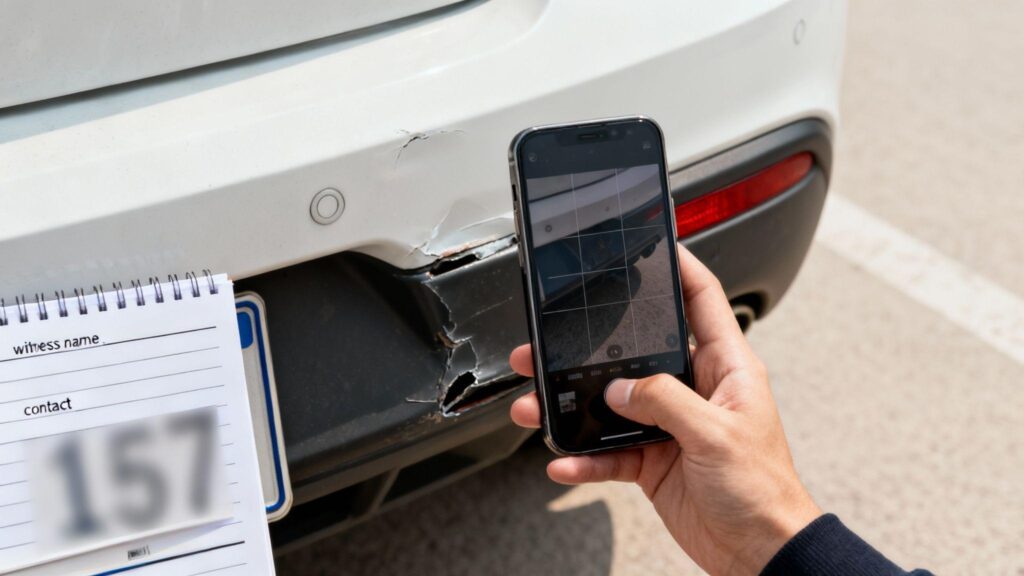
Take photographs of vehicle damage, roadway markings, traffic signals, skid marks, debris, and relevant weather or lighting conditions.
Include wide views showing vehicle positions and closer photographs of individual damage.
Exchange Driver Information
Collect the other driver’s name, contact information, vehicle registration, and insurance details.
Avoid confrontations or arguments about fault.
Identify Witnesses
Independent witnesses may provide valuable observations about traffic signals, vehicle movement, or the sequence of events.
Obtain contact information when possible, but do not pressure witnesses into making statements. How to File
Step 4: Seek Appropriate Medical Attention
Some accident-related injuries require immediate emergency treatment.
Other symptoms may become noticeable after the initial shock of a collision.
Don’t Ignore Developing Symptoms
Headaches, neck pain, dizziness, numbness, and worsening discomfort deserve appropriate medical evaluation.
If you experience severe symptoms, seek emergency care.
Follow Medical Recommendations
Attend necessary appointments and follow the treatment plan provided by your healthcare professional.
Keep copies of medical records, prescriptions, bills, and related expenses.
These records may help explain your injuries and associated costs.
Do not delay necessary care merely because an insurance claim has not yet been approved.
Step 5: Notify Your Auto Insurance Company
Contact your insurance provider promptly after the accident.
Insurance policies generally contain notice and cooperation requirements.
Review your policy rather than assuming that every insurer follows the same reporting deadline.
Information to Provide
The company may request the date, location, vehicle details, information about the other drivers, and a general description of what occurred.
Provide accurate facts and explain when information is uncertain.
Avoid guessing about vehicle speeds, medical diagnoses, or circumstances you did not observe.
Obtain a Claim Number
Once a claim is opened, save the claim number and contact information for the assigned representative.
Keep records of communications and important deadlines.
Step 6: Understand Your Available Insurance Coverage
South Carolina requires minimum bodily injury liability coverage of $25,000 per person and $50,000 per accident, plus $25,000 in property damage liability coverage.
Drivers must also carry uninsured motorist coverage at required minimum levels.
Liability Insurance
Liability coverage can pay qualifying damages caused by an insured driver, subject to policy limits and other conditions.
Uninsured Motorist Coverage
Uninsured motorist coverage may apply when an at-fault driver lacks qualifying insurance or in certain hit-and-run situations.
Notice and cooperation requirements are particularly important in these cases.
Underinsured Motorist Coverage
South Carolina insurers must offer underinsured motorist coverage, but drivers are not required to purchase it.
This optional coverage may help when the at-fault driver’s available insurance is insufficient for covered damages.
Collision and Medical Coverage
Your own policy may also provide collision, medical payments, or other optional benefits.
Review actual policy language to understand eligibility, deductibles, and reimbursement conditions.
Step 7: Document Your Financial and Personal Losses
An insurance claim should be supported by reliable evidence of the losses connected to the accident.
Medical Expenses
Maintain records of emergency treatment, physician visits, diagnostic testing, rehabilitation, medication, and other medically necessary expenses.
Lost Income
If injuries prevent you from working, employment records and appropriate medical documentation may help establish lost earnings.
Self-employed individuals may need business records and additional evidence.
Vehicle Damage
Obtain repair estimates and document towing charges, storage fees, and qualifying transportation expenses.
Other Compensable Losses
Depending on the circumstances, South Carolina law may permit compensation for pain, suffering, lasting limitations, and other damages.
Compensation is never automatic, and available amounts depend on the evidence and applicable law.
Step 8: Understand South Carolina’s Comparative Negligence Rule
South Carolina follows a modified comparative negligence system.
Under the rule established by the South Carolina Supreme Court, a claimant may generally recover damages when their negligence does not exceed that of the defendant or, in applicable cases, the combined negligence of defendants.
How Shared Fault Affects Compensation
Suppose a person has $40,000 in otherwise recoverable damages and is found 20% responsible.
Their recoverable amount would generally be reduced to $32,000.
In a straightforward two-driver case, a claimant whose fault exceeds 50% is generally barred from recovering negligence damages.
Cases involving multiple responsible parties can be more complicated, particularly under South Carolina’s updated 2026 liability-allocation rules.
An attorney can explain how these rules may affect a specific claim.
Step 9: Work With the Insurance Adjuster
After receiving the claim, an insurer may investigate liability, review damage, and request supporting documents.
The adjuster may examine photographs, repair estimates, medical information, and recorded accounts.
Be Accurate and Organized
Answer reasonable questions truthfully.
If you don’t know an answer, say so rather than speculating.
Understand Recorded Statements
Your own insurance policy may require cooperation with certain requests.
Requests from another driver’s insurer raise different considerations.
For a significant injury or disputed claim, consider legal advice before giving a detailed recorded statement or signing broad authorizations.
Keep Written Records
Save emails, letters, estimates, and notes from conversations.
Ask for explanations when an insurer questions coverage or reduces an estimated loss.
Step 10: Review Settlement Offers Carefully
An insurance company may offer compensation after evaluating the claim.
However, an early settlement may not reflect future treatment needs or other losses that are not yet understood.
Review the Complete Offer
Consider whether the proposed payment addresses documented medical expenses, lost income, property damage, and other applicable losses.
Understand the Release
Settlement agreements often require claimants to release specified legal claims.
Signing a final release can prevent further recovery for the matters covered, even if additional complications arise later.
For significant injuries, legal review before signing may be especially important.
How Long Do You Have to File a Car Accident Lawsuit?
South Carolina Code Section 15-3-530 generally provides a three-year filing period for ordinary personal injury lawsuits.
The deadline is a legal limit for beginning court proceedings, not a recommended waiting period for reporting an accident to an insurer.
Claims Against Government Entities
Claims governed by the South Carolina Tort Claims Act generally have a two-year lawsuit deadline.
A properly filed verified claim can affect the available period, potentially extending it to three years under the statute’s conditions.
Verified claims have separate procedural and timing requirements.
Why Early Action Matters
Different claims can involve exceptions, shorter deadlines, or specific notice requirements.
Contact an appropriately qualified South Carolina attorney promptly to determine which deadlines apply.
Professional Car Accident Legal Help in Myrtle Beach
Drivers researching how to file a claim after a car accident in Myrtle Beach may find additional information through Morris Law, LLC.
The firm represents people injured in motor vehicle accidents throughout Myrtle Beach and nearby Horry County communities.
Services Described by Morris Law
According to its official website, the firm assists with crash investigations, evidence preservation, insurance communications, settlement negotiations, and personal injury litigation.
It also advertises representation in truck, motorcycle, pedestrian, and other injury-related cases.
Local Representation
Morris Law identifies Myrtle Beach, North Myrtle Beach, Surfside Beach, Conway, Garden City, and surrounding communities among the areas it serves.
The firm offers free initial consultations and describes a contingency-fee arrangement for accident cases.
Prospective clients should obtain written details concerning fees, litigation expenses, and representation terms.
When Legal Assistance May Be Useful
Consider consulting a lawyer when injuries are serious, fault is disputed, insurance coverage is inadequate, or the claim involves a commercial or government vehicle.
An attorney can evaluate legal options, but no settlement or verdict is guaranteed.
Special Considerations for Myrtle Beach Tourists
Myrtle Beach attracts visitors who may be unfamiliar with local roads.
An accident involving an out-of-state driver or rental vehicle can introduce additional insurance questions.
Rental Car Coverage
Review the rental agreement, optional protection products, and any coverage provided through your personal insurance or credit card.
Out-of-State Drivers
The location of the collision may influence the applicable legal rules, even when the drivers live elsewhere.
An attorney familiar with South Carolina law can help explain jurisdiction and claim procedures.
Common Mistakes to Avoid After a Collision
Failing to report a qualifying accident, delaying medical evaluation, or losing important evidence can complicate a claim.
Other mistakes include making inaccurate statements, ignoring insurer correspondence, and accepting a settlement without understanding its terms.
Avoid posting detailed claims about injuries or responsibility on social media while the matter remains unresolved.
Finally, don’t assume that an insurance negotiation pauses the legal deadline for filing a lawsuit.
Frequently Asked Questions About Myrtle Beach Car Accident Claims
How Do I File a Claim After a Car Accident in Myrtle Beach?
Address immediate safety needs, report the accident when required, collect evidence, obtain medical attention, notify your insurer, and submit the relevant claim documentation.
Do I Need a Police Report?
Police documentation is valuable. South Carolina also has specific reporting requirements for injury crashes and certain collisions not investigated by law enforcement.
What Is the Deadline for Filing a Claim?
Insurance notice requirements vary by policy. Most ordinary South Carolina personal injury lawsuits have a three-year deadline, while certain government-related claims have different rules.
What If the Other Driver Has No Insurance?
Required uninsured motorist coverage may provide benefits, depending on the policy, accident circumstances, and compliance with applicable requirements.
Can I Recover Compensation If I Was Partly at Fault?
Potentially. South Carolina’s comparative negligence rules may permit reduced recovery when the claimant’s degree of fault remains within the applicable threshold.
Should I Accept the First Settlement Offer?
Review the offer and release carefully. For substantial injuries or uncertain future expenses, consider obtaining legal advice before accepting.
Can a Tourist File a Claim After a Myrtle Beach Accident?
Yes, potentially. Residency alone does not prevent a visitor from pursuing an eligible claim arising from a South Carolina collision.
Do I Need a Car Accident Lawyer?
Not every claim requires legal representation. A lawyer may be particularly helpful for serious injuries, disputed liability, complex insurance questions, or approaching deadlines.
Conclusion: Protect Your Rights After a Myrtle Beach Car Accident
Understanding how to file a claim after a car accident in Myrtle Beach can help drivers respond more confidently during a stressful situation.
Begin with safety and medical needs, follow applicable reporting requirements, preserve evidence, and notify the appropriate insurance providers.
Keep detailed financial and treatment records, and review settlement terms before making final decisions.
South Carolina’s fault rules, insurance requirements, and lawsuit deadlines can significantly influence the claims process.
When legal issues become complicated, qualified professional advice can help clarify your options.
With careful documentation and timely action, you can approach the insurance and legal process with a clearer understanding of your rights and responsibilities.

Written by Twastia Editorial Team
Twastia Editorial Team shares practical insights about website design, SEO services, Google Ads, content marketing, social media, conversion rate optimization, and digital marketing strategy.
Last updated: Oct 15, 2026
Related posts from Twastia
Explore more useful articles from twastia.com about digital marketing, SEO, websites, ads, content, and growth strategy.