Ultimate Guide to the Words and Phrases Benjamin Franklin Originally Coined
When we think of the Founding Fathers of the United States, we often picture them drafting the Declaration of Independence, […]
When we think of the Founding Fathers of the United States, we often picture them drafting the Declaration of Independence, fighting the Revolutionary War, or debating the framework of the Constitution. However, the legacy of these remarkable figures extends far beyond politics and government. Among them, one individual stands out as a true polymath: a brilliant diplomat, a pioneering scientist, a successful publisher, and an incredibly influential writer. The vast array of terms and expressions that Benjamin Franklin originally coined continues to shape the way we speak, write, and understand the world today.
For Americans, Franklin is the quintessential self-made man. He rose from humble beginnings as a printer’s apprentice in Boston to become one of the most famous and respected men in the Western world. What is less commonly known is his profound impact on the English language. When exploring the specific words that Benjamin Franklin originally coined, we uncover a fascinating intersection of science, philosophy, and practical American wit. He possessed a unique ability to observe complex phenomena and assign them clear, accessible names.
From the scientific vocabulary we use to describe electricity to the timeless proverbs we share with our children, few realize exactly how many words Benjamin Franklin originally coined. He did not just help forge a new nation; he helped forge the uniquely American dialect. In this comprehensive guide, we will explore the history, context, and enduring legacy of the diverse vocabulary he gifted to modern society.
The Linguistic Genius of an American Founding Father
To understand why a statesman was inventing words, we must understand the environment of the eighteenth century. The Enlightenment was in full swing, and thinkers across Europe and the American colonies were pushing the boundaries of human knowledge. As Franklin conducted his famous experiments, he realized that the existing English vocabulary was simply insufficient to describe his groundbreaking discoveries. If he was going to explain his findings to the Royal Society in London or to his fellow colonists in Pennsylvania, he needed a fresh lexicon.
Consequently, the scientific vocabulary that Benjamin Franklin originally coined was born out of sheer necessity. He had to communicate abstract, invisible forces to a public that had never encountered them before. But his linguistic creativity did not stop at science. As the publisher of The Pennsylvania Gazette and Poor Richard’s Almanack, he was also uniquely positioned to influence popular culture. By distributing his writings across the colonies, the everyday idioms and phrases that Benjamin Franklin originally coined spread like wildfire, rapidly embedding themselves into the daily speech of early Americans.
Electrical Terms That Benjamin Franklin Originally Coined

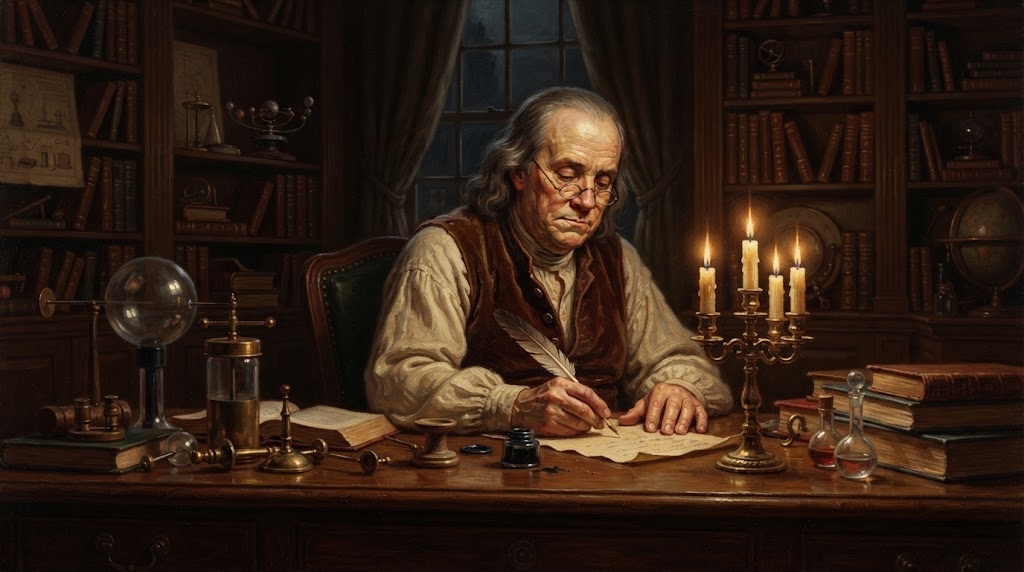
Perhaps his most significant and lasting contribution to the English language comes from his work as an amateur physicist. During the 1740s and 1750s, electricity was viewed largely as a parlor trick—a mysterious force used by magicians and entertainers to create sparks for amused crowds. Franklin took it seriously. Through rigorous experimentation, including his legendary kite experiment, he proved that lightning and electricity were the exact same phenomenon.
Positive and Negative Charge
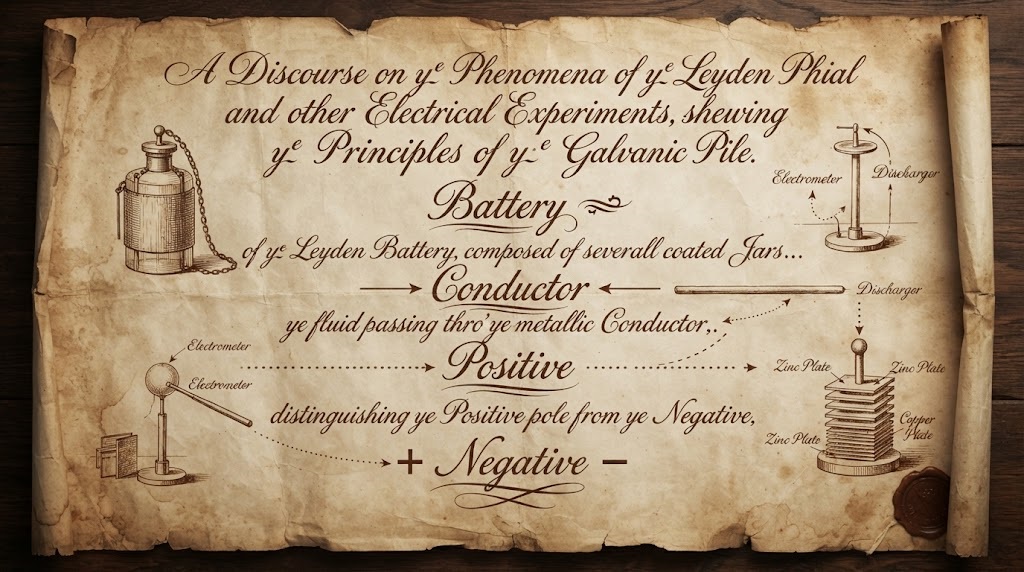
Before Franklin, scientists believed that electricity consisted of two different types of fluid. Franklin proposed a revolutionary “one-fluid” theory, suggesting that electricity was a single, invisible fluid present in all matter. To explain how this fluid moved, he borrowed mathematical concepts. The specific terms “positive” and “negative” in an electrical context are words that Benjamin Franklin originally coined to describe the surplus or deficit of this electrical fluid. When an object had too much of the fluid, it was positively charged; when it had too little, it was negatively charged.
Battery and Conductor
Another highly recognizable word that Benjamin Franklin originally coined for scientific use is “battery.” Prior to his experiments, the word battery was used exclusively as a military term to describe a row of artillery cannons firing together. When Franklin linked multiple Leyden jars (early capacitors) together to store and discharge a massive amount of electricity at once, the setup reminded him of a row of cannons. He repurposed the military term, and today, we still use his exact word to describe the power sources in our cell phones, cars, and laptops.
He also needed a word to describe materials that allowed this electrical fluid to pass through them freely. The word “conductor” is another essential term that Benjamin Franklin originally coined in the realm of physics. He also introduced terms like “charge,” “discharge,” “uncharged,” “condenser,” and “armature.” Every time you plug in an appliance or jump-start a car, you are using the electrical vocabulary that Benjamin Franklin originally coined over two and a half centuries ago.
Everyday Phrases That Benjamin Franklin Originally Coined
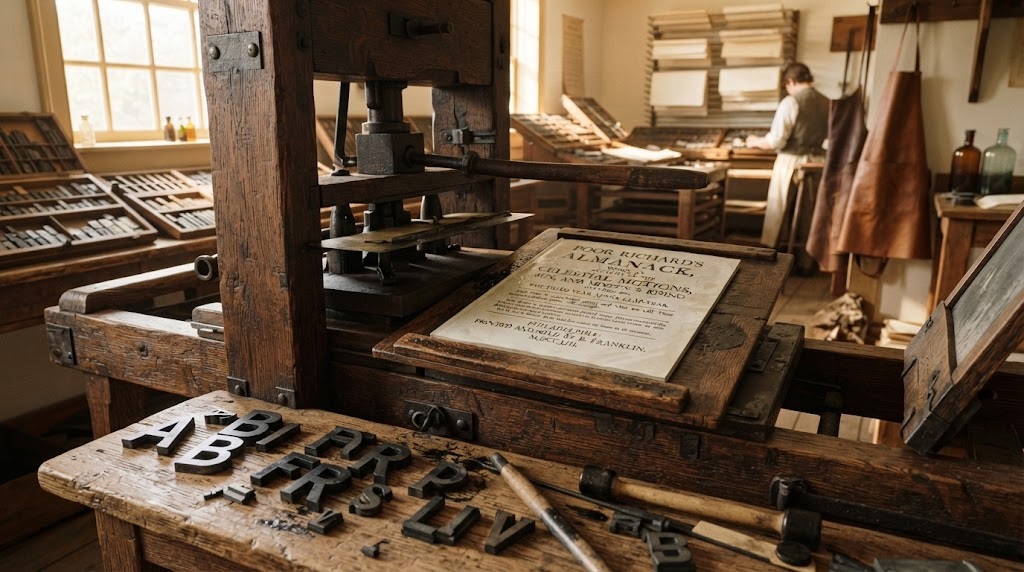
While his scientific terms transformed global physics, his work as an author and publisher transformed American culture. He published Poor Richard’s Almanack under the pseudonym Richard Saunders from 1732 to 1758. The publication was a massive success, offering weather forecasts, astronomical data, recipes, and a wealth of proverbs.
“Time is Money”
When reviewing the colloquial phrases Benjamin Franklin originally coined, “Time is money” is undoubtedly one of the most famous. He introduced this concept in his 1748 essay titled Advice to a Young Tradesman. He wrote: “Remember that time is money. He that can earn ten shillings a day by his labour, and goes abroad, or sits idle, one half of that day… has really spent, or rather thrown away, five shillings.” This phrase perfectly encapsulated the emerging American work ethic and capitalistic spirit.
Financial Wisdom and Cultural Idioms
There are several famous idioms Benjamin Franklin originally coined or adapted to promote thrift, hard work, and financial independence. While he often borrowed concepts from earlier European writers, he rewrote them with a sharp, punchy cadence that made them unforgettable. For example, he popularized the concept behind “A penny saved is a penny earned,” though his exact wording in the Almanack was actually “A penny saved is two pence clear.”
However, there is no debate over the financial advice Benjamin Franklin originally coined regarding debt. He famously wrote, “Creditors have better memories than debtors,” a brilliant observation on human psychology and borrowing that remains entirely relevant today. Furthermore, the sharp wit that Benjamin Franklin originally coined is evident in his humorous observations, such as, “Fish and visitors smell in three days,” a hilarious but practical rule for household hospitality.
Political and Social Terms That Benjamin Franklin Originally Coined
Beyond science and personal finance, Franklin used language to shape the political destiny of the American colonies. He was a master of political messaging, understanding that unifying the diverse and often quarrelsome colonies required shared concepts and a shared vocabulary.
Uniting the Colonies Through Language
Many political concepts that Benjamin Franklin originally coined or popularized helped define the American ethos. In 1754, during the French and Indian War, he created what is considered the first political cartoon in American history: a severed snake with the caption “Join, or Die.” This powerful visual and textual message urged the colonies to unite.
Later, as a diplomat in France, he used his mastery of language to secure vital military and financial support for the American Revolution. He understood the nuances of persuasion better than almost anyone of his era. Even his famous quip at the signing of the Declaration of Independence—”We must, indeed, all hang together, or most assuredly we shall all hang separately”—demonstrates his brilliant ability to use wordplay to emphasize the gravity of their treason against the British Crown.
How Words That Benjamin Franklin Originally Coined Shaped American English
Franklin’s influence on the English language went so deep that he actually attempted to formally reform American spelling. He believed that the English alphabet was inefficient and full of silent, unnecessary letters. In 1768, he published A Scheme for a New Alphabet and a Reformed Mode of Spelling, in which he proposed removing the letters C, J, Q, W, X, and Y, and adding six new letters to represent specific phonetic sounds.
While his phonetic alphabet never caught on, his desire to create a distinct, logical, and practical American language did. The unique vocabulary Benjamin Franklin originally coined helped separate American English from its British roots. Noah Webster, the creator of the first American dictionary, was heavily influenced by Franklin’s linguistic philosophy. Webster adopted Franklin’s preference for simpler, more phonetic spellings, which is why Americans today write “color” instead of “colour” and “center” instead of “centre.”
Every time we use the words Benjamin Franklin originally coined, we are participating in a linguistic tradition that values clarity, practicality, and innovation. He believed that language should serve the people, not the other way around. By stripping away academic pretension and creating words that everyday people could understand, he democratized both science and literature.
The Legacy of a Master Wordsmith
The sheer volume of the linguistic terms Benjamin Franklin originally coined demonstrates the limitless curiosity of his mind. He was a man who looked at a thunderstorm and saw a unified physical theory; he looked at a chaotic, developing nation and saw a unified republic. To bring his visions to life, he had to give them names.
Today, his face graces the hundred-dollar bill, and his inventions, like the lightning rod and bifocal glasses, are still in use. But arguably, his most invisible and yet most pervasive invention is his vocabulary. From the batteries powering our modern digital lives to the proverbs guiding our financial decisions, the expressions Benjamin Franklin originally coined remain deeply embedded in the DNA of the modern world. He proved that the right word, invented at the exact right moment, has the power to illuminate the dark, spark a revolution, and endure for centuries.
Frequently Asked Questions
What are some common words Benjamin Franklin originally coined?
He is credited with inventing numerous electrical terms that we still use daily. These include battery, charge, discharge, uncharged, conductor, condenser, armature, plus, minus, positive, and negative in relation to electrical currents.
Did Benjamin Franklin invent the phrase “Time is money”?
Yes, the phrase “Time is money” is a concept that Benjamin Franklin originally coined in his 1748 essay Advice to a Young Tradesman. He used it to explain the opportunity cost of laziness and the financial value of hard work to young American workers.
Did he really coin “A penny saved is a penny earned”?
While he is heavily associated with this phrase, he actually wrote, “A penny saved is two pence clear” in his Poor Richard’s Almanack. Over the decades, the public evolved his original phrase into the familiar “A penny saved is a penny earned” that we use today.
Why did Benjamin Franklin need to invent new words?
During the mid-18th century, the study of electricity was entirely new. There was no existing scientific vocabulary in the English language to describe the behavior of electrical currents, charges, and storage devices. He invented new terms out of necessity so he could accurately describe his groundbreaking experiments to other scientists.
Did Benjamin Franklin try to change the English alphabet?
Yes, in 1768 he proposed a new phonetic alphabet that removed six letters (C, J, Q, W, X, and Y) and added six new ones. While his alphabet was never officially adopted, his push for a simpler, more logical spelling system deeply influenced Noah Webster and the development of American English.
Conclusion
Reviewing the expressions Benjamin Franklin originally coined offers a fascinating window into the mind of one of history’s greatest innovators. He was not merely a passive observer of the world; he actively shaped it through his scientific discoveries, political diplomacy, and brilliant command of language. By giving us the vocabulary to understand electricity and the proverbs to navigate daily life, he left an indelible mark on global culture. The next time you charge your phone battery, check your bank account, or advise a friend that “time is money,” remember that you are carrying forward the linguistic legacy of America’s most inventive Founding Father.

Written by Twastia Editorial Team
Twastia Editorial Team shares practical insights about website design, SEO services, Google Ads, content marketing, social media, conversion rate optimization, and digital marketing strategy.
Last updated: Oct 19, 2026
Related posts from Twastia
Explore more useful articles from twastia.com about digital marketing, SEO, websites, ads, content, and growth strategy.