What Exactly Is an Evaporative Cooler? Best & Easy Guide
Keeping a home comfortable during summer can become expensive, especially when temperatures remain high for several months. Traditional air conditioning […]
Keeping a home comfortable during summer can become expensive, especially when temperatures remain high for several months. Traditional air conditioning is a popular solution, but it is not always the most practical option for every household or climate.
In hot, dry regions, evaporative cooling provides another way to lower the temperature of incoming air.
What exactly is an evaporative cooler? It is a cooling appliance that uses the natural evaporation of water to reduce air temperature. Instead of relying on refrigerant and a compressor, most residential evaporative coolers use a fan, wet cooling pads, and a water reservoir.
These appliances are commonly called swamp coolers or desert coolers.
They can be particularly useful in parts of the American Southwest, where summer air is often hot and relatively dry. However, their performance decreases when outdoor humidity becomes high.
Understanding what exactly is an evaporative cooler, how it works, and its limitations can help homeowners decide whether this technology is suitable for their property.
This guide explains the cooling process, major components, different system types, energy use, installation considerations, and practical maintenance tips.
What Exactly Is an Evaporative Cooler and How Does It Work?
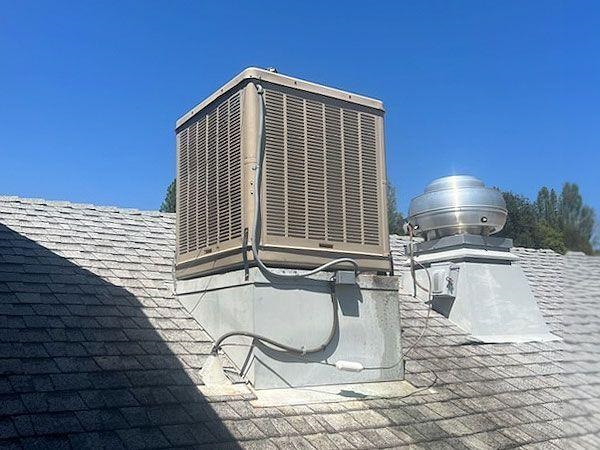
An evaporative cooler is an appliance that cools air by moving it across water-moistened material.
As a portion of the water evaporates, it absorbs heat from the incoming air. The fan then delivers the cooler air into the room or building.
The Science Behind Evaporation
Water requires energy to change from a liquid into vapor.
During evaporative cooling, some of this energy comes from the heat contained in the surrounding air.
As the water evaporates, the air temperature decreases.
This is the same basic physical process that helps perspiration cool the human body.
A Simple Example
Imagine standing outside on a hot day after getting your skin wet.
When dry air moves across the water, evaporation can create a cooling sensation.
An evaporative cooler applies a similar principle to a controlled stream of air.
Why Humidity Matters
Dry air can absorb more moisture before approaching saturation.
Air that is already humid has less capacity for additional evaporation, which limits the cooling effect.
This makes regional climate an important factor in selecting a system.
The Main Components of an Evaporative Cooler
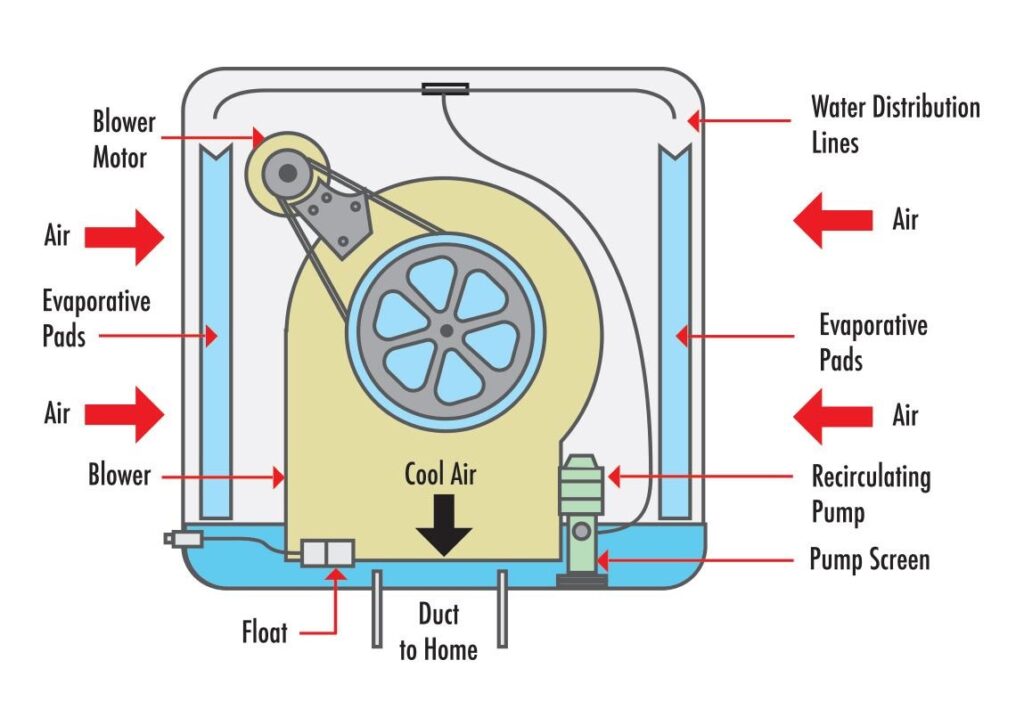
To understand what exactly is an evaporative cooler, it helps to examine the components that make the appliance function.
Cooling Pads
Evaporative pads are designed to retain water while allowing air to flow through them.
Many residential products use treated cellulose media or other specialized materials.
Water Reservoir
A reservoir stores the water needed to keep the cooling pads wet.
Portable models usually include a removable or refillable tank.
Water Pump
Many systems use a small pump to circulate water from the reservoir onto the cooling media.
Other designs use different water-distribution arrangements.
Blower or Fan
The fan draws air through the wet pads and directs it into the occupied space.
Controls
Depending on the model, controls may include fan speed, cooling operation, timers, and automatic water management.
All these components must function together to provide effective cooling.
Different Types of Evaporative Coolers
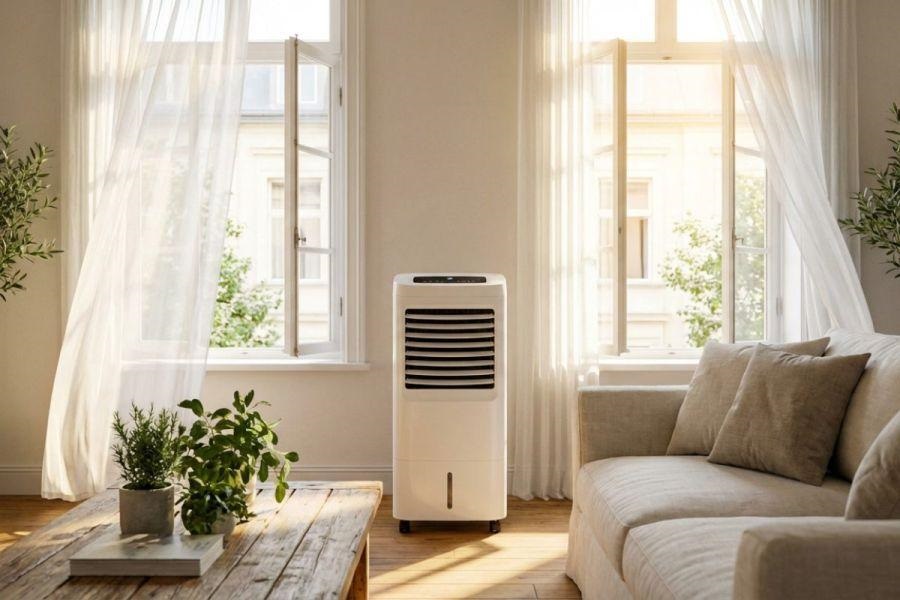
Understanding what exactly is an evaporative cooler also involves recognizing that not every model operates in the same way.
Direct Evaporative Coolers
Direct systems pass incoming air through wet cooling pads.
The process lowers the air temperature and adds moisture to the air entering the home.
This is the familiar swamp cooler design used in many residential applications.
Indirect Evaporative Coolers
Indirect systems use a separate air stream and a heat exchanger.
Evaporation cools one stream, while the heat exchanger transfers cooling to another.
The supplied air is not directly exposed to the evaporating water.
Two-Stage Evaporative Coolers
Some systems combine indirect precooling with a subsequent direct evaporative cooling stage.
These designs can provide additional cooling under suitable conditions, but they may be more complex.
Portable Evaporative Coolers
Portable models are smaller appliances designed for localized cooling.
They typically have wheels, a refillable water tank, and adjustable fan settings.
Whole-House Evaporative Coolers
Larger units may be installed on roofs, through walls, or in other suitable locations.
These systems can distribute cooled outside air throughout much of a home.
The Major Benefits of Evaporative Cooling
When homeowners ask what exactly is an evaporative cooler, they are often interested in whether it can provide comfortable cooling with lower energy consumption.
Lower Electricity Requirements
Conventional evaporative coolers generally avoid the compressor used in refrigerated air conditioning.
Their principal electrical loads are typically the fan and water pump.
For suitable dry-climate installations, electricity consumption can be substantially lower than that of conventional central air conditioning.
Fresh-Air Ventilation
Many direct systems continually introduce outside air.
When properly designed and operated, this airflow can help replace warmer indoor air with newly cooled air.
Simpler Mechanical Design
Many units have comparatively straightforward components.
However, simplicity does not mean they operate without maintenance.
Additional Moisture in Dry Air
Direct evaporative cooling increases the humidity of the air it supplies.
That can be useful in an extremely dry climate, although too much moisture is undesirable.
Potentially Affordable Operation
Lower electricity consumption can make these systems economical in appropriate conditions.
Actual savings depend on electricity rates, water costs, weather, equipment size, and operating habits.
Where Do Evaporative Coolers Work Best?
Climate is one of the most important considerations when deciding whether an evaporative cooler is suitable.
Hot and Dry Regions
Parts of Arizona, New Mexico, Nevada, Utah, and other Southwestern states can offer favorable conditions for evaporative cooling.
Dry Summer Weather
Even outside the desert Southwest, some inland regions experience periods with sufficiently low humidity.
Humid Coastal Regions
Areas with persistently humid summers are generally less favorable for direct evaporative cooling.
Seasonal Climate Changes
A location may be dry during one part of summer and considerably more humid during another.
Cooling effectiveness can therefore change from day to day.
Outdoor Air Quality
Evaporative systems often introduce outside air directly.
During wildfire smoke events or other episodes of poor outdoor air quality, their ventilation design can become a limitation.
A properly selected filtration system may help in certain circumstances, but ordinary wet cooling pads should not be assumed to remove harmful pollutants adequately.
Evaporative Cooler vs. Air Conditioner
Another important part of understanding what exactly is an evaporative cooler is comparing it with conventional refrigerated air conditioning.
| Feature | Evaporative cooler | Conventional air conditioner |
|---|---|---|
| Cooling process | Water evaporation | Refrigeration cycle |
| Compressor | Typically absent | Generally included |
| Humidity effect | Direct systems add moisture | Usually removes some indoor moisture |
| Best climate | Hot and dry | Suitable across wider climate conditions |
| Fresh-air intake | Common in whole-house direct systems | Depends on system design |
| Water use | Requires water | Usually no continuous water supply for basic residential cooling |
| Temperature control | Strongly weather-dependent | More precise control generally possible |
| Maintenance | Pads, reservoir, pump, water quality | Filters, coils, refrigerant system and related equipment |
Air conditioners are generally preferable when dependable cooling and humidity control are needed in hot, humid conditions.
Evaporative cooling may offer advantages when the air is dry enough for evaporation to work efficiently.
How Much Electricity Does an Evaporative Cooler Use?
Understanding what exactly is an evaporative cooler helps explain why it can consume less electricity than conventional air conditioning.
Why Energy Demand Can Be Lower
A typical direct evaporative cooler uses electrical energy to circulate water and move air.
It does not need to compress refrigerant to create cooling.
What Determines Consumption?
Important factors include blower motor size, fan speed, pump operation, equipment efficiency, and operating time.
Are Energy Savings Guaranteed?
No.
The U.S. Department of Energy describes examples in which evaporative cooling can use substantially less energy than conventional central air conditioning.
However, results depend on equipment and climate, so the same savings should not be promised for every home.
Consider Water Costs
Evaporative cooling consumes water during operation.
Electricity savings should be considered alongside local water rates, maintenance, and any restrictions on water use.
Does an Evaporative Cooler Increase Humidity?
The answer depends on which system is being used.
Direct Systems
A direct evaporative cooler adds water vapor to the cooled air.
This means the indoor humidity can rise during operation.
Indirect Systems
Indirect systems transfer cooling through a heat exchanger and do not directly add water vapor to the supplied air.
Why Too Much Humidity Is a Problem
Excessive indoor moisture may contribute to condensation and mold growth.
Proper ventilation and humidity monitoring are important.
Use a Hygrometer
A basic indoor humidity meter can help homeowners observe whether moisture levels are becoming excessive.
The EPA generally recommends keeping indoor relative humidity below 60%, ideally between 30% and 50%, to help control mold.
Choosing the Right Size for Your Home
When researching what exactly is an evaporative cooler, pay attention to airflow capacity rather than water tank size alone.
Understand CFM
Many evaporative coolers are rated in cubic feet per minute, or CFM.
This describes the volume of air moved by the appliance.
Match Airflow to the Space
A larger room generally needs more airflow than a compact room.
Whole-house systems require more detailed calculations.
Consider Ceiling Height
Two rooms with the same floor area can have different air volumes when their ceilings are different heights.
Account for Ventilation
Direct evaporative cooling requires an appropriate pathway for air to leave the building.
Ask About Professional Sizing
For a permanently installed system, consult a qualified HVAC contractor familiar with evaporative cooling in your region.
Avoid selecting a unit solely because it advertises a large cooling area.
How to Install an Evaporative Cooler
Installation depends on whether you choose a portable appliance or a built-in system.
Portable Cooler Setup
Position the unit on a stable surface.
Fill the tank according to the manufacturer’s instructions and provide suitable ventilation.
Window and Wall Units
Some systems require a secure mounting arrangement and an opening for outside air.
Whole-House Installation
Larger systems may require ductwork, water supply connections, electrical wiring, drainage, and properly arranged exhaust ventilation.
Electrical Safety
Use equipment rated for its intended environment and follow electrical instructions.
Fixed electrical work should be performed by qualified professionals where required.
Check Local Regulations
Building and electrical permit requirements vary by municipality.
How to Maintain Your Evaporative Cooler
To fully understand what exactly is an evaporative cooler, homeowners must recognize the importance of water-related maintenance.
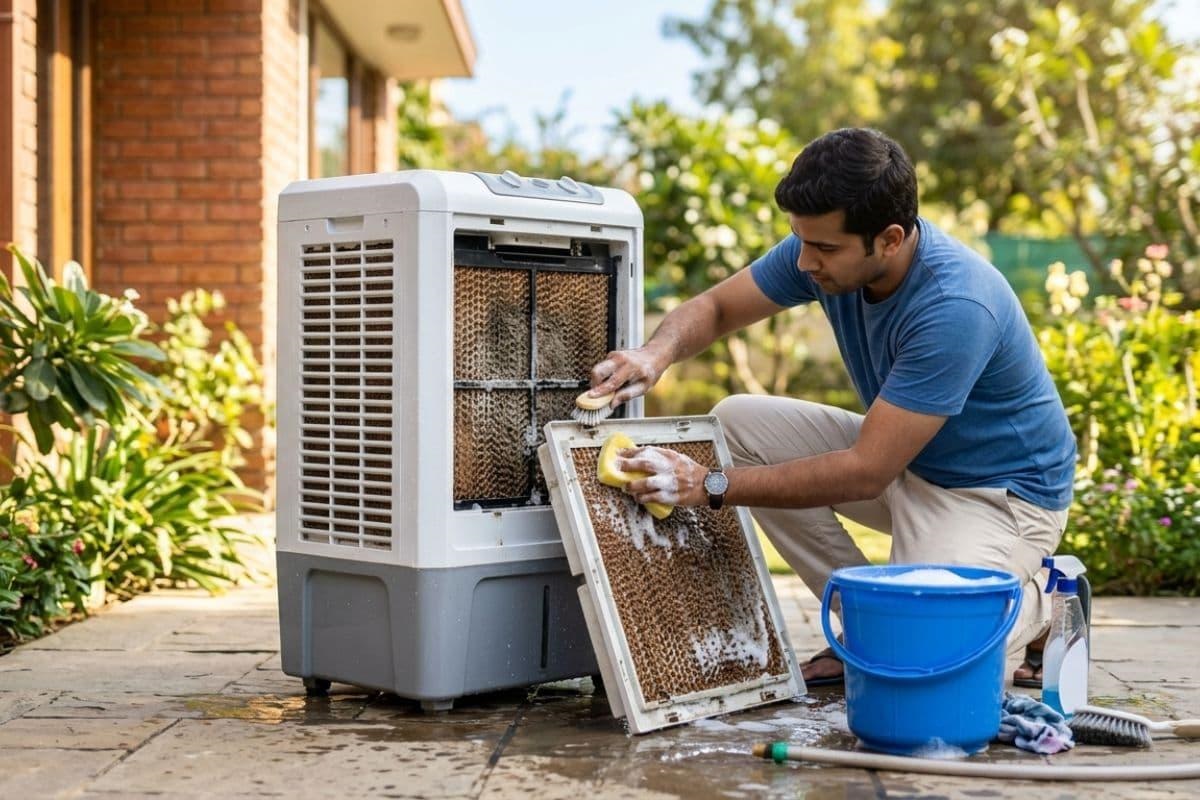
Clean the Reservoir
Standing water can accumulate sediment and microbial growth.
Drain and clean the reservoir according to the product instructions.
Inspect Cooling Pads
Mineral buildup can reduce airflow and cooling performance.
Clean or replace pads when recommended.
Check the Pump
Inspect accessible parts for debris, leaks, and problems with water circulation.
Monitor Water Quality
Hard water may leave mineral deposits on internal components.
Prepare for Seasonal Storage
In areas with freezing temperatures, follow the manufacturer’s winterization instructions.
Turn off electrical power before servicing the appliance.
Limitations You Should Know Before Buying
Evaporative cooling is useful, but it is not the ideal solution for every property.
Performance Depends on Weather
Cooling effectiveness decreases as humidity increases.
Water Is Required
The appliance needs an adequate water supply for cooling operation.
Regular Cleaning Is Necessary
Neglected reservoirs and pads can accumulate dirt, scale, and biological contamination.
Outdoor Air Can Be a Concern
Smoke and other pollutants may enter through systems that rely on unfiltered outside air.
Precise Cooling Is More Difficult
Evaporative systems cannot always maintain the same indoor temperature as compressor-based cooling equipment.
Consider these limitations when comparing your options.
Is an Evaporative Cooler Worth Buying?
Understanding what exactly is an evaporative cooler ultimately helps you decide whether the appliance matches your needs.
Consider Your Climate
Check typical summer humidity, not just maximum temperature.
Compare Operating Expenses
Evaluate expected electricity and water use.
Review Home Ventilation
A suitable airflow path is essential for conventional direct systems.
Assess Maintenance Requirements
Make sure you’re comfortable cleaning the reservoir and replacing cooling media.
Consider Your Comfort Expectations
If you need predictable temperature and humidity control, conventional air conditioning may be more suitable.
Frequently Asked Questions About Evaporative Coolers
1. What exactly is an evaporative cooler?
An evaporative cooler is a device that lowers air temperature using water evaporation, typically by drawing air through wet cooling media.
2. Is a swamp cooler the same as an evaporative cooler?
Yes. Swamp cooler is a common name for an evaporative cooler, especially a direct evaporative cooling system.
3. Does an evaporative cooler work without water?
The fan may operate without water on certain models, but the evaporative cooling function requires water.
4. Can an evaporative cooler cool an entire house?
Yes. Appropriately designed whole-house systems can provide cooling in suitable dry climates.
5. Do evaporative coolers work in humid weather?
Their cooling effectiveness usually declines as humidity increases.
6. Do I need to open a window when using an evaporative cooler?
Conventional direct systems need an adequate outlet for indoor air, often provided through open windows or properly designed vents.
7. Is an evaporative cooler cheaper to run than AC?
It can be in suitable dry climates, but actual costs depend on electricity, water, maintenance, and operating conditions.
8. How often should I clean an evaporative cooler?
Follow the manufacturer’s instructions and inspect water reservoirs and cooling pads regularly, particularly during frequent operation.
Conclusion
Understanding what exactly is an evaporative cooler can help homeowners explore an alternative to conventional air conditioning.
These systems use natural water evaporation to reduce incoming air temperature, making them especially useful in hot, dry climates.
Their potential advantages include lower electricity consumption, a relatively simple design, and continuous introduction of outside air in many whole-house systems.
However, they also consume water, require regular maintenance, and become less effective in humid conditions.
Before purchasing, evaluate your local climate, ventilation needs, room size, water availability, and preferred level of temperature control.
With suitable equipment, correct installation, and consistent maintenance, evaporative cooling can be a practical way to improve comfort in the right home.

Written by Twastia Editorial Team
Twastia Editorial Team shares practical insights about website design, SEO services, Google Ads, content marketing, social media, conversion rate optimization, and digital marketing strategy.
Last updated: Oct 29, 2026
Related posts from Twastia
Explore more useful articles from twastia.com about digital marketing, SEO, websites, ads, content, and growth strategy.