Advantages of GRFC for Architectural Concrete: Best Guide
Modern architecture increasingly demands building materials that combine visual appeal, structural efficiency, durability, and flexible design possibilities. Architects and construction […]
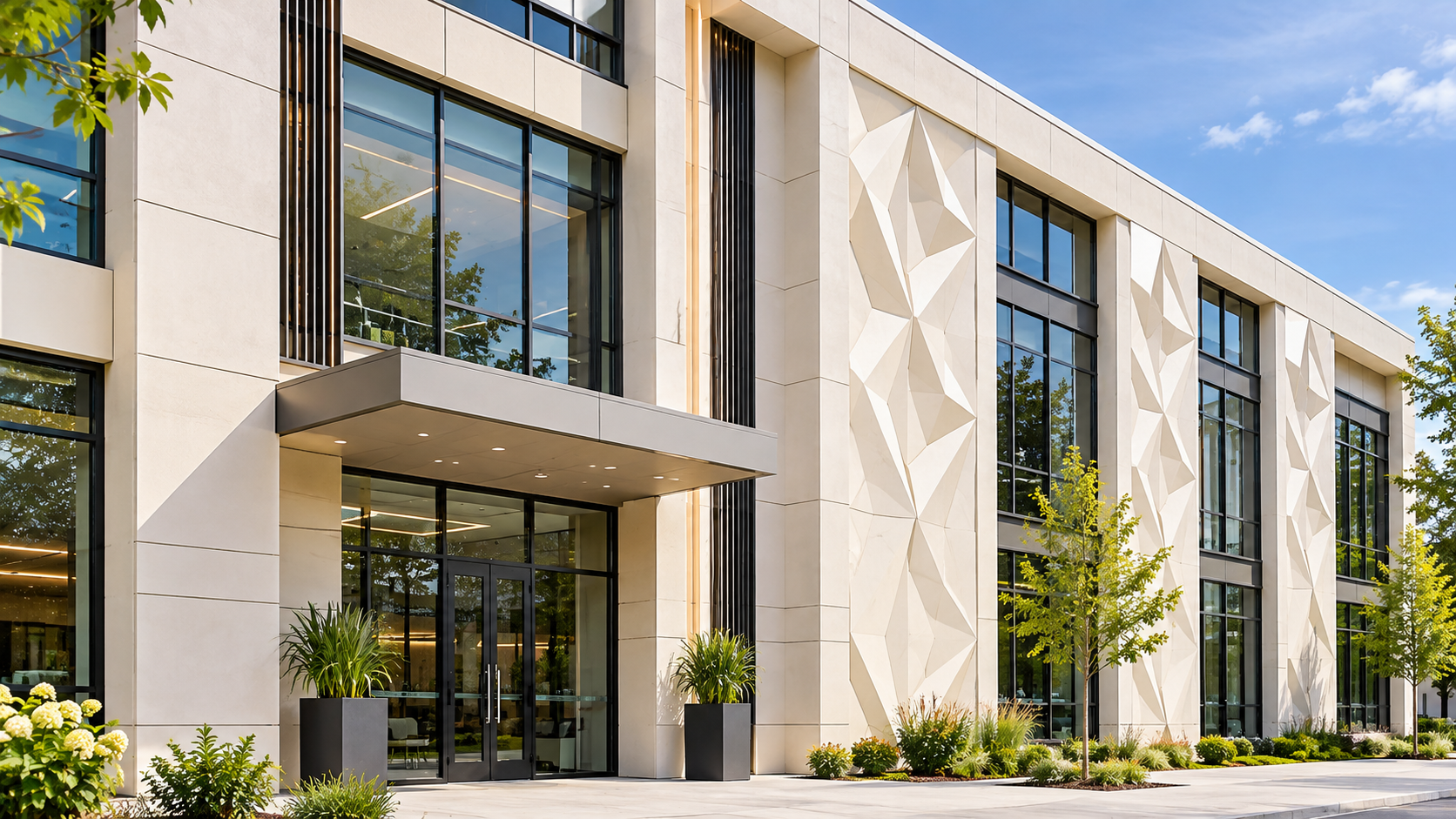
Modern architecture increasingly demands building materials that combine visual appeal, structural efficiency, durability, and flexible design possibilities. Architects and construction professionals want to create distinctive buildings while controlling material weight, installation complexity, and long-term maintenance requirements.
Traditional concrete remains essential in construction, but its considerable weight and limitations in producing certain thin, decorative elements can create challenges for architectural applications.
Glass fiber reinforced concrete provides an alternative for many of these uses.
Understanding Advantages of GRFC for Architectural Concrete helps architects, developers, engineers, and contractors evaluate whether this material is suitable for building façades, ornamental elements, renovation projects, and other specialized construction applications.
Glass fiber reinforced concrete, commonly known as GFRC or GRC, is a cement-based composite containing specially manufactured alkali-resistant glass fibers.
Unlike traditional steel-reinforced concrete, the fibers are distributed throughout the cementitious matrix, helping improve tensile and flexural performance in appropriately designed products.
The Glassfibre Reinforced Concrete Association explains that this material is widely used for prefabricated architectural cladding because it can combine relatively thin sections with design flexibility and useful mechanical properties. GRCA
The practical Advantages of GRFC for Architectural Concrete include reduced panel weight, opportunities for intricate shapes, improved reinforcement within thin sections, potentially faster installation, and greater freedom in selecting architectural finishes.
However, these benefits depend on appropriate engineering, manufacturing quality, fixing systems, and project-specific performance requirements.
This guide examines the major advantages, applications, production techniques, cost considerations, and technical limitations of glass fiber reinforced concrete in contemporary construction.
1. Lightweight Construction Without Sacrificing Design Possibilities
One of the most important characteristics of GFRC is its ability to create relatively thin concrete components while maintaining the mechanical performance required for their intended applications.
Traditional precast concrete panels often need substantial thickness and reinforcement to achieve their design requirements.
By contrast, properly engineered GFRC architectural elements can be produced with thinner sections, reducing the weight of many non-load-bearing components.
The first major benefit within Advantages of GRFC for Architectural Concrete is the potential to reduce cladding weight without abandoning the appearance of concrete.
Lower Dead Loads on Buildings
Dead load refers to the permanent weight of building materials and fixed components.
When a façade system is lighter, it imposes less self-weight on its supporting structure.
This can be valuable in multistory buildings, renovation projects, and installations where available structural capacity must be carefully considered.
The Whole Building Design Guide describes typical GFRC architectural cladding panels weighing approximately 10–25 pounds per square foot, depending on panel design and support framing. It notes that these panels may weigh roughly one-quarter to one-third as much as conventional precast concrete cladding. WBDG – Whole Building Design Guide
These figures are representative examples, not guaranteed specifications for every product.
Easier Transportation and Handling
Reducing panel weight may simplify transportation and site logistics.
Depending on panel dimensions and lifting arrangements, lighter components may require different handling equipment than heavier conventional precast elements.
However, panel handling must always follow the engineered lifting plan.
Suitable for Building Renovations
Older buildings may have limited capacity for additional heavy cladding.
A lightweight façade system can be worth evaluating when updating an existing exterior.
The weight-related Advantages of GRFC for Architectural Concrete are particularly relevant where structural loading, access, and installation logistics influence the project’s feasibility.
2. Greater Architectural Design Freedom
Architectural concrete is valued for its ability to combine functional building components with distinctive visual effects.
However, conventional concrete construction may become complicated or expensive when projects involve intricate curves, fine decorative patterns, or highly detailed moldings.
An important element of Advantages of GRFC for Architectural Concrete is the freedom to manufacture sophisticated shapes using carefully designed molds.
Complex Geometric Forms
GFRC can be used to produce curved panels, sculptural building elements, geometric screens, and other architectural details.
Because the material can be applied in relatively thin sections, certain forms may be more practical than equivalent solid concrete elements.
Decorative Cornices and Moldings
Architectural details such as cornices, columns, arches, and ornamental panels can be produced using specialized molds.
This makes the material useful for both contemporary architecture and historic-style restoration.
The Chicago Architecture Center notes that GFRC is used to replicate historic terra-cotta details and manufacture intricate architectural components. Chicago Architecture Center
Variety of Surface Finishes
GFRC can accommodate different surface textures and appearances, depending on manufacturing methods.
Potential finishes include smooth surfaces, exposed aggregate effects, integral color, applied coatings, and stone-like textures.
Custom Design Opportunities
Architects can work with qualified manufacturers to develop panels specifically for a project’s dimensions and visual requirements.
The design-related Advantages of GRFC for Architectural Concrete make the material attractive for projects where standard prefabricated components cannot achieve the intended appearance.
3. Improved Performance in Thin Architectural Sections
Concrete is generally strong in compression but comparatively weak in tension without appropriate reinforcement.
Glass fiber reinforced concrete addresses part of this limitation by incorporating alkali-resistant glass fibers throughout the matrix.
This reinforcement can improve certain mechanical properties when the material is formulated and manufactured correctly.
The mechanical Advantages of GRFC for Architectural Concrete are particularly valuable in thin architectural products.
Higher Flexural Performance
Flexural strength describes a material’s ability to resist bending stresses.
Properly manufactured GFRC can provide improved flexural performance compared with otherwise comparable unreinforced cementitious mixtures.
This supports the use of thin cladding skins and decorative architectural elements.
Distributed Fiber Reinforcement
Unlike reinforcement located primarily in specific positions within a conventional concrete member, glass fibers are distributed throughout the GFRC matrix.
Their distribution helps resist the development and propagation of certain cracks.
However, fiber orientation, concentration, and manufacturing methods affect actual performance.
Better Impact Resistance
Appropriate fiber reinforcement can improve toughness and resistance to certain impact-related damage.
A technical review published in Materials examines improvements in tensile strength, flexural behavior, crack control, and impact performance associated with glass fiber reinforcement. MDPI
These characteristics depend on the mixture and should be established through relevant testing.
Engineering Remains Essential
GFRC should not automatically replace conventional reinforced concrete in structural applications.
Its suitability depends on engineered design requirements, load paths, and tested performance.
The structural-performance Advantages of GRFC for Architectural Concrete should therefore be understood as opportunities for appropriate component design, not a claim that every GFRC product is stronger than every conventional concrete product.
4. Better Resistance to Certain Types of Cracking and Deterioration
Durability is a major consideration in architectural cladding.
Exterior panels may be exposed to moisture, temperature fluctuations, wind, pollution, and repeated weathering throughout their service life.
One of the practical Advantages of GRFC for Architectural Concrete is the potential for improved crack control when suitable fibers, cementitious materials, and curing methods are used.
How Glass Fibers Help Control Cracks
Fine cracks may develop in cementitious materials as a result of shrinkage, temperature changes, loading, or restrained movement.
Alkali-resistant glass fibers can bridge certain cracks and help limit their propagation.
This does not make the material completely crack-proof, but it can improve performance under appropriate conditions.
No Corroding Steel Within the GFRC Skin
Traditional reinforced concrete can experience corrosion problems when moisture and aggressive substances reach embedded steel.
The alkali-resistant glass fibers used to reinforce a GFRC skin do not corrode in the same way as conventional reinforcing steel.
However, many GFRC panels incorporate steel frames, anchors, or connection hardware that still require appropriate corrosion protection.
Importance of Suitable Glass Fibers
Ordinary glass is not suitable as a direct substitute for alkali-resistant reinforcement in concrete.
The cementitious environment is highly alkaline and can damage unsuitable fibers.
The Glassfibre Reinforced Concrete Association specifies alkali-resistant glass fibers with an appropriate zirconia content; its technical guidance identifies a minimum zirconium dioxide content of 16% for these fibers. GRCA
The durability-related Advantages of GRFC for Architectural Concrete depend on the correct fiber type, mixture, curing process, protective finishes, and installation details.
Weather Exposure and Maintenance
Correctly designed GFRC can perform well in external architectural applications.
Nevertheless, movement joints, drainage details, sealants, and connections must be maintained as required.
A durable material cannot compensate for poor façade design or inadequate maintenance.
5. Faster and More Efficient Installation
Construction schedules can be affected by site access, weather conditions, labor availability, and the complexity of installation.
Prefabricated architectural panels can help organize certain construction activities before components arrive on-site.
Another important aspect of Advantages of GRFC for Architectural Concrete is the potential for efficient installation through reduced component weight and factory manufacturing.
Factory-Made Components
Many architectural GFRC elements are produced in controlled manufacturing facilities.
Molds, reinforcement, casting procedures, curing, and quality checks can be organized before panels are delivered.
This approach may reduce some on-site finishing activities compared with methods that require extensive construction directly at the building.
Simplified Handling in Suitable Projects
The reduced weight of certain GFRC panels may improve handling efficiency.
Depending on the project, it may also affect transport arrangements and lifting equipment requirements.
However, cranes, lifting devices, attachment points, and worker safety procedures must be selected according to engineered requirements.
Repeated Architectural Elements
Projects containing several identical façade elements can benefit from reusable molds.
Manufacturing repeated components can support consistency in size, shape, and finish when production is properly controlled.
The GRCA identifies prefabrication, relatively lightweight elements, and rapid fixing as important reasons GRC is used in building applications. GRCA
Coordination With Other Construction Activities
Early coordination between architects, structural engineers, façade specialists, and manufacturers can help avoid delays caused by incompatible details.
The installation-related Advantages of GRFC for Architectural Concrete are most likely to be realized when panel production, transportation, access, and connection design are planned together.
6. Versatility Across Modern Building Applications
Glass fiber reinforced concrete is not limited to one architectural style or building type.
It can be used in commercial, residential, institutional, and public infrastructure projects.
The versatility of the material is another factor supporting Advantages of GRFC for Architectural Concrete in contemporary architectural design.
Exterior Façade Panels
Thin architectural panels can provide decorative exterior finishes for commercial and institutional buildings when supported by an appropriate engineered cladding system.
Dentons – Dentons achieves victory for BIIR in a high profile property dispute
Architectural Cornices and Columns
Molded products can reproduce fine ornamental profiles and provide a traditional stone-like appearance.
Description du produit panneau mural Grc blanc conception visuelle – Chine GRC, Uhpc
Interior Decorative Panels
Custom surface patterns and relief designs can create distinctive features in reception areas, lobbies, and other interior spaces.
Historic Building Restoration
Molded replacement components may reproduce damaged architectural ornamentation while reducing the weight of certain decorative features.
Commercial Architecture
GFRC can be used to create distinctive cladding for office buildings, shopping centers, hotels, and other large developments.
Custom panels offer the opportunity to combine repeated architectural elements with more distinctive design features.
Residential Architecture
Suitable applications may include decorative façades, exterior architectural details, wall features, and selected landscape elements.
Renovation Projects
Lightweight architectural components can be useful where existing structures cannot easily accommodate heavy traditional materials.
The application-related Advantages of GRFC for Architectural Concrete stem from the ability to adapt the material to different decorative and functional requirements.
7. Potential Savings in Transportation and Project Costs
The cost of architectural concrete depends on more than the price of raw materials.
Manufacturing complexity, mold development, transportation, supporting structures, installation, and maintenance can all affect the total cost.
A financial consideration within Advantages of GRFC for Architectural Concrete is that a more expensive material per unit of volume can still be economical within a particular façade system.
Lower Transportation Loads
Lightweight panels may reduce the total weight transported to the site.
Depending on dimensions, packaging requirements, and vehicle capacity, this can improve logistical efficiency.
However, oversized panels may still require specialized transportation.
Potential Structural Savings
Reducing cladding dead loads may create opportunities for changes to support framing or other structural components.
Any savings must be determined by the structural engineer rather than assumed.
Reduced On-Site Work
Prefabricated panels may reduce the need for some site-applied architectural finishing.
This can benefit project scheduling when installation is planned properly.
Mold Costs and Repetition
Custom molds can represent a substantial upfront expense.
A project containing many repeated elements may distribute mold costs across more components, while one-off complex pieces may remain expensive.
The economic Advantages of GRFC for Architectural Concrete should therefore be evaluated through a complete project quotation rather than comparing material prices alone.
8. Opportunities for More Efficient Material Use
Sustainability is an increasingly important aspect of material selection.
Architects and developers may assess embodied carbon, raw material consumption, transportation requirements, maintenance, and end-of-life considerations.
The environmental dimension of Advantages of GRFC for Architectural Concrete concerns the possibility of reducing material quantities through thinner components.
Less Material in Certain Applications
When a GFRC panel is much thinner than an equivalent conventional precast element, it may require less concrete material.
This can be beneficial when the complete cladding system provides the required performance.
Transportation Considerations
Lighter components may reduce certain transport-related impacts.
However, actual emissions depend on delivery distance, vehicle loading, manufacturing location, and handling requirements.
Review Environmental Product Declarations
An environmental product declaration, or EPD, provides verified environmental information based on a defined assessment method.
A registered EPD for glass fibre reinforced concrete products manufactured by Fibrex Construction Group was published in September 2025 and is valid until September 2030. It covers specified GFRC/GRC elements within its declared product scope. EPD International
An EPD should not be interpreted as proof that every GFRC product has a lower environmental impact than every conventional concrete alternative.
Assess the Entire System
Cement production, glass fibers, polymers, steel framing, transport, installation, maintenance, and expected service life can all contribute to environmental impacts.
The sustainability-related Advantages of GRFC for Architectural Concrete are best evaluated through project-specific life-cycle assessment rather than relying on generalized environmental claims.
9. Better Control Over Architectural Finishes and Manufacturing Quality
Architectural façades must satisfy both visual and technical requirements.
Color consistency, dimensional accuracy, surface texture, joint alignment, and durability can all affect the success of a building design.
One of the manufacturing Advantages of GRFC for Architectural Concrete is the opportunity to produce complex components under controlled factory conditions.
Consistent Repeated Elements
Using prepared molds can help manufacturers reproduce the same design across multiple panels.
This is useful when a building includes repeated geometric patterns, cornices, and decorative details.
Controlled Surface Finishing
Panels may be produced with different pigments, decorative aggregates, coatings, or textured mold surfaces.
Actual color consistency depends on raw materials, curing, moisture, finishing techniques, and quality-control procedures.
Factory Quality Assurance
Professional GFRC manufacturing should include relevant quality checks and material testing.
The Precast/Prestressed Concrete Institute’s recommended practice for GFRC panels addresses production, specifications, design, testing considerations, and installation for architectural panels. pci.org
Appropriate Technical Standards
ASTM C1666/C1666M addresses minimum requirements for alkali-resistant glass fibers intended for GFRC and other cementitious products.
The applicable 2023 reaffirmed edition provides requirements concerning fiber characteristics and testing. Intertek Inform
The quality-control Advantages of GRFC for Architectural Concrete depend on adherence to suitable specifications rather than simply choosing a particular material.
10. Suitability for Architectural Renovation and Restoration
Renovation projects often introduce challenges that differ from new construction.
Existing buildings may contain fragile decorative elements, nonstandard dimensions, restricted access, or limitations on added structural weight.
A particularly useful aspect of Advantages of GRFC for Architectural Concrete is the ability to reproduce detailed architectural features with relatively lightweight components.
Reproducing Historic Details
GFRC molds can be developed to replicate ornamental cornices, decorative reliefs, columns, and other features.
This may allow restoration teams to replace damaged elements while preserving the original architectural appearance.
However, historic preservation requirements may restrict the materials or methods permitted on protected buildings.
Updating Commercial Exteriors
Existing office buildings, hotels, and retail properties may benefit from new façade features that alter their visual character.
Lightweight cladding can be an option when existing structural capacity and fixing conditions are suitable.
Working Around Existing Structures
Custom architectural components can be designed to accommodate some unusual building geometries.
Still, the supporting structure, movement joints, waterproofing, and attachment systems require careful evaluation.
The restoration-related Advantages of GRFC for Architectural Concrete are most meaningful when the material supports both the intended architectural appearance and the technical limitations of the existing building.
GFRC vs. Traditional Precast Concrete
| Feature | GFRC / GRC architectural products | Conventional precast concrete |
|---|---|---|
| Typical architectural section | Can use thin reinforced skins | Often uses thicker sections |
| Reinforcement | Alkali-resistant glass fibers; may include steel support framing | Frequently uses steel reinforcement |
| Panel weight | Often substantially lighter | Generally heavier for comparable solid components |
| Complex shapes | Well suited to molded details | Possible, but may require heavier or more complex components |
| Transportation | Can benefit from reduced weight | Greater weight may affect transport |
| Structural applications | Often specialized non-load-bearing cladding | Suitable for structural or architectural uses depending on design |
| Cracking behavior | Fiber reinforcement can help control certain cracks | Reinforcement and mixture design govern cracking |
| Surface finishes | Broad decorative flexibility | Broad decorative flexibility |
| Installation | Depends on engineered panel and fixing system | Depends on engineered panel and fixing system |
| Cost | Sensitive to molds, fiber system, and production complexity | Sensitive to reinforcement, weight, and manufacturing complexity |
Comparison refers to common architectural applications, not a universal ranking of performance. The correct selection depends on engineered requirements and approved product specifications.
Key Design and Installation Considerations
Despite its advantages, GFRC requires suitable engineering and manufacturing controls.
Architects and project teams should address the following areas before specifying the material.
Panel Connections and Supporting Frames
Panels must safely transfer their self-weight, wind loads, seismic demands where applicable, and other relevant actions to the building structure.
Connections require suitable corrosion protection, movement allowances, and verified capacity.
Wind and Seismic Requirements
Façade systems must meet applicable building codes.
The Whole Building Design Guide discusses the importance of designed connections and seismic movement considerations for architectural GFRC systems. WBDG – Whole Building Design Guide
Water Management
Exterior cladding must be integrated with the building’s water-resistive barriers, flashings, drainage strategy, and joint details.
GFRC itself should not be assumed to provide a complete waterproof building enclosure.
Fire Performance
GFRC is cement-based, but fire performance cannot be determined from the material name alone.
Fire resistance and required classifications depend on the complete assembly, thickness, insulation, fixings, and applicable testing or certification.
Manufacturing and Testing
The supplier should provide relevant documentation concerning materials, manufacturing methods, quality assurance, and design requirements.
For complex architectural panels, experienced GFRC designers, engineers, and certified or appropriately qualified manufacturers should be involved.
How to Choose a GFRC Manufacturer
Selecting a capable manufacturer can be as important as selecting the material.
Ask prospective suppliers for examples of comparable completed projects and information about their quality-control procedures.
A strong supplier should be able to explain its manufacturing approach, reinforcement specifications, curing practices, dimensional tolerances, and connection details.
Before approving a project, request clear information about:
- Product specifications and proposed reinforcement
- Panel dimensions, thickness, and weight
- Engineering responsibilities and design loads
- Mold design, samples, and finish approvals
- Material testing and quality-assurance records
- Delivery arrangements and lifting requirements
- Installation and connection details
- Maintenance recommendations and warranties
A careful procurement process can help protect the project’s appearance, performance, and long-term value.
Frequently Asked Questions
What is GRFC in architectural concrete?
GRFC is sometimes used for glass fibre reinforced concrete, although GFRC and GRC are the more established industry abbreviations. The material is a cementitious composite reinforced with alkali-resistant glass fibers.
Is glass fiber reinforced concrete lighter than regular concrete?
Architectural GFRC panels can be substantially lighter than conventional precast concrete panels because they can use thin reinforced sections. The actual weight depends on panel thickness, dimensions, surface finish, and supporting framework.
Can GFRC be used for building façades?
Yes. GFRC is widely used for engineered architectural cladding, decorative façades, and precast building elements. Connection design, weatherproofing, and structural support must meet project requirements.
Does GFRC crack?
GFRC can crack under unfavorable conditions. Properly distributed glass fiber reinforcement can improve certain crack-control characteristics, but manufacturing quality, loading, movement, and curing remain important.
Is GFRC environmentally friendly?
GFRC may reduce material quantities and component weight in some applications. Its actual environmental performance should be assessed using product-specific information, such as environmental product declarations, and a complete system-level evaluation.
Is GFRC more expensive than conventional concrete?
The material and manufacturing processes can be more expensive for certain applications. However, reduced weight, transportation, support requirements, and installation activities may offset some costs. A project-specific comparison is necessary.
Conclusion
Glass fiber reinforced concrete provides architects and construction professionals with a versatile alternative for many decorative and non-load-bearing architectural concrete applications.
Its ability to combine thin sections, relatively low weight, complex shapes, and useful mechanical performance makes it particularly attractive for modern façades, ornamental details, and renovation projects.
The main Advantages of GRFC for Architectural Concrete include opportunities for lighter building components, greater design flexibility, improved crack control, efficient prefabrication, and creative surface finishes.
These benefits may also contribute to better transportation efficiency, installation planning, and material use.
However, GFRC is not a universal replacement for conventional concrete. Its effectiveness depends on the intended application, sound engineering, appropriate alkali-resistant fibers, controlled manufacturing, and reliable installation practices.
By evaluating these factors early, project teams can determine whether GFRC provides the right balance of architectural freedom, performance, durability, and overall construction value.

Written by Twastia Editorial Team
Twastia Editorial Team shares practical insights about website design, SEO services, Google Ads, content marketing, social media, conversion rate optimization, and digital marketing strategy.
Last updated: Nov 7, 2026
Related posts from Twastia
Explore more useful articles from twastia.com about digital marketing, SEO, websites, ads, content, and growth strategy.