Consider This Bearing: A Complete Guide to Mounted Bearings and Their Industrial Applications
Industrial machinery depends on numerous mechanical components working together smoothly. From manufacturing equipment to agricultural machines, each part contributes to […]
Industrial machinery depends on numerous mechanical components working together smoothly. From manufacturing equipment to agricultural machines, each part contributes to operational reliability, efficiency, and long-term performance. Among these components, bearings play an essential role in supporting rotating shafts and reducing friction.
When selecting components for mechanical applications, consider this bearing as an important part of your equipment’s overall design and maintenance strategy.
Mounted bearings are particularly useful because they combine a bearing unit with a supporting housing. This arrangement simplifies installation and provides reliable shaft support in many industrial environments.
However, selecting a suitable bearing involves more than finding the correct size. Load capacity, operating speed, environmental conditions, lubrication requirements, and housing configuration all influence performance.
For maintenance technicians, equipment operators, engineers, and industrial buyers throughout the United States, understanding mounted bearings can help prevent unnecessary downtime and improve equipment reliability.
This guide explains mounted bearing types, applications, selection factors, installation methods, and maintenance practices to help you make informed decisions.
What Is a Mounted Bearing?
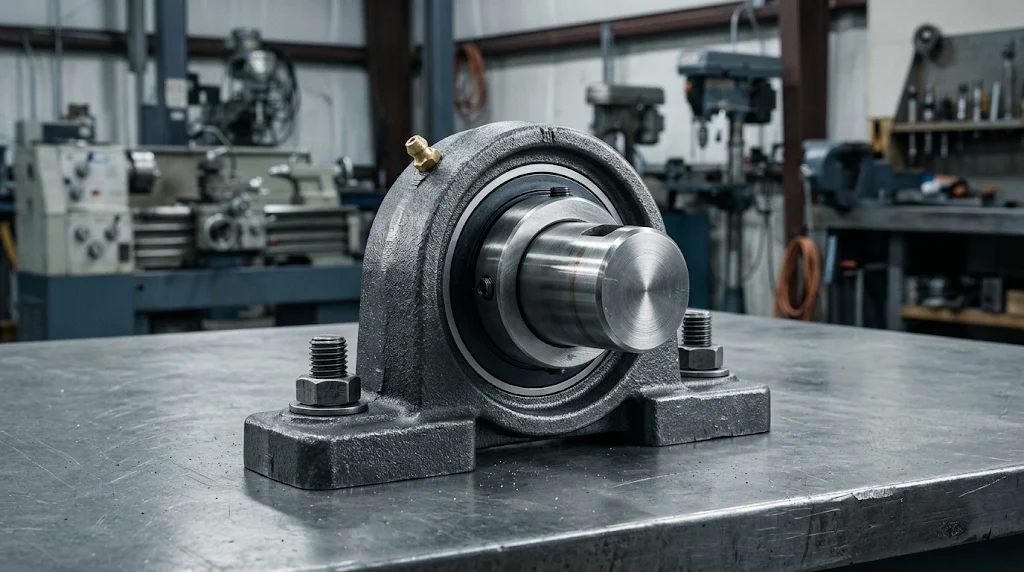
A mounted bearing is a mechanical assembly that combines a bearing with a housing designed for installation onto machinery or supporting structures.
The bearing supports a rotating shaft, while the housing helps maintain its position and transfer mechanical loads to the surrounding structure.
Mounted bearing units are commonly used in conveyors, agricultural equipment, processing machinery, and industrial power transmission systems.
How Mounted Bearings Work
Mounted bearings support rotating shafts while allowing movement with relatively low friction.
As a shaft rotates, the bearing elements help manage contact forces between moving and stationary components.
Depending on the design, the assembly may accommodate radial loads, limited axial loads, or a combination of both.
The housing secures the bearing to a mounting surface and helps maintain proper alignment.
Correct installation is important because excessive misalignment or improper loading can shorten bearing service life.
Why Mounted Bearings Matter in Industrial Equipment
Industrial machinery frequently operates under demanding conditions involving continuous rotation, heavy loads, vibration, and environmental exposure.
Mounted bearings provide a practical method for supporting rotating components without requiring a custom-designed bearing housing.
Key Benefits of Mounted Bearings
Simplified installation: Preassembled bearing and housing configurations can reduce installation complexity.
Reliable shaft support: Properly selected units maintain shaft positioning during normal operation.
Maintenance accessibility: Many designs allow lubrication, inspection, or replacement without extensive machinery modifications.
Flexible applications: Different housing styles support horizontal, vertical, and specialized mounting arrangements.
Equipment compatibility: Mounted bearings are available in various sizes and configurations for different machinery requirements.
Actual performance depends on product specifications, operating conditions, and installation quality.
Common Types of Mounted Bearings
Understanding different mounted bearing designs is essential when choosing components for industrial applications.
Each configuration provides specific installation and shaft-support characteristics.
Pillow Block Bearings
Pillow block bearings are mounted in housings designed to attach to a supporting surface.
They commonly feature mounting holes that allow the unit to be secured with bolts.
These bearings are frequently used in conveyor systems, agricultural machinery, and rotating equipment.
Pillow block configurations are often suitable when a shaft runs parallel to a mounting surface.
However, the appropriate housing and bearing design depend on load direction, shaft dimensions, and operating requirements.
Flange Mounted Bearings
Flange bearings use housings designed for attachment to vertical or flat structural surfaces.
Common configurations include two-bolt, three-bolt, and four-bolt flange units.
These designs are useful when machinery requires shaft support from a side-mounted plate or equipment frame.
Flange mounted bearings are widely used in material handling systems and processing equipment.
Take-Up Bearings
Take-up bearing units allow controlled adjustment of shaft position within a compatible supporting arrangement.
They are commonly associated with conveyor belt tensioning and similar mechanical systems.
Their adjustable design helps operators manage specific positioning requirements.
Hanger Bearings
Hanger bearings support shafts within certain suspended or enclosed mechanical arrangements.
They are commonly associated with screw conveyor systems.
The correct bearing material and configuration depend on the conveyed material, operating environment, and equipment design.
Consider This Bearing When Evaluating Load Requirements
One of the most important factors in bearing selection is the type and magnitude of mechanical load.
Bearings must withstand expected operating forces without experiencing excessive stress or premature wear.
Radial and Axial Loads
Radial loads act perpendicular to the shaft’s rotational axis.
Axial loads, sometimes called thrust loads, act parallel to the shaft.
Certain bearing designs can accommodate combined loading, but their capacities vary significantly.
Before selecting a unit, review the manufacturer’s load ratings and application recommendations.
Dynamic and Static Load Ratings
Dynamic load ratings relate to bearing performance under rotating operating conditions.
Static load ratings help evaluate conditions involving stationary or slowly moving loads.
Both values are important, but neither should be interpreted as a universal guarantee of service life.
Engineers should account for actual operating conditions, including shock loads, vibration, and duty cycles.
Choosing the Correct Bearing Size
A bearing must match the shaft and surrounding machinery dimensions.
Incorrect sizing can cause installation problems, unwanted movement, vibration, or mechanical damage.
Shaft Diameter
Start by measuring the shaft diameter accurately.
Mounted bearing units are available for different shaft sizes, including common inch-based dimensions used in American industrial equipment.
The selected bore must match the intended shaft and locking arrangement.
Housing Dimensions
Check the mounting hole locations, bolt spacing, housing height, and available installation clearance.
Even bearings with similar shaft bores may use different housing dimensions.
A replacement unit should be evaluated against the original equipment specifications rather than selected solely by visual appearance.
Shaft Locking Methods
Mounted bearings may use set screws, eccentric locking collars, adapter sleeves, or other shaft attachment methods.
Each design has particular installation requirements and operating characteristics.
Follow manufacturer instructions when selecting and tightening locking components.
Materials Used in Mounted Bearing Assemblies
Bearing materials influence strength, corrosion resistance, and suitability for specific environments.
Cast Iron Housings
Cast iron is commonly used for industrial bearing housings because it provides strength and structural stability.
These housings are suitable for numerous general industrial applications.
However, environmental exposure and mechanical loading must still be considered.
Stainless Steel Components
Stainless steel bearing units may be appropriate where corrosion resistance and washdown conditions are important.
Food processing and certain chemical handling environments may require specialized materials and sealing arrangements.
Material compatibility should always be confirmed for the intended application.
Thermoplastic Housings
Some mounted bearing products use engineered polymer housings.
These materials may offer corrosion resistance and reduced weight for selected applications.
Their temperature limits, load capacity, and chemical resistance must be evaluated before installation.
Common Industrial Applications of Mounted Bearings
Mounted bearings support equipment across numerous industries throughout the United States.
Manufacturing and Production
Factories use mounted bearings in rotating shafts, conveyor systems, packaging equipment, and automated production machinery.
Reliable bearing performance supports consistent equipment operation and minimizes avoidable interruptions.
Agriculture and Farming
Agricultural machines frequently operate in environments containing dust, moisture, vibration, and changing loads.
Mounted bearings are used in various harvesting, conveying, and material handling applications.
Appropriate seals and maintenance practices are particularly important in demanding outdoor conditions.
Food Processing Equipment
Food processing machinery may require bearing assemblies designed for frequent cleaning and exposure to moisture.
Suitable materials, sealing systems, and application-specific lubricants help meet operational requirements.
Warehousing and Material Handling
Conveyors and sorting equipment rely on properly supported rotating shafts.
Mounted bearings can help maintain consistent motion across rollers, drive assemblies, and associated equipment.
Best Practices for Mounted Bearing Installation
Proper installation is essential for achieving reliable bearing performance.
Even a high-quality bearing can fail prematurely when installed incorrectly.
Prepare the Mounting Surface
Before installation, inspect the mounting surface for damage, contamination, and unevenness.
Confirm that the shaft is clean and within the required dimensional tolerances.
Check Shaft Alignment
Improper alignment can create unwanted stress and increase vibration.
Some mounted bearing designs accommodate limited alignment variation, but they are not substitutes for proper machinery alignment.
Follow Torque Specifications
Use the manufacturer’s recommended tightening sequence and torque values for mounting bolts and shaft locking devices.
Avoid overtightening components or using unsuitable tools.
After installation, verify that the assembly operates correctly before returning equipment to normal service.
How to Maintain Mounted Bearings
Routine maintenance helps identify developing problems and can extend bearing service life.
Lubrication Requirements
Some mounted bearings require periodic relubrication, while others are supplied with sealed, maintenance-free configurations.
For relubricatable units, use the lubricant type, quantity, and interval specified by the manufacturer.
Excessive lubrication can be harmful, just as insufficient lubrication can lead to premature wear.
Monitor Noise and Vibration
Unusual noise, vibration, or temperature changes may indicate bearing damage, contamination, incorrect loading, or installation problems.
Investigate abnormal operating conditions promptly.
Inspect Seals and Housings
Check accessible components for damaged seals, corrosion, loose fasteners, and signs of lubricant leakage.
Follow applicable lockout and safety procedures before inspecting or servicing machinery.
Common Mistakes When Selecting Mounted Bearings
Choosing a bearing based only on appearance or purchase price can create expensive problems.
A low-cost bearing may not be suitable for continuous operation, high loads, or challenging environmental conditions.
Another mistake is overlooking shaft locking requirements or replacing an original component with a dimensionally incompatible product.
Improper lubrication practices can also reduce reliability.
To avoid these issues, compare technical specifications carefully and consult qualified professionals when application requirements are uncertain.
Frequently Asked Questions
What Is the Main Purpose of a Mounted Bearing?
A mounted bearing supports a rotating shaft while providing a housing that attaches to machinery. It helps maintain shaft positioning and supports efficient mechanical operation.
What Is the Difference Between Pillow Block and Flange Bearings?
Pillow block bearings generally mount onto a supporting surface, while flange bearing housings attach to suitable structural faces or plates. Their mounting configurations differ.
How Long Do Mounted Bearings Last?
Service life depends on load, speed, lubrication, alignment, contamination, operating temperature, and bearing quality. There is no universal replacement interval.
Can Mounted Bearings Be Replaced Without Changing the Housing?
Some assemblies allow bearing insert replacement, while others require replacing the complete unit. Check the manufacturer’s design and instructions.
Are Mounted Bearings Suitable for Outdoor Equipment?
Certain mounted bearings are designed for demanding outdoor environments. Appropriate sealing, corrosion resistance, and maintenance are important selection factors.
How Do I Know When a Mounted Bearing Needs Replacement?
Warning signs may include unusual noise, excessive vibration, abnormal temperature, looseness, or visible damage. A qualified technician should evaluate the cause.
Conclusion
Mounted bearings are essential components in many industrial machines, providing practical shaft support and helping equipment operate efficiently.
When evaluating mechanical components, consider this bearing selection process carefully by examining load capacity, shaft dimensions, housing design, environmental conditions, and maintenance requirements.
Understanding the differences between pillow block, flange, take-up, and other mounted bearing configurations helps buyers identify suitable options.
Proper installation, regular inspection, and manufacturer-recommended lubrication practices can also support reliable operation.
For engineers, maintenance professionals, and industrial equipment buyers throughout the United States, informed bearing selection is an important step toward improved machinery performance and reduced avoidable downtime.

Written by Twastia Editorial Team
Twastia Editorial Team shares practical insights about website design, SEO services, Google Ads, content marketing, social media, conversion rate optimization, and digital marketing strategy.
Last updated: Nov 13, 2026
Related posts from Twastia
Explore more useful articles from twastia.com about digital marketing, SEO, websites, ads, content, and growth strategy.