Logistics Software Development Services for Modern Supply Chains
Supply chains have never moved faster, and customers have never expected more. Same-day delivery, live tracking, and flawless fulfillment are […]

Supply chains have never moved faster, and customers have never expected more. Same-day delivery, live tracking, and flawless fulfillment are now baseline demands rather than premium perks. Meeting them with spreadsheets and disconnected legacy tools is nearly impossible, which is why logistics software development services have become one of the smartest investments a shipping, retail, or manufacturing business can make.
Custom-built platforms give companies control that off-the-shelf products rarely deliver. Routes become smarter, warehouses become leaner, and data flows between systems instead of sitting trapped in silos. Moreover, the businesses investing in tailored solutions today are building operational advantages that competitors will struggle to copy tomorrow.
This guide explains what logistics software development services include, which solutions deliver the strongest returns, what they cost, and how to choose a development partner with confidence. Whether you run a regional carrier or a global distribution network, the insights below will help you plan your next move.
Key Takeaways
- Logistics software development services cover the design, build, and integration of custom platforms such as TMS, WMS, fleet routing, and last-mile delivery tools.
- Last-mile delivery alone accounts for roughly 53 percent of total shipping costs, making optimization software the highest-leverage investment for most shippers.
- Industry data shows intelligent route optimization can cut fuel expenses by 15 to 25 percent while improving delivery times.
- Custom development typically pays for itself through efficiency gains, provided you choose an experienced partner and phase the rollout sensibly.
What Are Logistics Software Development Services?
Logistics software development services are professional technology services focused on designing, building, integrating, and maintaining software that manages the movement of goods. This spans everything from warehouse floors to cross-border freight, connecting carriers, drivers, inventory, and customers through one coordinated digital layer.
Unlike packaged software sold as-is, these services produce solutions shaped around your exact workflows. A development team studies how your operation actually runs — order intake, dispatch rules, carrier contracts, compliance needs — and then engineers applications that fit those processes rather than forcing your staff to adapt to generic tools.
Typically, logistics software development services include several stages: discovery and requirements analysis, system architecture, UI and UX design, coding, quality assurance, third-party integrations, deployment, and ongoing support. Consequently, the relationship resembles a long-term technology partnership more than a one-time purchase.
The demand behind this market keeps growing for a simple reason. Supply chains now generate enormous data volumes, and companies that convert that data into faster decisions consistently outperform those still coordinating shipments through email and phone calls.
Core Types of Logistics Software Development Services
The umbrella of logistics software development services covers a wide family of solutions. Understanding each type helps you identify where custom development will deliver the greatest impact for your operation.
Transportation Management Systems
A transportation management system, commonly called a TMS, acts as the command center for moving freight. It plans shipments, selects carriers, consolidates loads, manages documentation, and audits freight invoices. Custom TMS development adds capabilities generic platforms lack, such as proprietary pricing engines, specialized carrier networks, or industry-specific compliance workflows.
Warehouse Management Systems
Warehouse management systems coordinate everything happening inside storage facilities: receiving, put-away, picking, packing, cycle counting, and shipping. When built custom, a WMS can mirror your exact layout, automation equipment, and labor model, which frequently unlocks double-digit productivity gains over one-size-fits-all products.
Fleet Management and Route Optimization
Fleet platforms track vehicles through GPS and telematics while algorithms sequence stops for maximum efficiency. This category delivers some of the most measurable returns in the industry. Research consistently shows that intelligent route optimization reduces total miles driven by 20 to 30 percent and lowers fuel costs by 15 to 25 percent, often within weeks of deployment.
Last-Mile Delivery Solutions
The final leg of delivery is the most expensive by far. According to Statista, last-mile delivery now absorbs approximately 53 percent of total shipping costs, up sharply from 41 percent just a few years ago. Purpose-built last-mile software attacks this expense through route density optimization, real-time driver apps, delivery-window management, and proactive customer notifications that reduce costly failed attempts.
Freight Visibility and Tracking Platforms
Modern shippers expect to know where every order is at every moment. Visibility platforms aggregate data from carriers, IoT sensors, GPS devices, and RFID tags into a single live picture. Custom solutions then layer on predictive alerts, so exceptions surface hours before they become customer complaints.
Integrations, APIs, and Legacy Modernization
Often the highest-value work involves connecting systems rather than building new ones. Logistics software development services frequently include API development, EDI connections with carriers and retailers, and the modernization of aging platforms that still run critical operations. Clean integration eliminates duplicate data entry and the errors that come with it.
Key Features of Custom Logistics Software Solutions
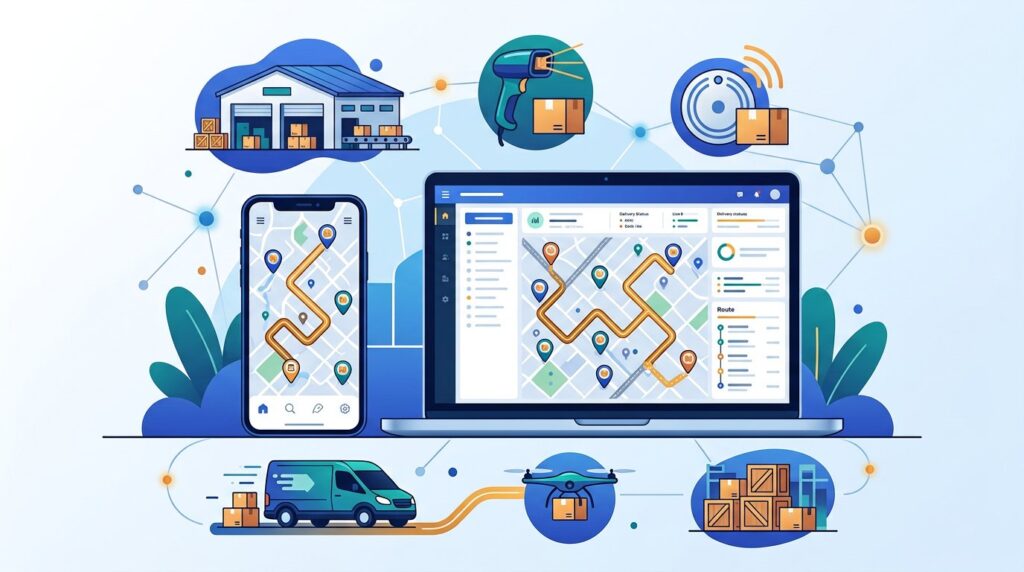
Regardless of which solution type you commission, certain capabilities distinguish excellent logistics platforms from merely functional ones.
Real-time tracking and visibility sits at the top of the list. Every stakeholder, from dispatcher to end customer, should see live status without picking up a phone. Equally important is intelligent automation: the system should assign loads, suggest routes, and flag exceptions automatically rather than wait for manual input.
Advanced analytics and forecasting turn historical data into planning power. DHL’s Logistics Trend Radar notes that predictive analytics can improve overall delivery efficiency by up to 20 percent, which explains why machine learning features now appear in nearly every serious platform. Meanwhile, mobile applications for drivers and field staff extend the system beyond the office, capturing proof of delivery, photos, signatures, and barcode scans on the go.
Finally, strong solutions offer open integration architecture. APIs and webhooks let your platform exchange data with ERP systems, accounting tools, e-commerce storefronts, and carrier networks. In practice, connectivity determines whether software becomes a growth engine or just another isolated tool.
Business Benefits of Logistics Software Development Services
Companies invest in logistics software development services for outcomes, not technology. The returns typically arrive through four channels.
Cost reduction comes first. Optimized routing trims fuel consumption, automated dispatch reduces administrative labor, and better load consolidation cuts empty miles. Industry analyses regularly report total logistics cost savings of 15 to 30 percent within the first year of comprehensive optimization.
Speed and reliability follow closely. Automated workflows shorten order-to-delivery cycles, while predictive alerts keep on-time performance high even during disruption. Because the system monitors every shipment continuously, problems get resolved before customers notice them.
Scalability protects future growth. A platform designed for your operation can expand into new regions, add sales channels, and absorb volume spikes without proportional increases in headcount. Additionally, owning your software means owning the roadmap — you decide which capabilities arrive next instead of waiting on a vendor’s priorities.
Customer experience ultimately ties everything together. Accurate tracking, reliable delivery windows, and fast problem resolution convert logistics from a cost center into a genuine competitive advantage. In markets where products and prices look similar, delivery experience often decides who wins repeat business.
How Much Do Logistics Software Development Services Cost?
Budget expectations vary widely because scope varies widely. A focused driver app might cost tens of thousands of dollars, while an enterprise-grade TMS with multiple integrations can reach several hundred thousand. Understanding the variables prevents unpleasant surprises.
Scope and complexity drive the largest share of cost. Features such as AI-driven forecasting, multi-system integrations, and custom mobile applications require more engineering hours than basic tracking functionality. Team geography matters as well, since hourly rates differ significantly between regions, though experienced partners in established outsourcing destinations frequently deliver excellent value.
Ongoing expenses deserve equal attention. Plan for hosting, maintenance, security updates, and feature evolution — typically 15 to 20 percent of the initial build cost annually. Furthermore, remember that the cheapest quote often becomes the most expensive project. Logistics software development services priced too low usually sacrifice architecture quality, which surfaces later as slow performance, security gaps, and costly rebuilds.
The soundest approach is phased investment. Start with a minimum viable product targeting your most expensive operational pain, measure the savings, and fund later phases from proven returns.
How to Choose the Right Logistics Software Development Services Partner

The partner you select influences results as much as the technology itself. Here is what separates reliable teams from risky ones.
| Evaluation Area | What to Look For | Red Flag |
|---|---|---|
| Domain experience | Logistics or supply chain projects in portfolio | Only generic app experience |
| Technical depth | Cloud, API, IoT, and AI/ML capability | Vague answers about architecture |
| Process maturity | Documented discovery, QA, and support stages | Jumping straight to coding |
| Communication | Dedicated project manager, clear reporting | Slow replies during sales stage |
| References | Verifiable client case studies | No contacts willing to vouch |
Domain knowledge deserves special emphasis. Teams that have built logistics platforms before already understand carrier onboarding, EDI quirks, and warehouse realities, which shortens discovery and prevents naive design decisions. Therefore, always ask potential partners to walk through a comparable project in detail, including what went wrong and how they fixed it.
Equally, evaluate the commercial structure. Transparent estimates, milestone-based payments, and clear intellectual property ownership protect your investment. Reputable providers of logistics software development services will happily put all of this in writing.
The Development Process From Discovery to Launch
Understanding how professional logistics software development services unfold helps you participate effectively as a client.
The journey begins with discovery, where analysts map your workflows, pain points, and integration landscape. Skipping or rushing this phase causes most downstream problems, so expect serious partners to invest real time here. Next comes solution architecture and design, translating requirements into system blueprints, data models, and interface wireframes you can approve before coding starts.
Development then proceeds in sprints, delivering working functionality every few weeks rather than one big reveal at the end. This rhythm lets you test assumptions early and redirect priorities as business needs evolve. Rigorous quality assurance runs alongside, covering functionality, performance under load, and security.
Finally, deployment and post-launch support bring the platform into daily operation. The best teams monitor real usage closely after go-live, resolving issues quickly and tuning features based on actual behavior. As a result, the software keeps improving long after launch day instead of slowly going stale.
FAQs
What do logistics software development services include?
These services cover the full lifecycle of building supply chain technology: discovery and requirements analysis, solution architecture, interface design, development, quality assurance, third-party integrations, deployment, and ongoing maintenance. Depending on your needs, the engagement might produce a transportation management system, warehouse platform, fleet routing tool, last-mile delivery app, or integrations connecting your existing systems.
Should my company choose custom development or off-the-shelf software?
Off-the-shelf products suit businesses with standard processes and limited budgets, offering faster deployment at lower initial cost. Custom logistics software development services make sense when your workflows provide competitive advantage, when packaged tools cannot support your requirements, or when integration complexity demands tailored engineering. Many companies blend both approaches, customizing around a commercial core.
How long does it take to build custom logistics software?
A focused application such as a driver delivery app typically takes three to five months from discovery to launch. Larger platforms like a full TMS or WMS generally require six to twelve months, with phased releases delivering usable functionality throughout development. Timeline depends mainly on scope, integration count, and the clarity of requirements established during discovery.
Can new logistics software integrate with our existing systems?
Yes, and integration capability should be a core requirement from day one. Modern platforms connect with ERP and accounting systems, e-commerce channels, carrier APIs, telematics hardware, and EDI networks. Experienced development partners design open API architecture specifically so your new software exchanges data smoothly with tools you already use, eliminating duplicate entry and data silos.
How does AI improve logistics operations today?
Artificial intelligence powers route optimization that reduces fuel costs by 15 to 25 percent, demand forecasting that sharpens inventory positioning, and predictive analytics that, according to DHL’s Logistics Trend Radar, can improve delivery efficiency by up to 20 percent. AI also automates document processing, detects potential disruptions early, and enables chat-based customer tracking updates, with capabilities expanding rapidly each year.
How do we measure ROI from logistics software investment?
Establish baseline metrics before development begins: cost per delivery, fuel consumption, on-time percentage, order cycle time, and administrative hours per shipment. Then review the same metrics quarterly after launch. Most businesses see meaningful returns within six to twelve months through reduced fuel spend, lower labor overhead, fewer failed deliveries — each failed attempt costs roughly 17 dollars on average — and improved customer retention.
Conclusion
Supply chain competition increasingly rewards companies that see clearly, decide quickly, and execute automatically. Logistics software development services provide the foundation for exactly that kind of operation — replacing fragmented tools with coordinated platforms built around the way your business actually works.
The evidence supports acting sooner rather than later. Last-mile costs continue climbing, customer expectations keep tightening, and the efficiency gap between digitally mature shippers and everyone else widens each quarter. Meanwhile, phased development approaches mean you no longer need a massive upfront budget to begin.
Start where the pain is sharpest, prove value quickly, and expand from results. Choose a partner with genuine logistics depth, insist on open architecture, and treat the build as a long-term capability rather than a one-off project.
Ultimately, logistics software development services are not about buying technology. They are about building a supply chain that thinks — one that compounds small efficiency gains into a lasting market advantage.

Written by Twastia Editorial Team
Twastia Editorial Team shares practical insights about website design, SEO services, Google Ads, content marketing, social media, conversion rate optimization, and digital marketing strategy.
Last updated: Jul 31, 2026
Related posts from Twastia
Explore more useful articles from twastia.com about digital marketing, SEO, websites, ads, content, and growth strategy.