Types of Abortion: Methods, Safety, Recovery, and What to Expect
Understanding the different types of abortion is important for anyone looking for accurate information about reproductive healthcare. Whether you are […]

Understanding the different types of abortion is important for anyone looking for accurate information about reproductive healthcare. Whether you are researching abortion methods, considering your medical options, or simply wanting to learn more, having clear and reliable information can help you make informed decisions.
Abortion is a medical process that ends a pregnancy. It may involve medications or a procedure performed by a qualified healthcare professional. The method used depends on several factors, including how far the pregnancy has progressed, a person’s medical history, personal preferences, and available healthcare services.
In the United States, abortion care is also affected by state laws, which can influence when and where certain services are available.
This guide explains the main types of abortion, how they work, what happens during recovery, possible risks, and important questions people frequently ask.
What Is Abortion?
Abortion refers to the ending of a pregnancy. Medical professionals generally distinguish between induced abortion and spontaneous abortion.
An induced abortion is intentionally performed using medications or medical procedures. A spontaneous abortion, commonly called a miscarriage, occurs when a pregnancy ends without an intentional intervention.
According to the American College of Obstetricians and Gynecologists (ACOG), induced abortion can be provided through medication or a medical procedure. The appropriate approach depends on pregnancy duration, individual health circumstances, and other considerations.
ACOG
Why Is It Important to Understand Abortion Methods?
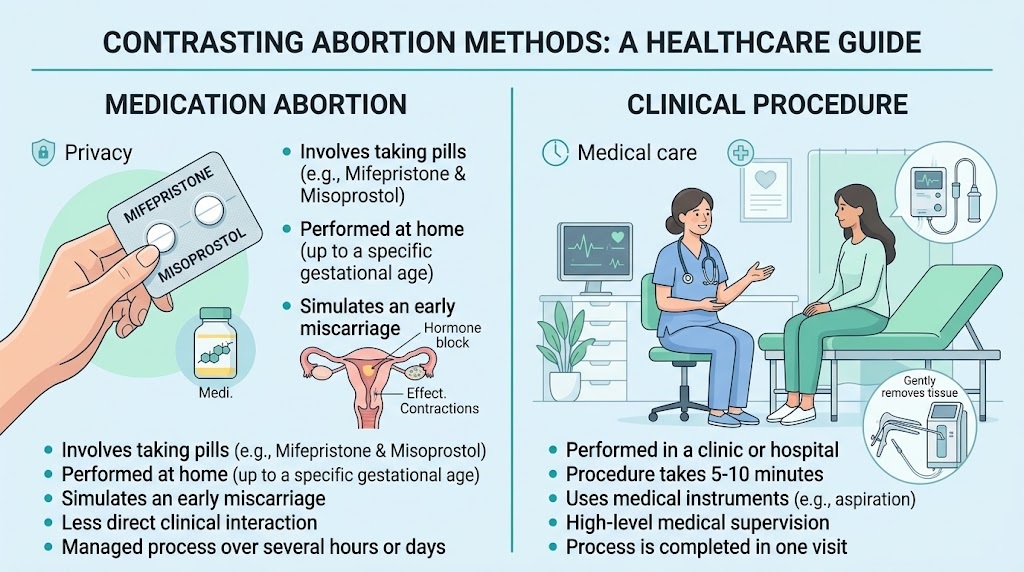
Learning about abortion methods helps people understand what treatment may involve and what questions to ask their healthcare providers.
Different methods involve different steps, recovery experiences, and clinical considerations. Some occur primarily at home following medical guidance, while others take place in clinics, medical offices, or hospitals.
Accurate information also helps distinguish medically established treatments from unsafe methods and misinformation circulating online.
What Are the Main Types of Abortion?

There are two principal categories of induced abortion: medication abortion and procedural abortion.
However, the specific approach within each category can differ depending on pregnancy duration and medical circumstances.
1. Medication Abortion (Abortion Pills)
Medication abortion, sometimes called medical abortion, uses prescribed medicines to end an established pregnancy.
In the United States, a commonly used medication regimen includes two medicines: mifepristone and misoprostol.
Mifepristone blocks progesterone, a hormone needed to maintain pregnancy. Misoprostol then causes the uterus to contract and expel pregnancy tissue.
The U.S. Food and Drug Administration approves the combined regimen for ending an intrauterine pregnancy through 70 days, or 10 weeks, calculated from the first day of the last menstrual period. Clinicians may use evidence-based medication protocols outside that labeled period when medically appropriate.
FDA
What Happens During Medication Abortion?

A healthcare professional first assesses the pregnancy and reviews the patient’s medical history.
After the prescribed medication is taken, cramping and vaginal bleeding usually occur as the uterus empties.
Some people experience nausea, diarrhea, chills, or temporary fever. Bleeding may be heavier than a normal menstrual period.
A follow-up plan helps confirm that the pregnancy has ended and that no additional treatment is needed.
Medication abortion may be especially appealing to people who prefer avoiding an in-clinic procedure. However, it may not be suitable for certain medical conditions, including an ectopic pregnancy.
2. Procedural Abortion (Often Called Surgical Abortion)
Procedural abortion involves removing pregnancy tissue from the uterus using specialized medical instruments.
Although commonly called surgical abortion, many procedures do not involve surgical incisions.
These procedures are performed by trained healthcare professionals in appropriate medical settings.
The two major procedural approaches are vacuum aspiration and dilation and evacuation.
Vacuum Aspiration
Vacuum aspiration is commonly used during the first trimester.
During the procedure, a healthcare professional gently opens the cervix when needed and inserts a thin tube into the uterus.
Controlled suction removes the pregnancy tissue.
The procedure itself is usually brief, although preparation, pain management, and observation increase the total appointment time.
Patients may receive local anesthesia, sedation, or other pain-management options depending on their needs and the facility.
Most people return home the same day when there are no complications.
Dilation and Evacuation (D&E)
Dilation and evacuation is commonly used for abortions later in pregnancy, particularly during the second trimester.
The procedure involves gradually opening the cervix and using suction and medical instruments to remove pregnancy tissue.
Cervical preparation may begin before the procedure, sometimes requiring an additional appointment.
D&E is performed by appropriately trained medical professionals, with pain control or anesthesia selected according to clinical circumstances.
The complexity of treatment depends on pregnancy duration and the patient’s medical needs.
Other Abortion-Related Medical Procedures
Although medication abortion and procedural abortion are the two broad categories, several additional terms frequently appear in reproductive healthcare discussions.
Dilation and Curettage (D&C)
Dilation and curettage involves opening the cervix and removing tissue from inside the uterus.
It may be used to manage miscarriage, retained pregnancy tissue, or certain gynecological conditions.
For early abortion care, modern vacuum aspiration is generally preferred over routine sharp curettage because it is less invasive and has a favorable safety profile.
Induction Abortion
Induction abortion is another medication-based method, generally used later in pregnancy.
Medicines stimulate uterine contractions that lead to expulsion of the pregnancy.
This approach usually takes place in a hospital or specialized healthcare facility where medical professionals can monitor the patient.
Induction may be considered for medical or pregnancy-related reasons, including certain serious fetal diagnoses or maternal health concerns.
ACOG describes second-trimester induction abortion as a monitored process that commonly takes approximately 12–24 hours, although individual experiences vary.
ACOG
Medication Abortion vs. Procedural Abortion
Understanding the differences between these types of abortion can help patients prepare for conversations with qualified medical professionals.
| Feature | Medication abortion | Procedural abortion |
|---|---|---|
| Method | Prescribed medicines | Suction or medical instruments |
| Common timing | Early pregnancy | Early or later pregnancy |
| Setting | Home or healthcare facility | Clinic, office, or hospital |
| Pain experience | Often significant cramping | Pain control or anesthesia may be offered |
| Bleeding | Often heavier during the process | Often lighter initially, but varies |
| Follow-up | Confirmation of completion is needed | Additional follow-up depends on circumstances |
| Effectiveness | High; additional treatment occasionally needed | High; repeat treatment is uncommon |
Neither method is automatically the right choice for everyone.
Individual medical needs, gestational age, practical considerations, and access to healthcare services are important factors when comparing abortion options.
How Are Abortion Methods Chosen?
Healthcare professionals consider several factors when discussing the available types of abortion.
Pregnancy Duration
Gestational age is one of the most important considerations.
Early pregnancies may be managed with medication abortion or vacuum aspiration. Later pregnancies generally require different clinical approaches, including D&E or induction.
Pregnancy duration is usually calculated from the first day of the last menstrual period, with ultrasound or other clinical evaluation when needed.
Medical History and Current Health
Certain medical conditions can influence treatment recommendations.
For example, a suspected ectopic pregnancy requires separate evaluation and cannot be treated with standard abortion pills.
Bleeding disorders, specific medications, and other conditions may also affect treatment planning.
Personal Preferences and Access
Some people prefer managing the process in a familiar setting, while others value having a procedure completed during a clinical appointment.
Travel, childcare, transportation, financial considerations, and local healthcare availability may also affect decisions.
Healthcare providers should explain appropriate options without assuming that every patient has the same needs.
Are the Different Types of Abortion Safe?
Abortion is generally very safe when performed using evidence-based methods appropriate to pregnancy duration and individual health.
Both medication and procedural abortion have strong records of safety and effectiveness.
The World Health Organization’s abortion care guidance emphasizes the importance of evidence-based medical practices and access to quality care.
World Health Organization
However, no medical treatment is completely free of risk.
Possible complications include excessive bleeding, infection, retained pregnancy tissue, or an incomplete abortion requiring additional treatment.
Serious complications are uncommon, particularly with appropriate medical care.
Importantly, unverified herbal treatments, physical trauma, or unsafe substances should never be considered reliable alternatives to established abortion methods.
What Happens After an Abortion?
Recovery experiences vary depending on the method used, pregnancy duration, and individual health.
Physical Recovery
After medication abortion, cramping and heavier bleeding are common during the period when pregnancy tissue passes.
Following procedural abortion, patients may experience mild to moderate cramps, spotting, or vaginal bleeding.
Fatigue and temporary discomfort are also possible.
Many people resume their usual activities relatively quickly, although recovery time is individual.
Healthcare professionals may recommend appropriate pain relief, hydration, rest, and follow-up assessment.
Emotional Recovery
Emotional responses after abortion differ widely.
Some people experience relief, while others may feel sadness, uncertainty, or a combination of emotions. Some experience little emotional change.
There is no single emotional response that everyone should expect.
Anyone who experiences ongoing emotional distress can seek support from a qualified mental health professional, trusted healthcare provider, or supportive personal network.
Warning Signs That Require Medical Attention
People recovering from an abortion should understand when symptoms may indicate a complication.
Contact a healthcare professional promptly for heavy bleeding that soaks two large pads per hour for two consecutive hours, fever above 100.4°F, worsening or severe pain, or unusual foul-smelling discharge.
Fainting, severe dizziness, or other signs of significant illness also require urgent assessment.
These warning signs are consistent with guidance published by ACOG.
ACOG
Abortion Laws and Access in the United States
Abortion availability differs significantly across the United States.
Following the Supreme Court’s 2022 decision in Dobbs v. Jackson Women’s Health Organization, individual states gained broader authority to regulate or restrict abortion.
As of October 2026, some states have extensive restrictions, while others protect access to abortion services.
Rules may affect pregnancy-duration limits, medication access, telehealth services, insurance coverage, and provider requirements.
Anyone seeking services should verify current information for their location rather than relying on older articles or assumptions.
The Guttmacher Institute’s interactive policy map provides regularly updated information about abortion laws and access throughout the country.
Guttmacher Institute
Finding Reliable Healthcare Information
Reliable sources include licensed healthcare professionals, established medical organizations, and reputable public-health agencies.
Patients should ask about treatment eligibility, expected symptoms, costs, appointment requirements, and emergency contact information.
When researching online, prioritize medically reviewed resources with clear publication dates and transparent sourcing.
Common Myths About Abortion
Several misconceptions can make understanding the different types of abortion more difficult.
Myth: All Abortions Require Surgery
Not all abortions involve medical procedures performed in a clinic.
Medication abortion uses prescribed medicines and may be managed outside a medical facility when appropriate.
Myth: Abortion Always Causes Infertility
An uncomplicated abortion generally does not prevent future pregnancy.
Fertility can return quickly after an abortion, making contraception counseling important for people who want to avoid another pregnancy.
Rare complications, such as serious infection or uterine injury, may affect reproductive health, but these outcomes are not typical.
Myth: Emergency Contraception Is an Abortion
Emergency contraception and abortion medications serve different purposes.
Emergency contraception helps prevent pregnancy after unprotected sex, primarily by delaying or preventing ovulation.
Medication abortion ends an established pregnancy.
Understanding this distinction can help people select appropriate reproductive healthcare information.
Frequently Asked Questions About Types of Abortion
What are the two main types of abortion?
The two main types are medication abortion and procedural abortion. Medication abortion uses medicines, while procedural abortion removes pregnancy tissue using suction or medical instruments.
Which type of abortion is most common?
Medication abortion accounts for a substantial share of abortions in the United States. Its use has increased over time, particularly during early pregnancy. The available method depends on gestational age and individual circumstances.
Is medication abortion painful?
Medication abortion commonly causes cramping, which can sometimes be intense, along with bleeding. Pain experiences vary. Healthcare professionals can explain appropriate options for managing discomfort.
How long does recovery take?
Many people resume everyday activities within a few days, although bleeding or spotting may continue longer. Recovery depends on the abortion method, pregnancy duration, and individual circumstances.
Can someone get pregnant again after an abortion?
Yes. Ovulation may return before the next menstrual period. People who want to prevent pregnancy can discuss contraception options with their healthcare professional.
Are abortion pills safe?
FDA-approved abortion medications have an established safety record when used appropriately. They are not suitable for every medical situation, so correct pregnancy assessment and reliable medical guidance remain important.
Can abortion be performed later in pregnancy?
Yes, some later-pregnancy abortions are medically performed using specialized procedural or medication-based approaches. Availability depends on medical circumstances, provider expertise, and applicable state laws.
Conclusion
Understanding the different types of abortion can help people recognize the medical options involved in ending a pregnancy and make informed healthcare decisions.
Medication abortion and procedural abortion are both established approaches, with specific methods chosen according to pregnancy duration, medical circumstances, and patient preferences.
Safe care includes accurate information, appropriate medical assessment, clear recovery instructions, and access to professional support when needed.
For anyone researching abortion options in the United States, consulting a qualified healthcare professional and checking current state-specific regulations are essential steps toward receiving reliable, individualized information.

Written by Twastia Editorial Team
Twastia Editorial Team shares practical insights about website design, SEO services, Google Ads, content marketing, social media, conversion rate optimization, and digital marketing strategy.
Last updated: Oct 10, 2026
Related posts from Twastia
Explore more useful articles from twastia.com about digital marketing, SEO, websites, ads, content, and growth strategy.