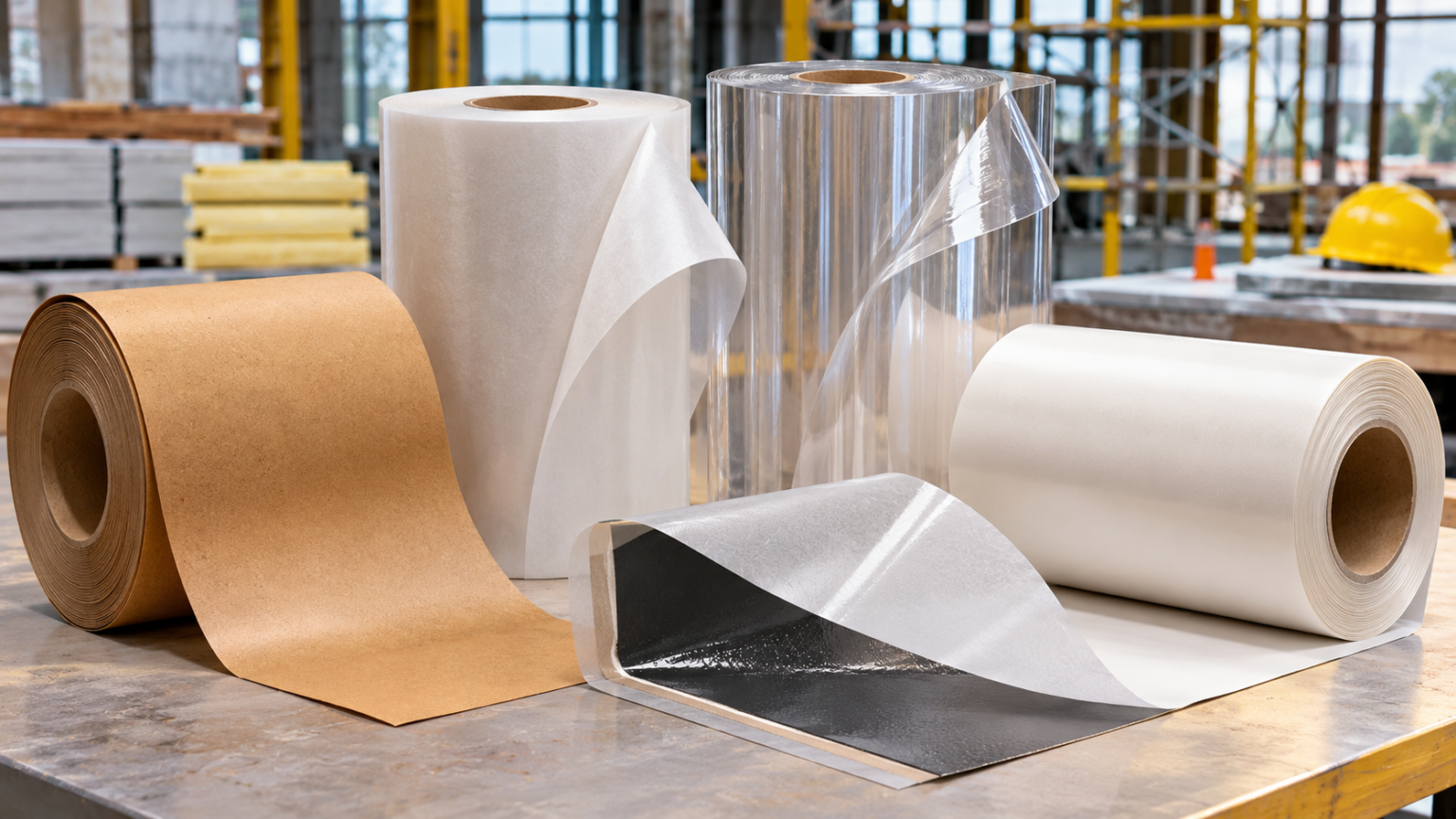
Different Types of Release Liners Used in The Construction Industry: Best Guide to Materials and Applications
Modern construction relies on specialized materials that improve installation efficiency, protect surfaces, and support long-term building performance. Among these materials, […]
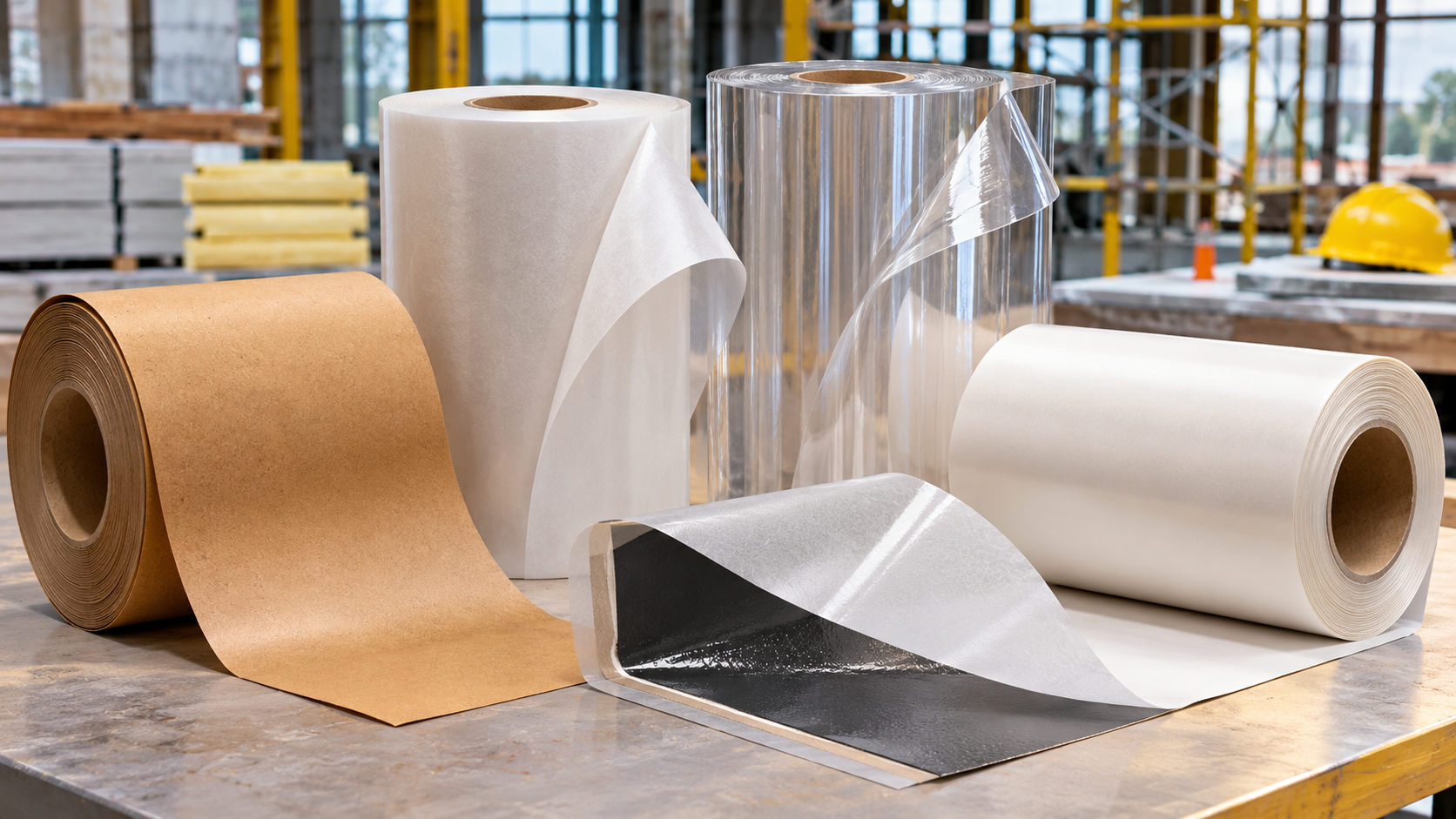
Modern construction relies on specialized materials that improve installation efficiency, protect surfaces, and support long-term building performance. Among these materials, release liners perform an important function that often goes unnoticed.
Release liners are protective sheets used with adhesive construction products. They prevent adhesives from sticking to unintended surfaces during manufacturing, transportation, storage, and handling. When installers are ready to apply the product, the liner is removed to expose the adhesive.
Understanding the different types of release liners used in the construction industry is valuable for manufacturers, contractors, architects, and building material suppliers.
These materials are commonly associated with self-adhesive roofing underlayments, waterproofing membranes, construction tapes, flashing products, and other adhesive systems.
Release liners may be made from paper, plastic films, or paper coated with polymers. Their surfaces often include silicone or other release coatings that allow controlled separation from adhesives.
According to 3M, release liners are available in paper, poly-coated paper, polyester film, and high-density polyethylene film constructions, with silicone or specialized non-silicone coatings. 3M United States
Choosing the appropriate liner depends on several factors, including adhesive chemistry, moisture exposure, temperature, manufacturing requirements, and installation conditions.
This guide explains the main release liner materials, their properties, and how they are used in construction applications.
What Are Release Liners in Construction?
A release liner is a removable protective material placed against an adhesive surface.
Its primary purpose is to preserve the adhesive until the product is ready for installation.
For example, a self-adhered waterproofing membrane may include a plastic liner covering its adhesive layer. During installation, the contractor removes the liner and presses the membrane onto the prepared substrate.
The protective backing helps prevent premature adhesion and contamination.
How Release Liners Work
Most conventional liners consist of two components: a base material and a release coating.
The base material provides strength, flexibility, and dimensional stability.
The release coating creates a surface from which the adhesive can separate with controlled force.
Silicone is widely used because of its low surface energy, although non-silicone technologies are available.
Avery Dennison explains that different adhesive tape constructions may use release coatings on one or both liner surfaces depending on their application. Performance Tapes
The correct combination helps ensure that the adhesive stays protected during handling but can be exposed when needed.
1. Silicone-Coated Paper Release Liners
Silicone-coated paper is one of the most widely used release liner constructions.
It consists of a paper substrate treated with a thin silicone-based release coating.
The silicone layer allows pressure-sensitive adhesives to separate from the liner without excessive sticking.
Key Features
Silicone-coated paper liners can offer predictable release performance, flexibility, and relatively economical manufacturing.
They are available in different thicknesses, strengths, and surface finishes.
Some versions are designed for manual handling, while others support industrial converting operations.
Construction Applications
Depending on the product design, silicone-coated paper liners may be used with construction adhesive tapes, bonding materials, and selected self-adhesive components.
They can help protect adhesive surfaces during storage and transportation.
However, paper-based liners may be more sensitive to moisture and dimensional changes than certain plastic films.
The manufacturer must select a paper grade compatible with the adhesive formulation and intended environment.
2. Kraft Paper Release Liners
Kraft paper is another important substrate used in release liner manufacturing.
It is produced using wood pulp and can be manufactured in different grades to provide suitable strength and surface characteristics.
Common varieties include supercalendered kraft, machine-finished kraft, and coated kraft papers.
Supercalendered Kraft Paper
Supercalendered kraft, commonly abbreviated as SCK, undergoes a finishing process that produces a smoother and denser surface.
This characteristic helps provide a consistent base for release coatings.
SCK liners are particularly common in adhesive tape and labeling applications.
The International Release Liner Association identifies glassine and SCK as major paper substrates used for labels, tapes, and industrial applications. IRLA
Advantages of Kraft Liners
Kraft paper can provide useful tensile strength and controlled handling characteristics.
Certain grades are suitable for converting, cutting, or dispensing operations.
However, performance depends on the coating, thickness, humidity conditions, and adhesive system.
Kraft liners should not automatically be considered waterproof merely because they are used with construction products.
3. Glassine Paper Release Liners
Glassine is a dense, smooth paper commonly used as a release liner substrate.
Its manufacturing process produces a refined surface that supports controlled release coating application.
Glassine is frequently associated with labels and adhesive tapes, although suitable grades can also support other industrial uses.
Properties of Glassine Liners
Glassine generally offers a smooth surface, uniform structure, and good converting characteristics.
Some grades are translucent, making the material visually different from ordinary kraft paper.
These properties can help manufacturers process adhesive materials efficiently.
Construction-Related Uses
Glassine liners may be suitable for selected adhesive tapes, specialty bonding components, and converted adhesive products used in construction-related manufacturing.
However, they are not necessarily the preferred choice for exposed, wet, or demanding jobsite applications.
Product manufacturers should verify moisture resistance, strength, and compatibility before selecting glassine.
4. Polyethylene-Coated Kraft Release Liners
Polyethylene-coated kraft paper combines a paper substrate with a polymer coating.
This construction is often referred to as poly-coated kraft or PCK.
The polymer layer creates a smoother surface and can improve resistance to moisture-related dimensional changes compared with some uncoated papers.
Why Poly-Coated Kraft Is Useful
Construction materials may experience varying storage temperatures and humidity conditions.
Poly-coated kraft liners can offer a combination of paper-based strength and polymer surface properties.
These characteristics may support applications where stable handling and relatively consistent liner performance are important.
The European Commission’s release liner industry analysis identifies polyolefin-coated kraft as a paper-based liner with film coatings and notes its use in construction applications. European Commission
Typical Applications
Suitable grades may be used with adhesive construction tapes, industrial laminates, and specialized protective bonding products.
Manufacturers can select different coating configurations to meet particular converting and release requirements.
However, poly-coated paper is a composite material, which can complicate recycling compared with certain single-material alternatives.
5. Polyester Film Release Liners
Polyester release liners are commonly manufactured from polyethylene terephthalate, known as PET.
PET film offers useful dimensional stability, toughness, and resistance to tearing.
These properties make it suitable for demanding industrial adhesive applications.
Advantages of PET Release Film
Compared with many paper-based liners, PET films generally offer greater resistance to moisture-related dimensional changes.
They may also provide consistent thickness and stable processing characteristics.
Clear polyester film can be useful when manufacturers require visibility or precise converting.
3M describes its clear PET secondary release liner as suitable for applications involving demanding acrylic adhesives, rotary die-cutting, and automated processing. 3M United States
Construction Applications
PET liners may be used with specialized industrial bonding tapes, construction adhesive components, and other converted products.
They can be useful where precise dimensions, controlled separation, or consistent handling are important.
However, PET should not automatically be considered suitable for every elevated-temperature construction application.
The complete liner, including its release coating, must be evaluated against the expected processing conditions.
6. Polyethylene and Polypropylene Film Release Liners
Polyethylene and polypropylene are additional plastic film materials used in release liner production.
These materials belong to the polyolefin family and can be formulated with different flexibility, strength, and processing characteristics.
Polyethylene Release Liners
Polyethylene films can be made using different resin types, including high-density polyethylene (HDPE).
Depending on construction, polyethylene liners can offer flexibility and resistance to moisture.
These characteristics make selected grades useful for industrial tapes and adhesive products.
Polypropylene Release Liners
Polypropylene release films may be used when a manufacturer needs particular strength, flexibility, or converting properties.
Biaxially oriented polypropylene, known as BOPP, is one available film construction.
The International Release Liner Association recognizes PET, polypropylene, and polyethylene as common film-based liner materials. gleicher.com
Building Industry Uses
Polyolefin release films are particularly relevant to certain self-adhesive construction membranes.
For example, Henry’s Blueskin VP160 air barrier uses a split-back polymer release film that is removed during installation. henry.com
Exact film compositions and installation requirements vary between products.
7. Specialty Release Liners and Split-Back Designs
Some construction applications require more than a standard single-sheet release liner.
Specialty products may use different release coatings, multiple liner sections, or specially designed peeling arrangements.
Single-Sided and Double-Sided Liners
Single-sided liners have release treatment on one surface.
They can protect one exposed adhesive face.
Double-sided release liners have suitable coatings on both surfaces and may be used for adhesive transfer tapes or particular roll constructions.
Sometimes the two surfaces are engineered with different release forces so the material unwinds correctly.
Split-Back Release Liners
Split-back liners divide the protective backing into sections.
This allows an installer to expose one part of an adhesive surface at a time.
The arrangement can help position large membranes before completing adhesion.
For example, Polyglass describes its Polystick MTS Plus roofing underlayment as having a split release film that protects the self-adhesive compound during installation. Polyglass
Non-Silicone Release Coatings
Some specialty adhesive systems require non-silicone release technologies.
These may include fluoropolymer or other proprietary coatings.
The correct option depends on adhesive compatibility, processing conditions, and potential contamination concerns.
Non-silicone liners are not universally superior; they serve specific requirements.
Where Are Release Liners Used in Construction?
Release liners are found in several important categories of building products.
Roofing Underlayments
Self-adhered roofing underlayments commonly use removable film liners to protect adhesive surfaces before installation.
The liner is removed as the membrane is positioned and secured.
Waterproofing Membranes
Below-grade and other self-adhered waterproofing systems may use plastic release liners.
Henry’s Blueskin PreSeal 435 system, for example, incorporates removable liners at certain membrane overlaps and tapes. henry.com
Air and Water Barriers
Certain self-adhered wall membranes use release films that installers remove while applying the product.
These membranes are designed to provide building-envelope functions when installed as specified.
Construction Adhesive Tapes
Double-sided tapes and adhesive transfer products may use paper or film release liners.
Avery Dennison describes single-coated, double-coated, and adhesive transfer tape constructions with different liner arrangements. Performance Tapes
Comparison of Common Release Liner Materials
| Release liner type | Key characteristic | Potential construction-related use |
|---|---|---|
| Silicone-coated paper | Controlled adhesive release | Selected adhesive tapes |
| Kraft paper / SCK | Smooth, strong paper substrate | Industrial tapes and converted materials |
| Glassine paper | Dense, refined surface | Specialty adhesive components |
| Poly-coated kraft | Improved moisture resistance and stability | Construction tapes and laminates |
| PET film | Toughness and dimensional stability | Precision industrial adhesive products |
| PE and PP film | Flexible polymer constructions | Self-adhered membranes and tapes |
| Split-back liner | Section-by-section removal | Roofing and waterproofing membranes |
These are general material characteristics rather than universal performance guarantees.
Actual suitability must be established using the manufacturer’s technical specifications.
How to Choose the Right Release Liner for Construction Applications
Choosing among the different types of release liners used in the construction industry requires evaluating the entire adhesive product.
The liner should protect the adhesive during manufacturing and storage while allowing predictable removal during installation.
Consider Adhesive Compatibility
Different adhesives interact differently with release coatings.
A liner suitable for one acrylic adhesive may not provide the same results with another formulation.
Manufacturers should conduct compatibility and release-force testing rather than relying only on material descriptions.
Evaluate Temperature and Moisture Conditions
Release liners may encounter temperature changes, humidity, and prolonged storage.
Certain paper grades can experience dimensional changes under humid conditions.
Plastic films may provide advantages in particular environments, but every construction has limits.
Assess Installation Requirements
A large membrane may benefit from a split-back liner that supports controlled positioning.
A narrow adhesive tape may require a different liner construction.
Consider how workers will handle, peel, and dispose of the material.
Review Sustainability and Waste Management
Release liner disposal can generate substantial waste during large construction projects.
Some paper-based liners may qualify for specialized recycling systems, depending on their coatings and local collection capabilities.
Plastic liners may also require dedicated collection or processing.
Do not assume all silicone-coated or poly-coated liners are accepted by ordinary municipal recycling programs.
Interestingly, some membrane manufacturers now offer liner-free products. GCP’s PREPRUFE Plus waterproofing membranes are an example of a system designed without disposable release liners. GCP Applied Technologies
Common Mistakes When Selecting Release Liners
One common mistake is selecting a liner based only on cost.
An inexpensive material may create difficulties if it tears, curls, or separates unpredictably.
Another mistake is assuming all silicone-coated liners have identical release characteristics.
The release coating, adhesive chemistry, substrate, and processing conditions influence performance.
Manufacturers should also avoid overlooking liner thickness and tensile strength.
Poorly matched liners can complicate converting and application.
Finally, contractors should never remove a release liner earlier than specified by the product manufacturer.
Exposing adhesive prematurely can increase the risk of contamination or unintended adhesion.
Frequently Asked Questions
What are the different types of release liners used in the construction industry?
Common types include silicone-coated paper, kraft paper, glassine, poly-coated kraft, polyester film, polyethylene film, polypropylene film, and specialty split-back liners.
What is the purpose of a release liner in construction?
A release liner protects an adhesive surface during manufacturing, transportation, storage, and handling. It is removed when the adhesive product is ready for application.
Are release liners used in waterproofing membranes?
Yes. Many self-adhered waterproofing membranes use removable plastic liners to protect adhesive surfaces or overlap areas before installation.
What is the difference between PET and paper release liners?
PET film generally provides greater moisture-related dimensional stability and tear resistance, while paper liners can offer economical and practical solutions for many adhesive applications.
Are silicone-coated release liners waterproof?
Not necessarily. Silicone release coatings provide separation characteristics, but water resistance depends on the substrate, coating system, and complete liner construction.
Can release liners be recycled?
Some release liners can enter specialized recycling streams, depending on their material composition and local facilities. Composite and silicone-coated products may not be accepted through standard municipal recycling systems.
Conclusion
Understanding the different types of release liners used in the construction industry is important for selecting suitable adhesive products and supporting efficient installation.
Release liners protect adhesive surfaces and help ensure materials remain manageable until they are ready to be used.
Paper-based materials such as kraft, glassine, and silicone-coated paper offer practical options for many adhesive constructions.
Poly-coated kraft combines paper and polymer characteristics, while PET, polyethylene, and polypropylene films can provide additional performance advantages for selected industrial applications.
Specialty designs, including split-back and double-sided liners, accommodate more demanding handling and installation requirements.
However, no single liner material is best for every construction application.
Adhesive compatibility, environmental conditions, release performance, installation procedures, and waste management should all influence material selection.
By following manufacturer specifications and evaluating the complete adhesive system, construction professionals can choose release liner solutions that support dependable handling, appropriate installation, and efficient use of materials.

Written by Twastia Editorial Team
Twastia Editorial Team shares practical insights about website design, SEO services, Google Ads, content marketing, social media, conversion rate optimization, and digital marketing strategy.
Last updated: Nov 5, 2026
Related posts from Twastia
Explore more useful articles from twastia.com about digital marketing, SEO, websites, ads, content, and growth strategy.