How AI Is Changing Hiring: A Practical Guide for Businesses and Job Seekers
Recruitment processes have changed with the introduction of AI. Companies can find suitable candidates quicker, and candidates can find relevant […]
Recruitment processes have changed with the introduction of AI. Companies can find suitable candidates quicker, and candidates can find relevant positions with less guesswork.
What is changing?
In the past, it was very time consuming to find the right employee for a position. Now, many changes are being made with the introduction of AI. For companies, candidates can be filtered quickly. For candidates, relevant opportunities can be found with less guess work.
Why this change is important
For companies:
If a role is advertised, many candidates may apply. As there are so many applications, recruiters will rarely be able to read through all applications thoroughly, and may be deciding based on a short read of each application (a few seconds).
For candidates:
There are many jobs advertised on job sites. These can be duplicated on different sites. Many of the roles may not be a good fit for the candidate, or may be old postings. As a result, candidates can apply to many roles and get no response.
Both parties are putting in much effort. This is what AI tools are trying to help to reduce.
How AI can be used in recruitment
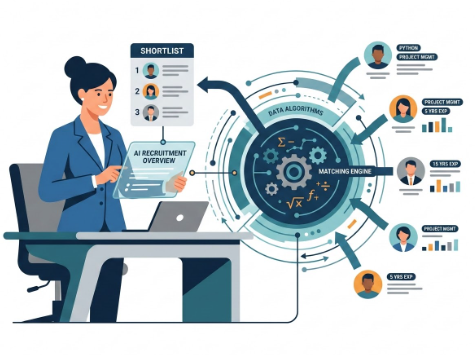
AI tools don’t replace the work of recruiters, but take over repetitive tasks, so that people can focus on more decision based tasks. The most common AI tools used in recruitment are:
- Finding suitable candidates: Algorithms match candidates to roles based on skills and experience, rather than exact keyword matching.
- Filtering applications in bulk: Software can rapidly filter applications to allow recruiters to see the best suitable candidates.
- Scheduling and updates: Candidates can be sent automated reminders, reducing frustration due to lack of feedback.
- Business insight: Businesses can understand where candidates are dropping out of the process, and which role descriptions attract the correct candidates.
If your company requires a specific system, an AI software development company can help greatly. Although many teams can be supported with a ready made system, companies with specific compliance requirements, internal systems or very unusual volumes of recruitment may benefit from a system tailored to their business practices.
How candidates can benefit from this technology
New systems mean candidates are no longer spending hours trawling through job sites. Intelligent matching means that relevant roles are shown to candidates based on their background. Using an AI job search engine means that your profile can be understood, and roles relevant to you will be shown. This means candidates can save time, and can apply to roles that are more likely to be successful.
However, this is just the first part of the process.
Applicant Tracking Systems
Most large and medium sized companies will have an Applicant Tracking System (ATS) in place. When applicants submit their CVs, relevant information is extracted (such as job roles, dates and skills) and added to a searchable database.
Problems may occur if the CV has complicated formatting. If there are many columns, diagrams, text boxes, unusual fonts or decorative icons, the information may be misread. This can cause important information to be in the wrong place, or completely missed out. As a result, a highly suitable candidate may be seen as less suitable.
To prevent this issue, it is best to keep the formatting simple. If unsure, try using an ATS resume template to ensure that the CV will be readable by humans and computers.
Tips for creating an ATS friendly CV
Whether using a template or designing your own, try to do the following:
- Simple headings: Use headings such as ‘Work Experience,’ ‘Education’ and ‘Skills’.
- Simple layout: A single column with clear spacing will be less likely to cause issues.
- Use similar language to the job description: If the job description asks for experience in project management and this is relevant to you, include this in your application using similar wording.
- Use easy to read fonts: A standard font including Arial, Calibri and Times New Roman is reliable.
- Highlight achievements: Instead of just listing responsibilities, include numerical values and results (such as “reduced processing time by 20%”) to demonstrate an impact.
- Save in the correct file type: If it is not specified, saving in Word or PDF format is typically acceptable. However, make sure to follow any instructions.
Top tips for employers
Although automation makes recruitment quicker, some considerations must be made:
- Make sure people are involved in decisions: Although software can be used to shortlist candidates, people should be involved in final decisions.
- Avoid bias: As the system has been trained on previous data, it may follow previous trends. Be sure to regularly check the results, and to test that the system is fair.
- Be transparent: Candidates will appreciate knowing how their information is being used, and for how long.
- Write clear role descriptions: By writing realistic requirements, suitable candidates may be attracted. Long wish lists may not attract suitable candidates.
- Ensure candidate data is protected: As CVs include personal data, it is important that proper security measures and data protection are in place.
Although recruitment may be quicker, it is important that processes are fair, clear and respectful.
Marketing Considerations
As a growing business, recruitment and marketing are closely related. Candidates will do research on the company, just as customers do. Having clear information in the careers section of your website, realistic role descriptions and a smooth application process can create a positive perception of your brand. If the application process is difficult, confusing or takes a long time, it may create a negative perception of your brand. On the other hand, a well run recruitment process can create a trusting relationship with future employees and customers.
Expectations for the future
Overall, we can expect more personalisation in matching candidates to roles, and quicker application processes. Those who understand how the systems work and prepare will benefit the most. Candidates who can clearly describe their experience, and employers who can use technology to make good decisions, will benefit.
Final Thoughts
Although AI is not a perfect solution to recruitment issues, it can be a very useful tool. Employers can save time, and find better candidates. Candidates can find more relevant roles, and can easily be understood by both people and systems. To make the best of AI, everyone should aim to have clear and organised processes with people at the centre of the process.

Written by Twastia Editorial Team
Twastia Editorial Team shares practical insights about website design, SEO services, Google Ads, content marketing, social media, conversion rate optimization, and digital marketing strategy.
Last updated: Nov 19, 2026
Related posts from Twastia
Explore more useful articles from twastia.com about digital marketing, SEO, websites, ads, content, and growth strategy.