Wooden Blinds For Your Living Room: Best Ideas & Guide
Windows are among the most important architectural features of a living room. They bring natural light into the home, connect […]
Windows are among the most important architectural features of a living room. They bring natural light into the home, connect indoor spaces with the outdoors, and influence the overall atmosphere of the room.
However, leaving windows uncovered may create privacy problems, uncomfortable glare, and difficulties controlling sunlight throughout the day.
The right window treatment can improve both the appearance and functionality of your living space.
Choosing Wooden Blinds For Your Living Room is one way to introduce natural texture, adjustable light control, and timeless decorative appeal without making major changes to your existing interior.
Wooden blinds feature horizontal slats that can be tilted to control the amount and direction of incoming light. They are available in different wood finishes, paint colors, slat widths, and operating systems.
Their versatility makes them suitable for contemporary, traditional, farmhouse, Scandinavian, and transitional interiors.
Unlike some fabric window treatments, wooden blinds introduce the visual warmth of timber while maintaining a structured and relatively minimalist appearance.
The benefits of Wooden Blinds For Your Living Room extend beyond decoration. Properly selected blinds can improve daytime privacy, reduce certain types of glare, and give homeowners more control over daylight.
The U.S. Department of Energy explains that interior blinds and shades can help reduce unwanted solar heat gain and manage natural daylight, although performance depends on the window and covering configuration. Department of Energy
This guide explores Wooden Blinds For Your Living Room, including the differences between real and faux wood, design options, color combinations, installation methods, cleaning requirements, and important safety considerations.
1. Discover Why Wooden Blinds Are a Timeless Choice
Interior design trends change, but natural materials continue to play an important role in creating comfortable and attractive spaces.
Wooden blinds offer a combination of texture, practicality, and visual simplicity that works with many furniture styles.
One of the main reasons homeowners choose Wooden Blinds For Your Living Room is their ability to complement existing decor while introducing a distinctive architectural feature.
Natural Warmth and Texture
Real wood blinds display natural grain patterns that can add depth and character to a room.
Warm oak, honey, walnut, and other timber finishes can help soften interiors dominated by painted walls, metal furniture, and smooth surfaces.
This makes wood particularly attractive in living rooms featuring natural materials or neutral color schemes.
Versatile Interior Styling
Wooden blinds are suitable for a variety of decorating styles.
Light wood finishes can complement Scandinavian or modern interiors, while dark walnut tones can create contrast in traditional living rooms.
White painted blinds offer another option for homeowners who prefer a clean, bright appearance.
A Balanced and Structured Look
Horizontal slats create neat architectural lines around a window.
Unlike full-length curtains, blinds do not necessarily cover large areas of the surrounding wall.
This can help preserve attractive window trims and maintain a streamlined appearance.
Long-Term Design Appeal
A classic wood finish may remain suitable even when you replace your sofa, repaint the walls, or change decorative accessories.
The decorative advantage of Wooden Blinds For Your Living Room is their flexibility across different room designs rather than their association with one short-lived trend.
2. Compare Real Wood and Faux Wood Options
Before purchasing window blinds, it is important to understand the difference between natural wooden blinds and products manufactured to resemble wood.
Both categories can create an attractive living room, but they differ in material, maintenance, weight, and moisture resistance.
Choosing the right material is a key step when shopping for Wooden Blinds For Your Living Room.
Real Wood Blinds
Real wood blinds are manufactured using suitable natural timber, such as basswood or other selected woods.
Their main appeal comes from genuine woodgrain, relatively lightweight construction, and a natural appearance.
They are especially suitable for dry living rooms where humidity and condensation are well controlled.
However, exposure to persistent moisture can cause certain wooden slats to swell, warp, or change shape.
Faux Wood Blinds
Faux wood blinds are generally made from PVC, vinyl, or composite materials designed to resemble natural timber.
They are often more resistant to moisture and may be easier to wipe clean.
Depending on their construction, faux wood slats can be heavier than natural wood, particularly across large windows.
A comparison published by Impress Blinds explains that real wood generally offers a more authentic grain and lighter weight, while faux wood is particularly useful where moisture resistance matters. Impress Blinds
Which Is Better for Living Rooms?
For a dry living room where natural appearance is the priority, real wood can be an attractive choice.
For a space with frequent condensation, high humidity, or more demanding maintenance conditions, faux wood may be more practical.
The material choice within Wooden Blinds For Your Living Room should reflect your environment, budget, preferred appearance, and everyday cleaning requirements.
Real Wood vs. Faux Wood Comparison
| Feature | Real wood blinds | Faux wood blinds |
|---|---|---|
| Material | Natural timber | PVC, vinyl, or composite |
| Appearance | Authentic woodgrain | Manufactured wood-like finish |
| Weight | Often relatively lightweight | Can be heavier |
| Moisture resistance | Requires protection from excess moisture | Generally more moisture-resistant |
| Maintenance | Gentle dusting and limited moisture | Usually easier to wipe clean |
| Cost | Often higher | Often more budget-friendly |
| Ideal use | Dry living rooms and bedrooms | Living rooms, kitchens, and humid spaces where suitable |
3. Improve Natural Light Control and Daytime Privacy
Natural daylight can make a living room appear brighter and more welcoming.
However, too much direct sunlight may cause glare on televisions and computer screens or make certain seating areas uncomfortable.
A practical advantage of Wooden Blinds For Your Living Room is the ability to adjust light without always raising the entire window covering.
Tilt the Slats to Adjust Sunlight
Horizontal slats can be angled to redirect incoming daylight.
Partially open slats may allow light into the room while reducing direct glare.
Fully opening the blinds can provide a clearer view and admit more daylight when privacy is not a concern.
Create Greater Daytime Privacy
Wooden blinds can help prevent direct views into the living room when their slats are appropriately positioned.
This can be useful for ground-floor homes and windows facing nearby buildings or busy streets.
However, partially open blinds may still allow visibility from certain angles.
Improve Television Viewing
Sunlight reflecting on a television screen can make viewing uncomfortable.
Adjusting the blind slats can help control glare without darkening the entire room as much as some opaque coverings.
Understand Nighttime Privacy
At night, interior lighting can make a room more visible from outside.
For greater privacy, close the slats fully and check for gaps, particularly around the edges and between slats.
The light-control benefits of Wooden Blinds For Your Living Room are most useful when the blind dimensions, slat design, and installation provide appropriate coverage.
Remember That Wood Blinds Are Not Usually Blackout Blinds
Light may pass between slats or around the edges, even when the blind is closed.
If complete darkness is important, consider layering suitable blackout curtains or another compatible window covering.
4. Choose the Best Colors and Wood Finishes
The color of your window blinds can influence how spacious, bright, or inviting a living room feels.
Because blinds cover a large visible portion of the window, their finish should coordinate with the surrounding walls, flooring, furniture, and trim.
Choosing an appropriate finish is an essential part of styling Wooden Blinds For Your Living Room.
White and Off-White Blinds
White wooden blinds are ideal for homeowners who want a clean and versatile appearance.
They can coordinate with white window frames, neutral walls, and contemporary furniture.
Off-white shades may create a softer look in rooms decorated with cream, beige, or warm gray.
Natural Oak and Honey Wood
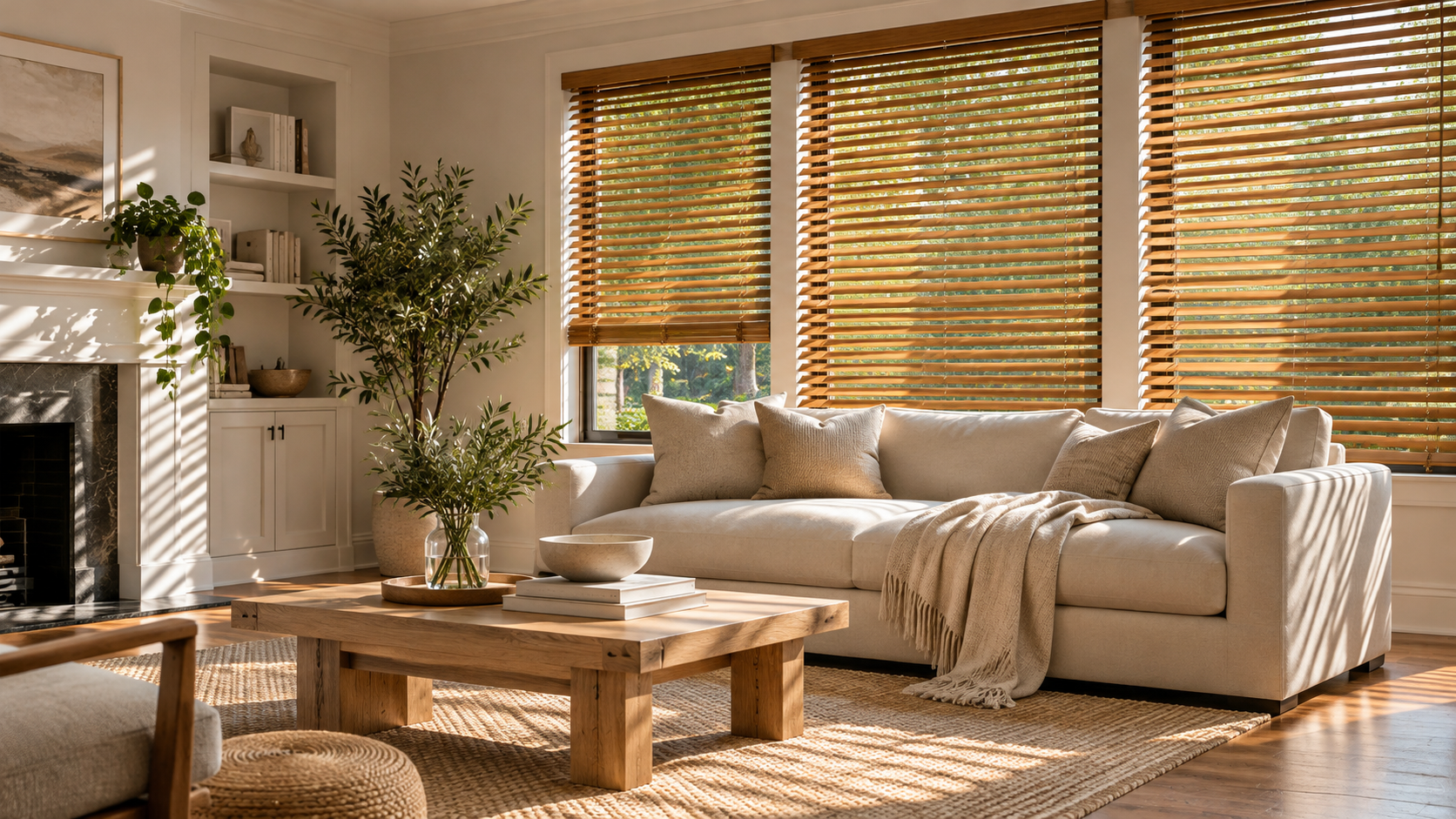
Natural oak-inspired finishes introduce warmth and work especially well with wooden furniture, woven rugs, and earth-toned accessories.
They can create a welcoming atmosphere without adding overly bold colors.
Walnut and Dark Wood
Walnut, espresso, and dark brown finishes add visual contrast.
They may work particularly well in larger living rooms with light-colored walls and comfortable neutral seating.
In a small or relatively dark living room, however, extensive dark finishes can make the space feel visually heavier.
Gray and Contemporary Finishes
Gray-stained wood or wood-look blinds can complement modern interiors featuring black metal, cool-toned flooring, and minimalist accessories.
Choose a shade that works with the room’s existing undertones rather than matching every surface exactly.
The color-selection benefit of Wooden Blinds For Your Living Room is the opportunity to create visual harmony while preserving a timeless appearance.
5. Select the Right Slat Width and Design
Wooden blinds are available with different slat sizes, and the width can affect their visual appearance, stack height, and view through the window.
The best choice depends on the window dimensions and the look you want to achieve.
Two-Inch Slats
Two-inch slats are common in residential window blinds.
They can suit small and medium windows while maintaining a familiar, classic appearance.
This size often complements a broad range of interior designs.
Two-and-a-Half-Inch Slats
Wider slats can create a more substantial visual effect and may offer a clearer view between slats when tilted open.
They can look attractive on larger living room windows.
However, wider slats may require additional mounting depth, so check the manufacturer’s specifications.
Decorative Valances and Tapes
Some wooden blinds include a valance that conceals the headrail.
Decorative cloth tapes may also be available to cover lift-cord holes or add visual detail.
These features can contribute to a more finished appearance, but their effect on privacy and light gaps depends on the design.
Consider Window Proportions
For small windows, excessively wide slats may look out of proportion.
For large windows, very narrow slats may create a busier appearance.
The design considerations associated with Wooden Blinds For Your Living Room should include proportion, mounting depth, and the desired visual balance.
6. Measure Your Windows Before Ordering
Accurate measurements are essential for a well-fitting window treatment.
Blinds that are too narrow may create excessive side gaps, while those that are too wide may not fit inside the window frame.
Careful measurement is one of the most important purchasing steps for Wooden Blinds For Your Living Room.
Inside-Mount Blinds
Inside-mount blinds fit within the window frame.
This creates a neat appearance and allows surrounding architectural trim to remain visible.
However, the frame must have enough depth to accommodate the headrail, slats, and brackets.
For an inside mount, LEVOLOR’s measuring guidance recommends measuring the width at the top, middle, and bottom, then recording the narrowest measurement. It also advises checking height at multiple positions and measuring the available mounting depth. FAUX WOOD TECHN
Outside-Mount Blinds
Outside-mount blinds attach above or around the window opening.
They can be useful when the window recess is too shallow or when you want greater coverage around the opening.
The added overlap may help reduce side light gaps.
Use a Steel Measuring Tape
A rigid steel tape provides more reliable measurements than flexible fabric measuring tapes.
Measure every window separately, even when the openings appear identical.
Follow the Supplier’s Instructions
Different manufacturers apply different size deductions, minimum depths, and mounting allowances.
Never assume the instructions from one supplier will apply to another product.
The measurement-related aspect of Wooden Blinds For Your Living Room can determine whether the final installation looks professionally finished or requires expensive adjustments.
7. Pair Wooden Blinds With Curtains and Other Decor
Wooden blinds can look attractive on their own, but they can also be layered with curtains to create a softer and more complete window treatment.
This approach combines the structured lines of horizontal blinds with the texture and movement of fabric.
One popular way to style Wooden Blinds For Your Living Room is to layer them with curtains that complement the room’s furniture.
Linen Curtains
Lightweight linen or linen-look curtains can soften natural wooden blinds.
This combination works well in Scandinavian, coastal, farmhouse, and transitional living rooms.
For example, honey-oak blinds paired with cream-colored curtains can create a warm, understated appearance.
Blackout Curtains
Wooden blinds alone generally do not provide complete darkness.
If reducing light is a priority, appropriately sized blackout curtains can offer additional coverage.
The actual result depends on fabric opacity, curtain dimensions, and installation.
Decorative Curtain Hardware
Choose curtain rods and hardware that coordinate with existing furniture and window finishes.
Black, brass, bronze, and natural wood tones can work depending on the interior style.
Avoid Overcrowding the Window
Large decorative valances, heavy curtains, and wide blinds can make smaller windows appear crowded.
Keep the treatment proportional to the room.
The layered decorating possibilities of Wooden Blinds For Your Living Room allow homeowners to combine functionality with softness and visual interest.
8. Consider Energy Efficiency and Indoor Comfort
Window coverings can influence solar heat gain and indoor comfort, particularly in rooms that receive strong direct sunlight.
The amount of benefit depends on the windows, climate, blind design, and how the coverings are used throughout the day.
An often-overlooked benefit of Wooden Blinds For Your Living Room is their role in managing sunlight and glare.
Reduce Unwanted Solar Heat
During hot weather, adjusting or closing blinds on sun-exposed windows can reduce some incoming solar radiation.
This may make the room feel more comfortable.
The U.S. Department of Energy identifies interior blinds and shades as useful tools for controlling solar heat gain and daylight. Department of Energy
Take Advantage of Winter Sunlight
In cooler weather, opening appropriate window coverings during sunny periods may help admit natural warmth.
Closing them afterward can provide some additional separation between the room and the window.
However, conventional slatted blinds generally offer less insulation than properly designed insulating cellular shades or well-fitted thermal coverings.
Reduce Glare Without Blocking All Daylight
Tilting slats can redirect some incoming light while maintaining a brighter interior than a completely closed opaque curtain.
This can be particularly useful in living rooms with televisions, reading chairs, or work areas.
Avoid Exaggerated Energy-Saving Claims
Wood blinds do not automatically create dramatic reductions in electricity bills.
Lawrence Berkeley National Laboratory explains that the energy performance of window attachments varies considerably and depends on their construction and use. Windows & Daylighting
The energy-related value of Wooden Blinds For Your Living Room lies primarily in adjustable sunlight control rather than guaranteed utility savings.
9. Prioritize Cordless Designs and Household Safety
Window covering safety is particularly important in homes with infants and young children.
Traditional blinds may contain accessible pull cords or loops that create strangulation hazards.
For that reason, the operating system should be considered before buying.
Choose Cordless Window Coverings
The U.S. Consumer Product Safety Commission recommends cordless window coverings in homes with young children.
Its guidance warns that accessible window covering cords can cause fatal strangulation incidents in a very short period. U.S. Consumer Product Safety Commission
Consider Motorized Blinds
Some wooden and wood-look blinds offer motorized tilt or lift functions.
Depending on the design, these can reduce the need for exposed operating cords.
However, check the product’s actual safety features, power requirements, and installation instructions.
Keep Furniture Away From Dangerous Window Areas
Children may climb onto sofas, tables, or other furniture to reach windows or accessible cords.
Avoid placing climbable furniture near hazardous window coverings.
Replace Older Unsafe Blinds
Older corded window treatments may not meet current safety expectations.
The Window Covering Safety Council advises using only cordless coverings or products with inaccessible cords in homes with young children. Window Covering Safety Council
The safety considerations associated with Wooden Blinds For Your Living Room should be treated as an essential purchasing requirement, not an optional decorative feature.
10. Maintain and Clean Wooden Blinds Properly
Like other window treatments, wooden blinds collect dust and may develop surface marks over time.
Fortunately, routine maintenance is usually straightforward when the material and finish are treated correctly.
Regular care can help preserve the appearance of Wooden Blinds For Your Living Room.
Dust the Slats Regularly
Use a soft microfiber cloth or an appropriate dusting attachment.
Close the slats in one direction, wipe them gently, and then adjust them to access the opposite surfaces.
Avoid placing excessive pressure on individual slats.
Avoid Soaking Real Wood
Natural timber can react to excess moisture.
Do not immerse real wooden blinds in water or clean them with a soaking-wet cloth.
Use only cleaning methods approved by the manufacturer.
Clean Faux Wood Appropriately
Many faux wood products can tolerate gentle wiping with a slightly damp cloth.
However, cleaning products and methods should still follow the manufacturer’s instructions.
Protect Against Prolonged Moisture
Condensation and persistent humidity can damage certain natural wood finishes.
Monitor windows for moisture problems and improve ventilation where appropriate.
Inspect Moving Components
Check that the headrail, brackets, tilt mechanism, and lifting system operate smoothly.
If a part becomes damaged, contact the manufacturer or qualified installer rather than improvising a repair that could compromise safety.
The maintenance-related benefit of Wooden Blinds For Your Living Room is that a carefully chosen and properly maintained product can remain visually attractive for many years.
Best Wooden Blind Styles for Different Living Rooms
HOME LUX, Custom-Designed by – Line Haven
Scandinavian Living Room
Light oak or natural wood finishes complement soft white walls, linen furniture, and simple natural materials.
Cream Wood Venetian Blind | DotcomBlinds
Modern Minimalist Living Room
White or light gray blinds create a clean, balanced appearance with contemporary furniture and uncluttered decor.
Premium Walnut Wooden Venetian Blinds with Tapes – Cheapest Blinds & Interiors Ltd
Traditional Living Room
Walnut and dark wood finishes can complement classic furniture, warm neutral walls, and detailed wooden flooring.
Modern Farmhouse Window Treatments Ideas | Hestia Blinds
Modern Farmhouse Living Room
Honey-oak blinds paired with soft linen curtains create a cozy atmosphere with rustic and contemporary details.
Common Mistakes to Avoid When Buying Wooden Blinds
Choosing blinds based only on appearance can lead to problems with fit, operation, and long-term maintenance.
Common mistakes include measuring windows incorrectly, ignoring mounting depth, selecting natural wood for persistently damp environments, and choosing slats that do not suit the window’s proportions.
Another mistake is assuming closed wooden blinds will provide complete blackout performance. Small light gaps are normal in many slatted products.
Homeowners should also avoid overlooking child safety or buying older blinds with accessible operating cords.
Finally, choosing a finish without comparing samples to existing furniture may result in mismatched wood tones.
Successful styling with Wooden Blinds For Your Living Room requires considering the material, color, dimensions, privacy requirements, and safe operation together.
Frequently Asked Questions
Are wooden blinds a good choice for living rooms?
Yes. Wooden blinds can provide a warm natural appearance, adjustable light control, and daytime privacy. They work especially well in dry living rooms with traditional, contemporary, or neutral interiors.
Are real wood blinds better than faux wood blinds?
Neither is universally better. Real wood offers authentic grain and is often lighter, while faux wood generally provides better moisture resistance and may be more affordable. The best option depends on your environment and preferences.
What color wooden blinds make a living room look bigger?
White, off-white, and light natural wood finishes can create a brighter appearance, especially when coordinated with light-colored walls. However, room size, window dimensions, and lighting also influence how spacious the room feels.
Can wooden blinds block out sunlight completely?
Wooden blinds can reduce incoming sunlight, but light may enter through slat openings and around the edges. For stronger room darkening, consider pairing them with suitable blackout curtains.
Are wooden blinds difficult to clean?
No. Regular dusting is usually sufficient for routine maintenance. Real wood should be protected from excessive moisture, while many faux wood products tolerate gentle wiping with a damp cloth.
Should I choose cordless wooden blinds?
Cordless designs are strongly recommended, particularly in homes with young children. Select products with appropriate safety features and follow all manufacturer installation instructions.
Conclusion
Wooden blinds are a versatile window treatment that can combine natural beauty with everyday practicality.
Whether you prefer light oak, warm honey tones, dark walnut, or painted white finishes, there are options to complement different living room designs.
Choosing Wooden Blinds For Your Living Room can help you create a comfortable space with adjustable light, improved daytime privacy, and timeless decorative appeal.
However, selecting the right product requires more than choosing an attractive color.
You should compare real and faux wood materials, confirm measurements, evaluate mounting options, and consider the household’s safety requirements.
For rooms exposed to persistent moisture, faux wood may offer practical advantages. In dry living areas, genuine wood can provide the warmth and character of natural timber.
Ultimately, Wooden Blinds For Your Living Room are most successful when they complement your existing furnishings, function comfortably, and suit your long-term maintenance needs.
With careful planning and suitable installation, wooden blinds can become an attractive and functional feature of your living space.

Written by Twastia Editorial Team
Twastia Editorial Team shares practical insights about website design, SEO services, Google Ads, content marketing, social media, conversion rate optimization, and digital marketing strategy.
Last updated: Nov 8, 2026
Related posts from Twastia
Explore more useful articles from twastia.com about digital marketing, SEO, websites, ads, content, and growth strategy.