Direct vs. Indirect-Fired Job Site Heaters: Best Guide
Cold weather can create serious challenges on construction sites. Low temperatures may affect worker comfort, building materials, project schedules, and […]
Cold weather can create serious challenges on construction sites. Low temperatures may affect worker comfort, building materials, project schedules, and certain construction processes. Whether contractors are working on an unfinished commercial structure, renovating an existing building, or completing interior finishes, reliable temporary heating is often necessary.
However, selecting a construction heater involves much more than finding equipment capable of producing hot air.
Different heating systems introduce different safety risks, ventilation requirements, operating costs, and installation considerations.
Understanding Choosing The Right Heater For Your Job Site: Indirect Vs. Direct Fired is essential for contractors, construction managers, and equipment rental customers who need to balance heat output with worker safety and project requirements.
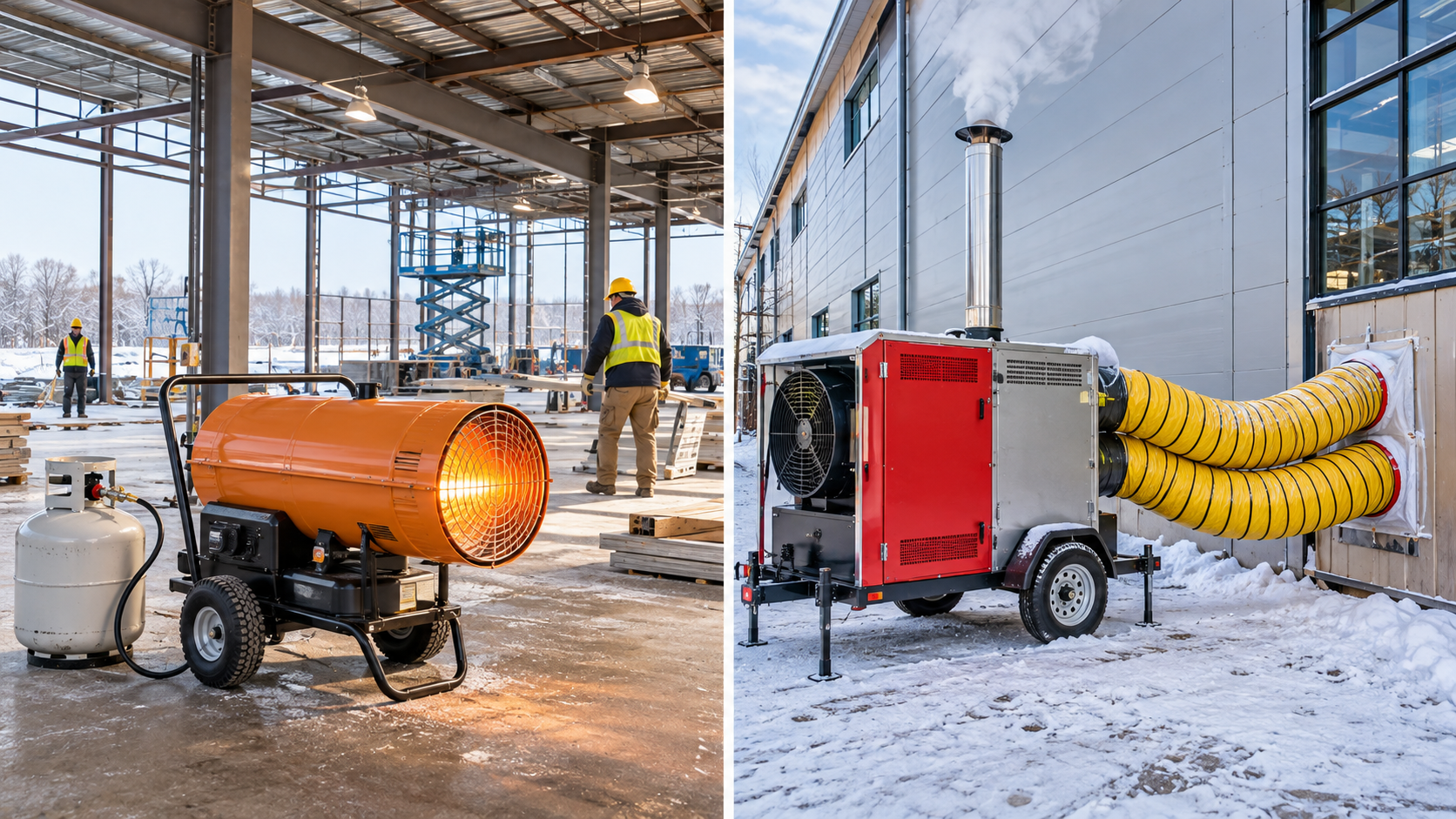
Direct-fired heaters generally deliver heat directly from fuel combustion into the heated airflow. Indirect-fired heaters use a heat exchanger that separates the combustion gases from the air supplied to the workspace.
That distinction affects where each system may be suitable.
The U.S. Occupational Safety and Health Administration (OSHA) requires adequate fresh air for temporary construction heaters and additional care when heaters operate in confined spaces. Occupational Safety and Health Administration
The decision covered by Choosing The Right Heater For Your Job Site: Indirect Vs. Direct Fired is therefore about selecting equipment that matches the construction phase, enclosure conditions, heating load, ventilation, fuel availability, and applicable safety requirements.
This guide explains how both systems work, where they are commonly used, and what to consider before renting or purchasing temporary heating equipment.
1. Understanding Temporary Heating on Construction Sites
Temporary construction heating is used when permanent building heating systems are unavailable, incomplete, or unsuitable for current site conditions.
Common applications include winter renovations, new building construction, warehouse projects, temporary enclosures, and certain temperature-sensitive construction activities.
Heating equipment may be needed to provide workers with a more comfortable environment or to help maintain conditions specified by material manufacturers.
Why Construction Sites Need Specialized Heating
A partially enclosed construction site behaves differently from a finished commercial building.
Open doorways, unfinished walls, temporary coverings, exposed floors, and changing ventilation conditions can create substantial heat loss.
As the building progresses toward completion, the heating requirements may also change.
Temperature Is Only One Consideration
A heater can produce substantial heat while introducing unwanted moisture or combustion products into the workspace.
For some construction activities, those side effects may be as important as the temperature itself.
The Importance of Construction Phase
During rough construction, a large, naturally ventilated area may accommodate a different heating system than a nearly finished building containing paint, flooring, cabinetry, and other sensitive materials.
A key principle in Choosing The Right Heater For Your Job Site: Indirect Vs. Direct Fired is to evaluate current site conditions rather than assuming one type of equipment will be suitable throughout the entire project.
2. How Direct-Fired Construction Heaters Work
Direct-fired heaters generate heat by burning fuel directly in the airflow delivered to the heated area.
In common portable models, a fan moves air through or across the combustion zone and discharges the resulting heated air into the surrounding space.
These units may use propane, natural gas, or certain liquid fuels, depending on their specific design.
Main Features of Direct-Fired Heaters
Direct-fired models often have a relatively simple construction.
They may include a burner, fan, fuel controls, safety systems, and a protective housing.
Portable forced-air models are sometimes called torpedo heaters or salamander heaters.
Advantages of Direct Heating
Because there is no separate heat exchanger and flue carrying away combustion heat, direct-fired heaters can transfer a high proportion of the fuel’s energy into the delivered air.
They are often compact, portable, and comparatively economical for certain applications.
Carrier Rentals notes that direct-fired heaters can be useful in outdoor areas, ventilated construction sites, and other environments where suitable airflow is available. Carrier Rentals
Important Limitations
Direct-fired heating introduces combustion products into the supplied air.
Depending on fuel and combustion conditions, these may include carbon dioxide, water vapor, carbon monoxide, nitrogen oxides, and other emissions.
Adequate ventilation is therefore essential, and some buildings or projects prohibit their use.
Suitable Applications
Direct-fired heaters may be appropriate for some open construction areas and large, properly ventilated workspaces when permitted by the equipment listing, site safety plan, and local requirements.
The direct-heating discussion within Choosing The Right Heater For Your Job Site: Indirect Vs. Direct Fired highlights why rapid heating and fuel efficiency must be considered alongside ventilation and air quality.
3. How Indirect-Fired Construction Heaters Work
Indirect-fired heaters use a different method of transferring heat.
Fuel burns inside a separated combustion chamber, and a heat exchanger transfers energy from that combustion process into a separate airflow.
The combustion exhaust is vented away from the supplied air.
Many temporary indirect-fired systems are positioned outside the building, with heated air delivered through appropriately rated ductwork.
Main Components
An indirect-fired heater typically includes a burner, combustion chamber, heat exchanger, fan, exhaust outlet, fuel system, and appropriate control equipment.
Some configurations also include duct connections, temperature controls, and remote monitoring capabilities.
Cleaner Delivered Air
Because combustion gases are separated from the supply air, the system can deliver heated air without intentionally mixing exhaust products into that airstream.
This is particularly useful in enclosed work areas.
However, correct exhaust placement, heat exchanger integrity, and equipment maintenance remain essential.
Ducting Flexibility
Properly rated ducting may allow heated air to be directed into an enclosed structure or distributed across selected work zones.
Duct length, bends, backpressure, and airflow restrictions must remain within the manufacturer’s limits.
Common Applications
Indirect-fired heaters are frequently used during interior finishing, renovations, large enclosed construction projects, and other activities where combustion byproducts should not enter the workspace.
Travelers and Sunbelt Rentals both identify indirect-fired systems as useful for enclosed construction environments, with appropriate exhaust and installation controls. Travelers Insurance+1
An important advantage discussed in Choosing The Right Heater For Your Job Site: Indirect Vs. Direct Fired is the ability to supply heated air while keeping the combustion process separated from the occupied work zone.
4. Compare Heating Efficiency and Fuel Consumption
Energy efficiency is an important factor when selecting construction heating equipment.
However, efficiency alone should not determine which heater is suitable.
A highly efficient system may still be the wrong choice if it introduces unacceptable combustion products into an enclosed workspace.
The efficiency comparison is one of the most practical parts of Choosing The Right Heater For Your Job Site: Indirect Vs. Direct Fired.
Direct-Fired Heating Efficiency
Direct-fired heaters often achieve high thermal efficiency because nearly all combustion heat is discharged into the supplied airflow.
They do not have the same flue-related heat losses as conventional indirect-fired systems.
As a result, direct-fired equipment may deliver substantial heating output relative to fuel input.
However, the building’s ventilation requirements can increase overall heat loss. Any energy savings must be evaluated at the site level.
Indirect-Fired Heating Efficiency
Indirect-fired heaters transfer heat through a heat exchanger.
Some energy leaves through the combustion exhaust, reducing the proportion of fuel energy delivered as useful heat.
United Rentals describes indicative efficiencies of approximately 95% for some direct-fired heaters and 80% for some indirect-fired equipment. These are examples, not universal performance ratings. United Rentals
Actual thermal efficiency varies by equipment model, operating conditions, and system design.
Consider Total Operating Costs
Fuel consumption depends on several factors, including heater capacity, operating duration, outside temperature, building heat loss, and control settings.
Rental charges, electrical requirements, ducting, fuel delivery, and maintenance can also affect overall expenses.
The efficiency-focused lesson in Choosing The Right Heater For Your Job Site: Indirect Vs. Direct Fired is that lower fuel consumption does not automatically mean lower total project cost.
Avoid Comparing Input Capacity With Delivered Heat
Two heaters with the same advertised fuel input may not deliver the same usable heat.
When comparing models, identify whether the published BTU rating refers to fuel input or useful heating output.
That distinction matters for both equipment sizing and operating costs.
5. Understand Ventilation and Carbon Monoxide Risks
Ventilation is one of the most important safety considerations when using combustion-powered construction heaters.
Fuel-burning equipment can produce carbon monoxide, particularly when combustion is incomplete or equipment is malfunctioning.
Carbon monoxide is colorless, odorless, and potentially fatal.
The ventilation requirements associated with Choosing The Right Heater For Your Job Site: Indirect Vs. Direct Fired must therefore be evaluated before any fuel-burning heater is operated.
Direct-Fired Equipment Requires Particular Care
Direct-fired heaters introduce combustion products into the heated airflow.
If the workspace does not receive adequate fresh air, hazardous substances may accumulate.
The amount of ventilation required depends on the equipment specifications, fuel, operating conditions, enclosure configuration, and applicable regulations.
A general statement that a building has some open windows is not sufficient proof of safe ventilation.
OSHA Requirements for Temporary Heating
Under OSHA’s construction standard 29 CFR 1926.154, fresh air must be provided in quantities sufficient to protect workers.
When natural ventilation is inadequate, mechanical ventilation must be used.
The regulation also addresses heater clearances, installation, and special requirements for temporary heating equipment. Occupational Safety and Health Administration
Indirect-Fired Does Not Mean Risk-Free
Indirect-fired heaters keep combustion gases separate from the heated supply air when properly functioning.
However, incorrectly located exhaust outlets, damaged heat exchangers, fuel leaks, or faulty installation can still create hazards.
Exhaust must be directed away from air intakes and building openings.
Carbon Monoxide Monitoring
The National Institute for Occupational Safety and Health warns that carbon monoxide can build up to dangerous concentrations in buildings and semi-enclosed spaces, sometimes even when an area appears well ventilated. CDC
A site-specific safety plan should address exposure monitoring, suitable alarms, worker training, ventilation verification, and emergency procedures.
Recognize Possible Exposure Symptoms
Headache, dizziness, nausea, weakness, confusion, and unusual fatigue can be symptoms of carbon monoxide exposure.
If an alarm activates or exposure is suspected, stop work, evacuate to fresh air, contact emergency services, and do not reenter until the area is assessed and declared safe by qualified personnel.
Choosing The Right Heater For Your Job Site: Indirect Vs. Direct Fired should always begin with a review of worker safety, permitted equipment types, and reliable ventilation arrangements.
6. Consider Moisture and Building Material Requirements
Temperature is not the only environmental condition that matters during construction.
Humidity, condensation, air circulation, and the drying requirements of materials can also influence project quality.
An important technical issue in Choosing The Right Heater For Your Job Site: Indirect Vs. Direct Fired is how the heating system affects moisture within the workspace.
Direct-Fired Heaters Add Combustion Moisture
Burning hydrocarbon fuels produces water vapor.
When a direct-fired heater discharges combustion products into the workspace, that moisture enters the heated air.
In certain conditions, elevated humidity may contribute to condensation or interfere with moisture-sensitive work.
Indirect-Fired Heaters Separate Combustion Moisture
Indirect-fired systems vent the combustion products separately.
Consequently, they do not intentionally add combustion-generated water vapor to the supply air.
This can be advantageous when maintaining environmental conditions for interior finishes.
However, indirect-fired heat alone does not remove moisture already present in concrete, lumber, drywall, or the building air.
Concrete and Masonry Work
Concrete curing requires appropriate temperature and moisture management.
The required conditions depend on the concrete mix, curing method, ambient environment, and project specifications.
Simply applying more heat is not always beneficial. Uncontrolled heating may cause excessive surface drying or undesirable temperature differences.
Follow the concrete supplier’s instructions and the engineer’s cold-weather construction requirements.
Painting, Drywall, and Flooring
Paint, adhesives, joint compounds, and flooring products may have specific temperature and relative-humidity requirements.
Some materials also impose limits on surface temperature and substrate moisture.
Indirect-fired systems are often preferred during finishing stages because they avoid adding combustion byproducts directly into the work area.
Sunbelt Rentals specifically distinguishes open rough-construction areas from enclosed buildings containing final finishes when recommending heating equipment. Sunbelt Rentals
The moisture-control aspect of Choosing The Right Heater For Your Job Site: Indirect Vs. Direct Fired is particularly important when improper conditions could damage materials or delay project completion.
7. Select the Right Heater for the Construction Phase
Construction sites change continuously.
An early-stage structure with large exterior openings may later become an enclosed building containing completed partitions, insulation, flooring, and other finishes.
The heating system selected at the beginning of a project may not remain appropriate throughout construction.
The project-stage considerations in Choosing The Right Heater For Your Job Site: Indirect Vs. Direct Fired can help managers plan equipment changes before conditions become unsuitable.
Open or Partially Enclosed Construction
Direct-fired equipment may be a practical option where ventilation is sufficient and the heater is permitted for the application.
Possible examples include certain open steel-framed buildings and appropriately ventilated rough-construction areas.
Weather conditions, wind exposure, and the movement of workers or materials still affect suitability.
Enclosed Building Construction
When a building becomes enclosed, the risk of combustion products accumulating can increase.
Indirect-fired equipment positioned outside the structure is frequently a more suitable choice.
However, the complete installation must still satisfy exhaust, ducting, electrical, and combustion-air requirements.
Interior Finishing
Final flooring, paint, drywall finishing, and other moisture-sensitive work often benefit from heating systems that do not introduce combustion moisture into the workspace.
Indirect-fired equipment can be useful when the system is properly sized and controlled.
Occupied Renovation Projects
Renovation work inside occupied buildings requires additional precautions.
Heater placement, combustion exhaust, noise, access routes, and air quality may affect both workers and occupants.
Electric or other approved heating systems may be preferable in some spaces.
The practical value of Choosing The Right Heater For Your Job Site: Indirect Vs. Direct Fired lies in matching equipment to the current construction environment rather than relying on the same setup during every project phase.
8. Calculate Heating Capacity and Job Site Requirements
Selecting a heater with insufficient output may leave the workspace too cold.
An oversized or poorly controlled system can waste energy, create uncomfortable conditions, or introduce additional hazards.
The sizing process is another important part of Choosing The Right Heater For Your Job Site: Indirect Vs. Direct Fired.
Identify the Heating Area
Begin by measuring the dimensions of the workspace.
Calculate the approximate enclosed volume, not just floor area.
Ceiling height, interconnected spaces, and the location of exterior openings can significantly affect heating requirements.
Estimate Building Heat Loss
Heat loss depends on insulation, outside temperatures, air leakage, exposed surfaces, and the desired indoor temperature.
Unfinished buildings may experience much greater losses than completed spaces.
A qualified heating specialist or rental supplier should assess the project rather than relying on a generic square-foot estimate.
Include Ventilation and Duct Losses
Fresh-air requirements and exhaust arrangements influence the amount of heat needed.
Indirect-fired systems may also lose some heat through ducting, depending on the length, insulation, layout, and surrounding temperatures.
Review Electrical Requirements
Fuel-fired heaters may still require electrical power for fans, burners, controls, and safety systems.
Confirm voltage, available power supply, protection requirements, and generator compatibility where applicable.
Example of Heating Load Planning
Consider a hypothetical unfinished warehouse measuring 100 feet long, 60 feet wide, and 20 feet high.
ILLUSTRATIVE BUILDING VOLUME
100 ft × 60 ft × 20 ft
This volume helps define the workspace but does not determine the required BTU/h output on its own.
The building’s construction, climate, desired temperature, ventilation, and heat losses must also be assessed.
The heater-sizing element of Choosing The Right Heater For Your Job Site: Indirect Vs. Direct Fired should involve a project-specific heat-loss calculation and verified equipment capacity.
9. Compare Equipment Rental, Setup, and Operating Expenses
Temporary heaters can be rented for individual projects or purchased for repeated use.
The appropriate choice depends on how often the equipment is needed, its capacity, transport requirements, and maintenance responsibilities.
A cost comparison is essential when evaluating Choosing The Right Heater For Your Job Site: Indirect Vs. Direct Fired.
Initial Equipment Costs
Direct-fired portable heaters often have lower initial equipment costs because they use relatively simple heating components.
Indirect-fired heaters can be more expensive because of their heat exchangers, exhaust assemblies, and additional installation requirements.
Actual prices vary by capacity, fuel type, manufacturer, and rental location.
Fuel Costs
Fuel prices and consumption rates influence ongoing expenses.
Direct-fired equipment may offer high thermal efficiency, but ventilation-related heat losses can increase the site’s total heating demand.
Indirect-fired systems may have greater equipment and fuel costs but offer advantages where enclosed spaces and finishes require separated combustion exhaust.
Ducting and Installation
Indirect-fired heaters may require flexible ducting, adapters, air-distribution equipment, suitable exhaust arrangements, and additional setup labor.
Some systems also require fuel tanks, delivery arrangements, and protected outdoor placement.
Maintenance and Service
Renting may allow contractors to obtain equipment maintained by a specialist supplier.
Before entering an agreement, confirm responsibility for inspections, repairs, fuel delivery, breakdown response, and emergency support.
Cost Comparison Checklist
| Cost factor | Direct-fired heater | Indirect-fired heater |
|---|---|---|
| Typical initial equipment cost | Often lower | Often higher |
| Fuel-to-air thermal efficiency | Generally higher | Typically lower due to exhaust losses |
| Installation complexity | Often simpler | May require ducting and exhaust planning |
| Ventilation considerations | Significant; combustion products enter supplied air | Still required, with separate exhaust management |
| Moisture introduced by combustion | Enters heated airflow | Normally exhausted separately |
| Portability | Many compact models | Varies; larger units may need transport support |
| Enclosed finished spaces | Often unsuitable or restricted | Commonly preferred when properly installed |
| Overall project expense | Depends on ventilation and operating conditions | Depends on rental, ducts, fuel, and setup |
The budgeting lesson in Choosing The Right Heater For Your Job Site: Indirect Vs. Direct Fired is to compare total installed and operating costs rather than relying solely on rental rates.
10. Follow Essential Temporary Heater Safety Practices
Every construction heating system requires appropriate installation, operation, and maintenance.
Even equipment designed with modern safety controls can become hazardous when installed incorrectly or operated outside its approved conditions.
A complete safety plan should be part of Choosing The Right Heater For Your Job Site: Indirect Vs. Direct Fired.
Maintain Required Clearances
Heaters must be positioned away from combustible materials according to the equipment listing, manufacturer instructions, and applicable regulations.
OSHA’s temporary heating standard specifies clearance and mounting requirements and includes additional provisions for heaters used near combustible coverings. Occupational Safety and Health Administration
Do not use a single assumed clearance distance for every model.
Secure Fuel Storage
Fuel cylinders and tanks should be located, protected, and secured according to relevant safety standards and manufacturer instructions.
Protect fuel connections from vehicles, falling objects, and other construction hazards.
Inspect Equipment Regularly
Inspect burners, hoses, connections, electrical components, ducts, exhaust outlets, and safety controls as required.
Damaged or malfunctioning heaters should be removed from service until appropriately repaired.
Prevent Unauthorized Operation
Only trained and authorized personnel should install, operate, inspect, or service temporary heating equipment.
Workers should know how to shut down the system and respond to suspected fuel leaks, combustion problems, or carbon monoxide alarms.
Plan for Unattended Periods
Temporary heaters should not simply be left operating after workers depart without a documented and approved arrangement.
Some applications may require continuous heating, but these installations need appropriate monitoring, supervision, and safety controls.
Travelers Insurance recommends regular inspections and additional supervision when temporary heaters must remain operating outside normal working hours. Travelers Insurance
The overall safety message of Choosing The Right Heater For Your Job Site: Indirect Vs. Direct Fired is that equipment selection is only one part of protecting workers and property.
Which Heater Is Better for Your Construction Project?
The choice depends on the type of building, construction stage, ventilation conditions, temperature requirements, and applicable safety standards.
SIP FIREBALL XD140 Diesel/Paraffin Space Heater – SIP Industrial Products Official Website
Direct-Fired Heating
Consider for approved outdoor or large, sufficiently ventilated rough-construction applications where combustion products can be safely managed.
Potential strengths include relatively straightforward installation, high heat delivery, portability, and lower equipment costs.
HI400HD D – Indirect Fired Air Heaters | SSR Equipment
Indirect-Fired Heating
Often preferable for enclosed construction areas and certain finishing applications where combustion exhaust should remain separated from the heated supply air.
Potential strengths include cleaner delivered air, less combustion-generated moisture in the workspace, and flexible ducted distribution.
These are general application distinctions, not installation approvals. Only use equipment permitted by its listing, manufacturer instructions, local rules, and site-specific safety assessment.
Common Mistakes When Choosing Construction Heaters
A common mistake is selecting equipment solely according to its advertised BTU rating.
Without assessing heat loss, ventilation, and equipment performance, contractors may rent a heater that does not meet the site’s actual requirements.
Another mistake is assuming that direct-fired heaters are appropriate for every unfinished building.
A partially enclosed structure may still have inadequate ventilation or conditions that make direct combustion heating unsafe.
It is also incorrect to assume that indirect-fired heating eliminates all safety concerns. Poor exhaust placement, damaged equipment, or incorrect ducting can still create hazardous conditions.
Other avoidable problems include neglecting electrical requirements, placing heaters near combustible materials, failing to protect fuel tanks, and ignoring manufacturer instructions.
A well-informed approach to Choosing The Right Heater For Your Job Site: Indirect Vs. Direct Fired involves considering the complete operating environment rather than treating the heater as an isolated piece of equipment.
Frequently Asked Questions
What is the main difference between direct-fired and indirect-fired heaters?
Direct-fired heaters transfer heat directly into the airflow, which also contains combustion products. Indirect-fired heaters use a heat exchanger to separate combustion gases from the air delivered to the workspace.
Are direct-fired heaters safe to use indoors?
They may be permitted in certain sufficiently ventilated construction or industrial environments, depending on their listing and applicable rules. They should not be assumed safe for enclosed spaces. Appropriate ventilation, exposure controls, and professional site assessment are essential.
Why are indirect-fired heaters often preferred for enclosed buildings?
Indirect-fired heaters vent combustion gases separately from the heated supply air. This reduces the introduction of combustion byproducts and combustion-generated moisture into the workspace when the system is properly installed and maintained.
Which heater type is more fuel-efficient?
Direct-fired heaters generally transfer a greater proportion of combustion heat into the supplied airflow. However, overall energy performance depends on ventilation, heat loss, equipment specifications, and operating conditions.
Can indirect-fired heaters be used for concrete curing projects?
Yes, appropriately designed systems may help maintain temperatures required for certain concrete operations. However, concrete curing also requires suitable moisture control and compliance with project specifications. A qualified professional should determine the heating strategy.
Should I rent or buy a temporary construction heater?
Renting may be practical for occasional projects or changing capacity requirements. Purchasing may be suitable for contractors with frequent and predictable heating needs. Compare ownership, maintenance, fuel, transport, and rental costs before deciding.
Conclusion
Selecting the right temporary heater is important for keeping construction projects productive during cold weather.
Direct-fired and indirect-fired systems both provide substantial heating capacity, but they operate differently and are suitable for different environments.
Direct-fired heaters can offer high thermal efficiency, portability, and relatively simple operation in approved, adequately ventilated applications.
Indirect-fired systems separate combustion exhaust from the heated airflow, making them especially useful for enclosed construction areas and projects involving moisture-sensitive finishes.
Understanding Choosing The Right Heater For Your Job Site: Indirect Vs. Direct Fired helps contractors make informed choices about ventilation, air quality, heating efficiency, operating costs, and worker protection.
Before renting or purchasing equipment, evaluate the construction phase, calculate the heating demand, confirm electrical and fuel requirements, and review applicable safety regulations.
Consult qualified heating specialists and follow manufacturer instructions for equipment placement, ventilation, exhaust, maintenance, and operation.
Ultimately, Choosing The Right Heater For Your Job Site: Indirect Vs. Direct Fired is about finding the heating system that delivers appropriate performance without compromising safety or construction quality.

Written by Twastia Editorial Team
Twastia Editorial Team shares practical insights about website design, SEO services, Google Ads, content marketing, social media, conversion rate optimization, and digital marketing strategy.
Last updated: Nov 8, 2026
Related posts from Twastia
Explore more useful articles from twastia.com about digital marketing, SEO, websites, ads, content, and growth strategy.