Commercial Concrete Floor Coatings in Orlando: 7 Best Benefits
Article Title:Commercial Concrete Floor Coatings in Orlando: A Practical Guide to Durable, Safe, and Professional Business Flooring Commercial floors endure […]
Article Title:
Commercial Concrete Floor Coatings in Orlando: A Practical Guide to Durable, Safe, and Professional Business Flooring
Commercial floors endure conditions that residential surfaces rarely experience. Warehouses deal with forklifts and pallet traffic, restaurants encounter spills and grease, automotive facilities handle chemicals and vehicle loads, while retail spaces need flooring that remains visually presentable despite constant foot traffic. Commercial concrete floor coatings in Orlando can provide businesses with protective flooring systems designed around these operational requirements while improving appearance, cleanability, safety, and resistance to selected forms of wear.
Orlando’s warm, humid climate adds another layer of complexity. Concrete slabs can contain or transmit moisture, and coating a slab without understanding its condition may contribute to adhesion problems, blistering, or other failures. Surface preparation, moisture evaluation, crack treatment, coating chemistry, installation conditions, and cure time all matter. The most expensive coating will not compensate for an improperly prepared substrate.
Businesses also have several coating technologies to compare, including epoxy, polyaspartic, polyurethane and other resinous systems. Each offers different characteristics involving cure time, chemical resistance, UV stability, appearance, and installation requirements. The ideal solution for a showroom may therefore be very different from the system appropriate for a commercial kitchen or industrial workspace.
This guide explores seven major benefits of commercial concrete coatings, available system types, surface preparation, safety, maintenance, project costs, and how Orlando businesses can choose a qualified flooring contractor.
What Are Commercial Concrete Floor Coatings in Orlando?
Commercial concrete floor coatings in Orlando are protective or decorative systems applied over prepared concrete surfaces in business, institutional, industrial, and other non-residential environments.
Depending on the facility and system, coatings may provide:
- Abrasion resistance.
- Chemical resistance.
- Improved cleanability.
- Decorative color.
- Defined traffic zones.
- Slip-resistant textures.
- A more finished appearance.
A coating should be specified according to what the floor actually encounters during normal operations.
Why Orlando Businesses Use Concrete Floor Coatings
Bare concrete can function effectively in many spaces, but it is porous and may stain, dust, or deteriorate under particular conditions.
A properly selected coating system can create a more controlled surface.
Common applications include:
- Warehouses.
- Retail stores.
- Restaurants.
- Commercial kitchens.
- Automotive shops.
- Hotels.
- Healthcare facilities.
- Manufacturing spaces.
- Commercial garages.
Performance requirements differ significantly across these environments.
1. Improve Resistance to Everyday Wear
Commercial floors can receive thousands of footsteps, cart movements, and vehicle passes.
Coatings designed for appropriate traffic conditions may help protect concrete surfaces from certain types of abrasion and wear.
However, “durable” is not a universal specification.
A coating designed for light retail foot traffic may not be appropriate for:
- Forklifts.
- Steel wheels.
- Heavy machinery.
- Repeated impact.
Tell the contractor exactly how the floor is used before selecting a system.
2. Create Easier-to-Clean Surfaces
One reason businesses consider Commercial concrete floor coatings in Orlando is maintenance.
Bare or deteriorated concrete can contain pores, cracks, and irregularities that collect contaminants.
A continuous coated surface can be easier to clean when installed correctly.
This may be particularly useful in:
- Retail.
- Foodservice.
- Automotive environments.
- Maintenance facilities.
Cleaning chemicals still need to be compatible with the coating.
Using an aggressive product outside manufacturer recommendations may dull or damage the finish.
3. Improve Chemical Resistance
Certain commercial environments regularly expose floors to:
- Oils.
- Cleaners.
- Fuel.
- Automotive fluids.
- Food-related substances.
- Industrial chemicals.
Coating manufacturers often provide chemical-resistance information for their specific products.
Do not assume “epoxy” automatically means resistance to every substance.
Chemical concentration, temperature, exposure duration, and cleaning procedures can all influence performance.
For demanding facilities, request documented compatibility with the chemicals actually used onsite.
4. Add Slip-Resistance Options
Safety is an important flooring consideration.
Smooth, glossy surfaces can become slippery when contaminated with water, oil, food, or other substances.
Commercial coating systems can incorporate aggregates or textures intended to improve traction.
However, there is a balance.
Extremely aggressive texture can make cleaning more difficult or create challenges for certain wheeled equipment.
The appropriate profile depends on:
- Facility use.
- Contaminants.
- Footwear.
- Cleaning methods.
- Accessibility requirements.
A qualified contractor should help determine a suitable finish.
5. Upgrade the Appearance of a Facility
Commercial flooring can support the overall presentation of a business.
Available decorative approaches may include:
- Solid colors.
- Flake systems.
- Metallic effects.
- Quartz broadcast systems.
- Decorative textures.
- High-gloss finishes.
- Satin finishes.
Facilities can also use contrasting colors for:
- Walkways.
- Work zones.
- Equipment areas.
- Safety markings.
Decorative choices should still support operational requirements.
6. Protect Existing Concrete
Concrete slabs can represent a substantial structural investment.
Coatings can protect the surface from selected forms of staining, abrasion, and environmental exposure.
They cannot repair serious structural problems simply by covering them.
Before coating, issues such as:
- Significant cracks.
- Spalling.
- Movement.
- Contamination.
- Moisture.
should be properly evaluated.
Structural concerns may require an engineer or other appropriately qualified professional.
7. Customize Flooring for Different Business Areas
One of the strongest advantages of Commercial concrete floor coatings in Orlando is the ability to specify different systems for different environments.
A large facility might use:
- Decorative coating in reception.
- Heavy-duty resinous flooring in production.
- Slip-resistant finish in wet areas.
- Traffic markings in loading zones.
Trying to use one identical coating throughout a complex facility may create unnecessary compromises.
Epoxy Floor Coatings
Epoxy is one of the most recognized commercial concrete coating technologies.
Two-component epoxy systems chemically cure after their components are mixed.
Depending on formulation, benefits may include:
- Strong adhesion.
- Durable build.
- Chemical resistance.
- Decorative flexibility.
Some epoxies can discolor or chalk under prolonged UV exposure, making topcoat selection particularly important in sun-exposed areas.
Polyaspartic Floor Coatings
Polyaspartic systems have become popular for projects requiring relatively fast cure times.
Potential characteristics can include:
- Rapid installation.
- UV stability with suitable formulations.
- Abrasion resistance.
- Decorative compatibility.
Faster curing can also reduce working time during application, making proper installation technique important.
Performance varies by product.
Polyurethane and Urethane Coatings
Polyurethane or urethane topcoats can offer useful abrasion, chemical, and UV characteristics depending on formulation.
They are sometimes used as top layers within multi-coat systems rather than as standalone solutions.
A contractor should specify the entire system, including primer, base coat, broadcast media, and topcoat where applicable.
Epoxy vs. Polyaspartic
Neither is universally better.
Epoxy May Be Attractive When:
- A high-build base is required.
- Strong substrate adhesion is important.
- The project benefits from longer working time.
Polyaspartic May Be Attractive When:
- Faster cure is important.
- UV exposure matters.
- Rapid return to service is valuable.
Many professional systems combine multiple coating chemistries to use the strengths of each.
Surface Preparation Is Critical
The long-term performance of Commercial concrete floor coatings in Orlando depends heavily on surface preparation.
Concrete must generally be:
- Structurally suitable.
- Clean.
- Properly profiled.
- Free of incompatible contaminants.
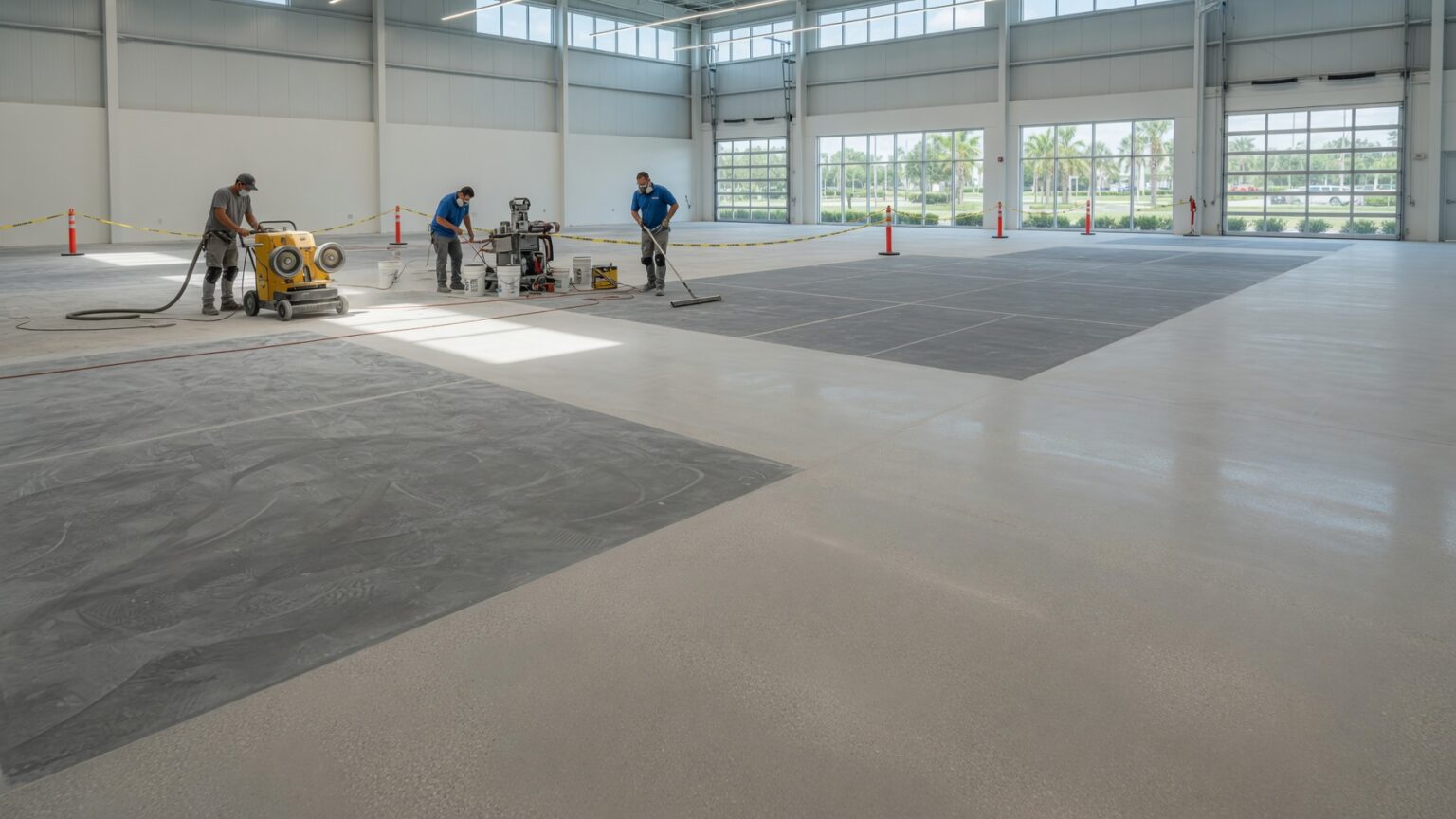
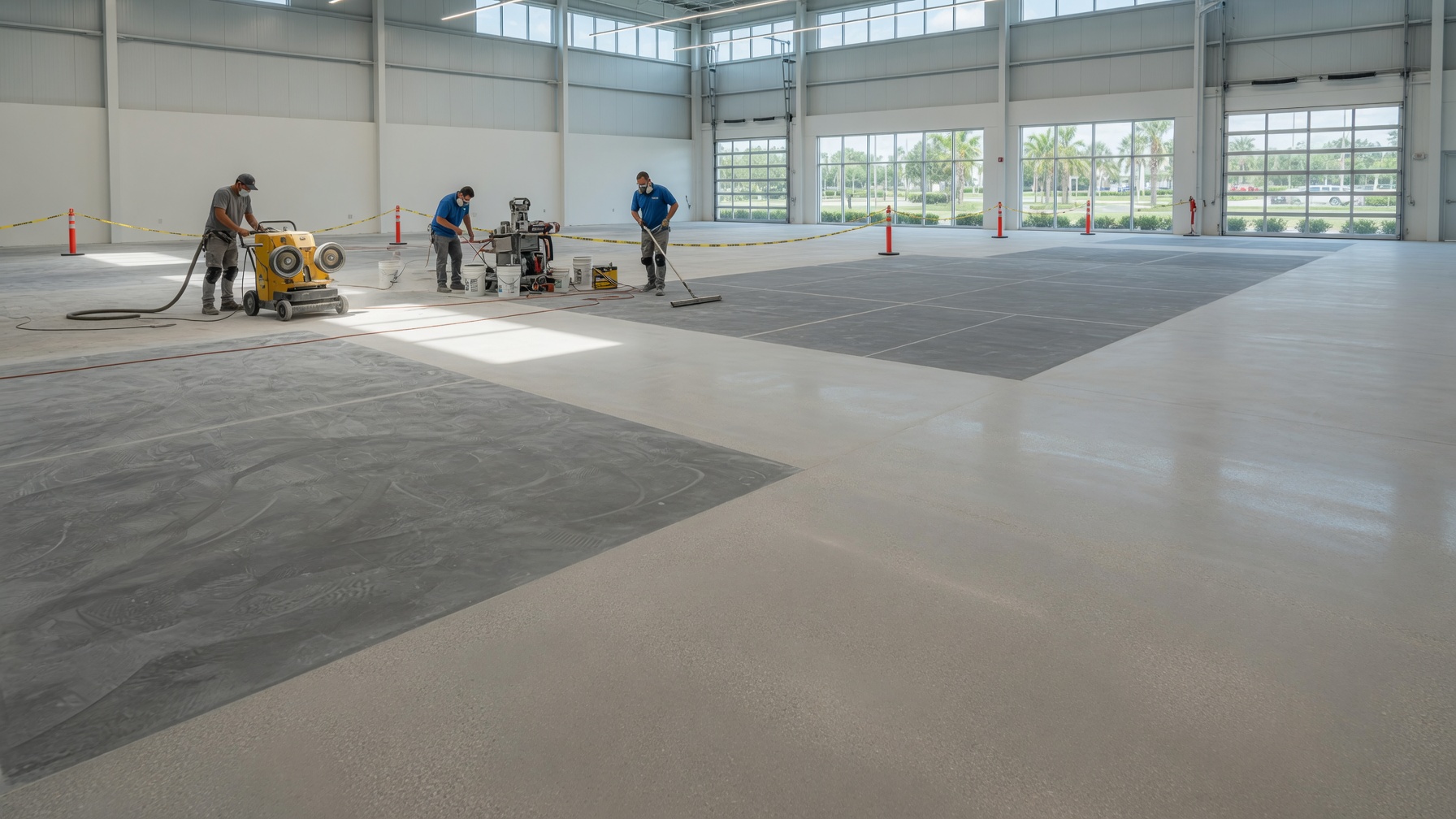
Professional preparation may involve:
Diamond Grinding
Mechanical grinding removes surface material and creates a profile for coating adhesion.
Shot Blasting
Shot blasting propels abrasive media against the floor to prepare larger concrete surfaces.
Specialized Removal
Old coatings, mastics, oils, and contaminants may require additional treatment.
Acid washing alone should not be assumed equivalent to professional mechanical preparation for every coating system.
Moisture Problems in Orlando Concrete
Florida’s humidity and groundwater conditions make slab moisture an especially important issue.
Moisture can move through concrete as vapor even when the floor appears dry.
Potential problems include:
- Blistering.
- Delamination.
- Discoloration.
- Bond failure.
Before installing moisture-sensitive systems, appropriate testing may be required.
Testing methods and acceptable levels depend on the coating manufacturer’s requirements.
New Concrete and Coating Installation
Fresh concrete cannot necessarily be coated immediately.
Concrete requires time to cure, and moisture conditions need to meet the selected coating system’s requirements.
The traditional assumption of waiting a fixed number of days is not a substitute for following product-specific requirements and appropriate testing.
If project schedules are tight, discuss compatible options with the coating manufacturer and installer before the slab is poured.
Crack Repair Before Coating
Concrete naturally develops cracks for various reasons.
Before coating, the installer should determine whether cracks are:
- Stable.
- Moving.
- Structural.
- Non-structural.
Some cracks can be repaired with compatible materials before coating.
However, coatings generally cannot guarantee that cracks or movement will never reappear.
Significant or unexplained movement deserves professional evaluation.
Commercial Kitchens and Foodservice
Restaurant and commercial kitchen floors require specialized attention.
Potential requirements include:
- Slip resistance.
- Grease resistance.
- Hot-water exposure.
- Frequent cleaning.
- Sanitation.
- Cove bases.
- Chemical resistance.
Applicable health and building requirements should influence system selection.
A decorative garage-style coating should not automatically be assumed suitable for food-production environments.
Warehouse Coatings
Warehouse floors may experience:
- Forklift traffic.
- Pallet movement.
- Heavy racks.
- Impact.
- Tire marks.
The coating system should be specified for expected traffic and equipment.
Warehouses may also benefit from color-coded:
- Pedestrian paths.
- Loading areas.
- Safety zones.
Markings should align with applicable workplace safety requirements.
Automotive and Service Facilities
Vehicle service areas expose flooring to demanding conditions.
Possible contaminants include:
- Engine oil.
- Brake fluid.
- Coolants.
- Cleaners.
- Fuel.
Before selecting a coating, compare manufacturer chemical-resistance information with the actual substances used by the business.
Retail and Showroom Flooring
Retail floors balance durability with aesthetics.
Businesses may prefer:
- Glossy decorative systems.
- Neutral solid colors.
- Flake finishes.
- Custom patterns.
Lighting interacts strongly with floor gloss.
Highly reflective floors may brighten a showroom but can also reveal dirt, scratches, or imperfections more easily.
Healthcare and Institutional Flooring
Healthcare environments may prioritize:
- Cleanability.
- Seamless transitions.
- Chemical resistance.
- Slip performance.
- Cove details.
Facility requirements can differ significantly from ordinary commercial spaces.
Flooring specifications should align with applicable regulations and infection-control practices where relevant.
How Long Do Commercial Coatings Last?
There is no universal lifespan.
Service life depends on:
- Coating system.
- Surface preparation.
- Concrete condition.
- Traffic.
- Chemicals.
- UV exposure.
- Maintenance.
A floor used by pedestrians will experience different wear from one subjected to heavy forklifts.
Be cautious of lifetime claims that do not explain exclusions and operating conditions.
Commercial Concrete Floor Coatings in Orlando Cost Factors
Pricing depends on much more than square footage.
Cost can be influenced by:
- Existing floor condition.
- Coating removal.
- Crack repair.
- Moisture mitigation.
- Surface preparation.
- System thickness.
- Decorative finish.
- Number of coats.
- Installation schedule.
Night or weekend work intended to reduce business disruption may also affect labor cost.
How Long Does Installation Take?
Project duration depends on:
- Square footage.
- Preparation.
- Repairs.
- Coating chemistry.
- Cure times.
- Environmental conditions.
Fast-curing systems may allow earlier return to service, but rushing preparation simply to shorten downtime can compromise the project.
Ask contractors to distinguish between:
- Installation completion.
- Foot-traffic readiness.
- Vehicle-traffic readiness.
- Full chemical cure.
These may occur at different times.
Choosing a Commercial Flooring Contractor
When comparing Commercial concrete floor coatings in Orlando contractors, evaluate:
Commercial Experience
Residential garage expertise does not automatically translate to industrial flooring.
Surface Preparation Equipment
Ask whether preparation is performed mechanically and with appropriate dust control.
Product Specifications
A proposal should identify the actual coating system.
Moisture Evaluation
The contractor should address moisture where relevant.
References
Request examples of similar commercial projects.
What a Professional Quote Should Include
A detailed proposal should identify:
- Floor area.
- Preparation method.
- Crack treatment.
- Moisture assumptions.
- Primer.
- Coating layers.
- Decorative media.
- Topcoat.
- Cure times.
- Warranty.
Without these details, comparing quotes is difficult.
Common Coating Mistakes
Frequent causes of disappointing results include:
- Inadequate preparation.
- Ignoring moisture.
- Applying incompatible products.
- Incorrect cure conditions.
- Wrong system for traffic.
- Coating contaminated concrete without proper remediation.
The visible coating represents only the final portion of the installation process.
Maintenance After Installation
Follow the coating manufacturer’s cleaning recommendations.
General practices may include:
- Removing abrasive dirt.
- Cleaning spills promptly.
- Using compatible detergents.
- Avoiding unsupported harsh chemicals.
- Inspecting damaged areas.
Facility managers should document approved cleaning procedures so maintenance staff do not unintentionally damage the coating.
Safety and OSHA Considerations
Commercial coating projects can involve dust, chemicals, grinding equipment, and restricted work zones.
Professional contractors should follow applicable occupational safety requirements involving:
- PPE.
- Ventilation.
- Respiratory hazards.
- Silica dust.
- Chemical handling.
- Equipment operation.
Safety data sheets should be available for relevant products used onsite.
Sustainability Considerations
Businesses increasingly evaluate environmental impacts of flooring systems.
Potential considerations include:
- Coating service life.
- VOC characteristics.
- Existing-floor reuse.
- Maintenance requirements.
- Waste generation.
A durable coating that extends the service life of an existing slab may reduce the need for additional flooring materials, although overall environmental performance depends on the specific system.
AI and Commercial Flooring Management
AI and digital technologies are increasingly supporting facility maintenance.
Applications can include:
- Floor-condition monitoring.
- Predictive maintenance.
- Project scheduling.
- Digital estimating.
- Inspection documentation.
Computer-vision systems may eventually help identify wear patterns or damaged areas, but they cannot replace physical substrate evaluation before coating installation.
Conclusion
Commercial concrete floor coatings in Orlando can help warehouses, retail stores, restaurants, automotive facilities, offices, healthcare environments, and other businesses create durable and professional floor surfaces tailored to their operational needs. Successful installations depend less on choosing the most heavily marketed coating chemistry and more on evaluating the entire flooring system: concrete condition, moisture, surface preparation, cracks, traffic, chemical exposure, slip resistance, coating layers, and cure requirements. Orlando’s humid climate makes moisture assessment particularly important. Businesses should compare contractors based on commercial experience, preparation methods, detailed specifications, and relevant project references. When substrate preparation and system selection are handled correctly, commercial concrete coatings can provide a practical combination of protection, appearance, cleanability, and long-term functionality.
FAQs
What are Commercial concrete floor coatings in Orlando?
Commercial concrete floor coatings in Orlando are resinous or protective systems installed over prepared concrete in business, industrial, institutional, and commercial environments to improve durability, appearance, cleanability, or other performance characteristics.
Which coating is best for commercial concrete floors?
There is no universal best system. Epoxy, polyaspartic, polyurethane, and multi-layer systems offer different characteristics. Selection should reflect traffic, chemicals, UV exposure, downtime, and substrate conditions.
How much do Commercial concrete floor coatings in Orlando cost?
Costs vary based on square footage, preparation, existing coating removal, cracks, moisture, system type, decorative requirements, and installation schedule. Obtain site-specific written quotes.
Why is concrete moisture testing important in Orlando?
Moisture moving through a slab can interfere with certain coating systems and contribute to adhesion or blistering problems. Appropriate testing helps determine substrate conditions before installation.
How long before a commercial coated floor can be used?
Return-to-service times vary by coating chemistry, temperature, humidity, system thickness, and intended traffic. Foot traffic, vehicles, and chemical exposure may each have different required cure times.
How do I choose a contractor for Commercial concrete floor coatings in Orlando?
Look for commercial project experience, professional mechanical surface-preparation methods, moisture awareness, clear product specifications, references, safety practices, and detailed written warranty terms.

Written by Twastia Editorial Team
Twastia Editorial Team shares practical insights about website design, SEO services, Google Ads, content marketing, social media, conversion rate optimization, and digital marketing strategy.
Last updated: Aug 10, 2026
Related posts from Twastia
Explore more useful articles from twastia.com about digital marketing, SEO, websites, ads, content, and growth strategy.