Turbine Flow Meter: Working Principle, Types, Applications & Buying Guide 2026
Accurate flow measurement plays an essential role in industrial operations. Whether a facility handles clean water, fuels, industrial gases, or […]
Accurate flow measurement plays an essential role in industrial operations. Whether a facility handles clean water, fuels, industrial gases, or manufacturing chemicals, knowing how much fluid moves through a pipeline helps operators monitor processes, manage resources, and maintain consistent production.
Among the available technologies, turbine flow meters remain a popular option for measuring the volumetric flow of suitable liquids and gases.
These instruments combine a mechanical rotor with electronic sensing technology to provide flow rate information. Their relatively compact construction, rapid response, and availability in multiple configurations make them useful across many industrial applications.
However, selecting the right equipment requires understanding more than pipe diameter and purchase price. Fluid cleanliness, viscosity, operating temperature, pressure, measurement range, installation conditions, and calibration all influence performance.
This guide explains how turbine flow meters work, their advantages and limitations, common applications, essential specifications, and practical purchasing considerations for industrial facilities in the United States.
What Is a Turbine Flow Meter?

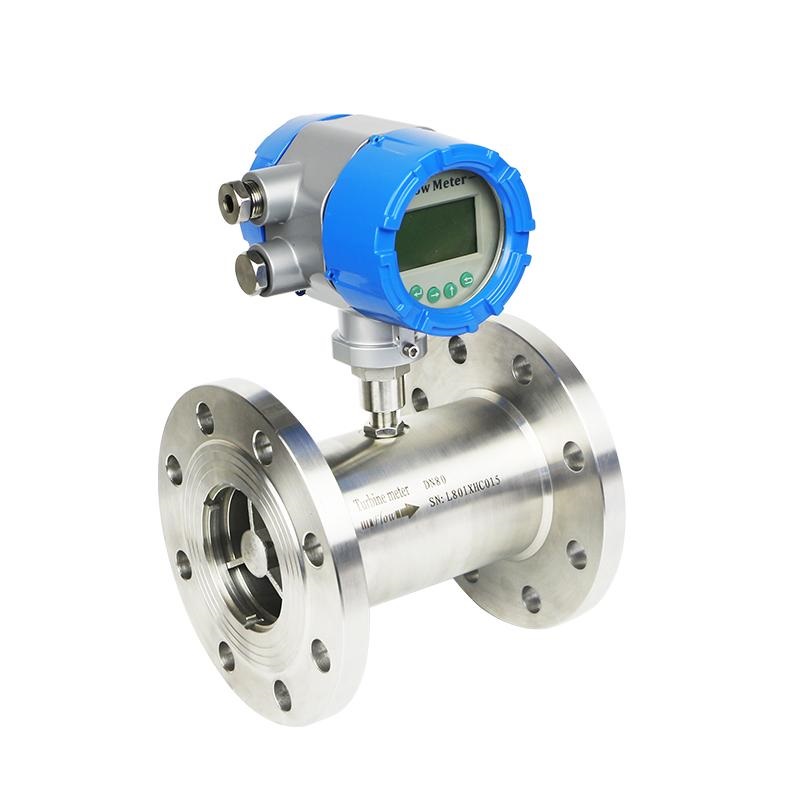
A turbine flow meter is a flow measurement instrument that uses a rotating turbine inside a pipe to determine the volumetric flow rate of a liquid or gas.
When fluid passes through the meter, it causes the turbine rotor to turn.
A sensor detects the rotor’s movement and generates a signal that can be processed into a flow measurement.
The instrument may display instantaneous flow rate, accumulated volume, or both.
What Does a Turbine Flow Meter Measure?
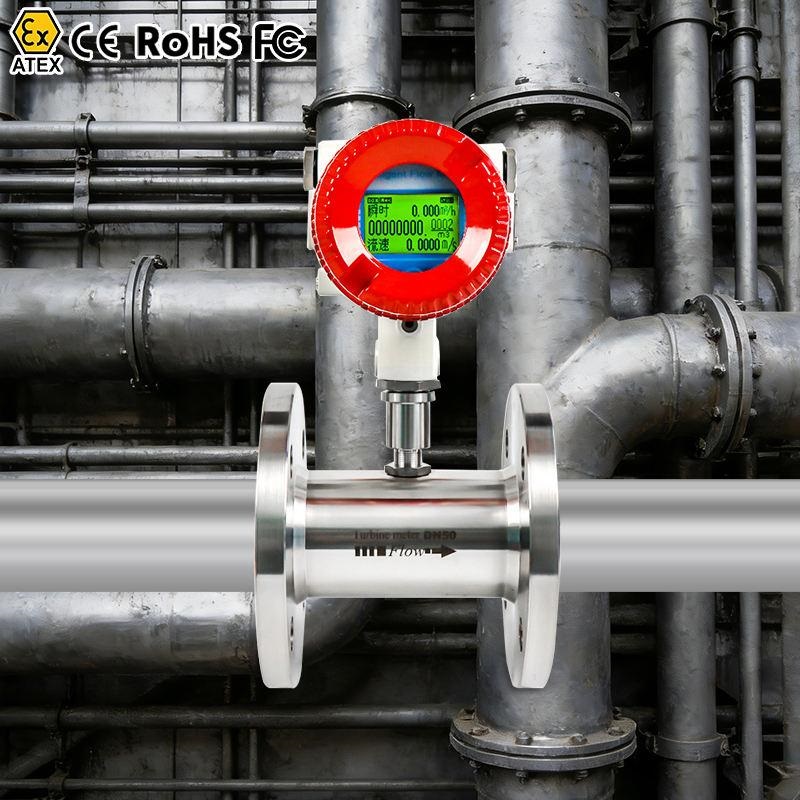
These instruments primarily measure volumetric flow.
Depending on the equipment, readings may be displayed in gallons per minute, liters per minute, cubic meters per hour, or other units.
Certain gas systems also incorporate pressure and temperature compensation to calculate volume referenced to specified conditions.
The appropriate measurement depends on the application’s requirements.
How Does a Turbine Flow Meter Work?
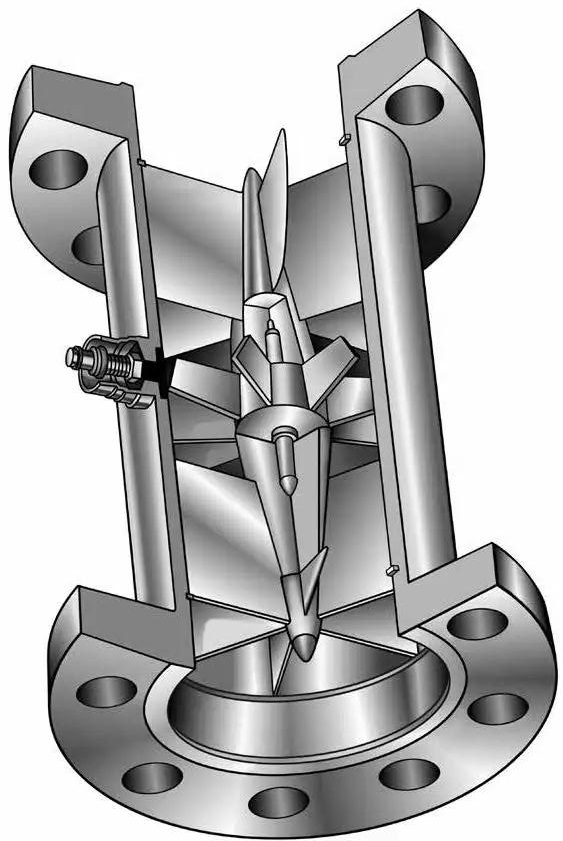
The basic operating principle involves converting fluid movement into rotor rotation.
Step 1: Fluid Enters the Meter
A liquid or gas passes through the instrument’s measuring tube.
The meter is designed to direct flow through its internal rotor.
Step 2: The Turbine Rotor Spins
Fluid movement transfers energy to the rotor blades.
Within the instrument’s intended operating range, rotor speed is related to volumetric flow rate.
Step 3: A Sensor Detects Rotation
An electromagnetic or other compatible pickup detects the passing rotor blades.
The resulting electrical pulses or frequency signal provide information about rotor speed.
Step 4: Electronics Calculate Flow
A transmitter or flow computer processes the signal using the meter’s calibration information.
The measurement can be shown on a display or transmitted to a control system.
This process enables both continuous monitoring and accumulated flow measurement.
Understanding the Turbine Flow Meter K-Factor
The K-factor is an important calibration value used with many turbine flow meters.
It expresses the number of output pulses associated with a unit of fluid volume.
For example, a meter calibrated to produce 500 pulses per U.S. gallon would have a K-factor of 500 pulses per gallon.
If the instrument records 5,000 pulses, the corresponding measured volume would be 10 gallons under the applicable calibration conditions.
Why Is the K-Factor Important?
Electronic instruments use the K-factor to convert pulse counts or frequency into meaningful flow measurements.
An incorrect K-factor may produce inaccurate readings even if the sensor operates normally.
The factor is specific to the instrument and can vary with flow conditions.
Calibration Conditions Matter
Fluid viscosity, Reynolds number, and operating conditions can influence the meter’s response.
The National Institute of Standards and Technology explains how turbine meter calibration characteristics can depend on these factors.
For demanding applications, use the calibration data appropriate to the actual operating conditions.
Types of Turbine Flow Meters
Turbine meters are available in multiple configurations.
The appropriate type depends primarily on the measured fluid and process requirements.
Liquid Turbine Flow Meter
A liquid turbine meter measures the volumetric flow of suitable liquids.
Common applications include clean water, certain fuels, compatible chemicals, and selected food-processing liquids.
These instruments generally work best with clean fluids that remain within their specified viscosity range.
Gas Turbine Flow Meter
A gas turbine meter is designed to measure appropriate gas streams.
Potential applications include natural gas, compressed air, nitrogen, and other industrial gases.
Because gas density changes with pressure and temperature, compensated gas measurement may require additional sensors and electronics.
Digital Turbine Flow Meter
Digital configurations incorporate electronic transmitters or displays.
Depending on the model, they may provide flow rate, totalized volume, pulse signals, analog outputs, or industrial communications.
Sanitary Turbine Flow Meter
Sanitary designs may feature specialized materials, surface finishes, and hygienic process connections.
For food, beverage, or pharmaceutical use, buyers must confirm the complete instrument meets the relevant sanitation and cleaning requirements.
Exploring Turbine Flow Meters From Silver Automation Instruments
Industrial buyers researching a turbine flow meter can explore the product selection published by Silver Automation Instruments.
The China-based instrumentation supplier advertises electronic turbine meters for liquid and gas applications, with customization options for different process requirements.
Liquid Turbine Meter Options
The company’s published specifications include stainless steel 304 and 316 sensor bodies, as well as threaded, wafer, flanged, and tri-clamp connections.
It lists several electronics options, including pulse, frequency, 4–20mA, Modbus RTU, and HART.
Its product range covers small-flow sensors and larger industrial pipeline instruments.
Gas Turbine Meter Options
The gas product descriptions include instruments for natural gas and selected industrial gases.
Available features may include LCD displays, battery-powered operation, and optional electronic volume correction.
Published Accuracy Information
Silver Automation Instruments describes typical liquid turbine meter accuracy of approximately ±0.5% to ±1.0%.
Its gas models are generally listed around ±1.0% to ±1.5%.
These figures are published specifications, not independently verified performance guarantees for every model or installation.
Purchasers should request a model-specific datasheet and calibration certificate.
Advantages of Turbine Flow Meters
Good Accuracy in Suitable Conditions
A properly selected and calibrated turbine meter can provide accurate volumetric measurements within its specified operating range.
Performance depends on stable flow conditions and the instrument’s condition.
Fast Measurement Response
Rotor-based measurement can respond relatively quickly to changing flow rates.
This characteristic is useful in certain monitoring and process-control applications.
Compact Construction
Many turbine meters have a relatively straightforward mechanical design.
This can simplify integration into pipelines where the required straight lengths are available.
Multiple Signal Outputs
Electronic models can communicate with displays, programmable logic controllers, and monitoring systems.
This supports automated industrial data collection.
Competitive Equipment Cost
For suitable clean-fluid applications, turbine meters can be a cost-effective alternative to some other measurement technologies.
However, purchase price should be evaluated alongside installation, maintenance, and calibration expenses.
Limitations of Turbine Flow Measurement
Turbine meters are not appropriate for every fluid or operating condition.
Sensitivity to Contaminants
Solids and debris may damage rotor blades or bearings.
Dirty wastewater and abrasive slurries usually require another measurement approach.
Moving-Component Wear
Bearings and rotors experience mechanical movement.
Wear may change the meter’s response or create maintenance requirements.
Viscosity Sensitivity
Changes in fluid viscosity can affect rotor behavior and calibration.
An instrument calibrated for water should not automatically be assumed accurate for a substantially more viscous liquid.
Flow Profile Requirements
Upstream elbows, pumps, control valves, and other disturbances can produce uneven flow.
Incorrect installation may reduce accuracy.
Limited Low-Flow Performance
Below a meter’s specified minimum operating flow, the rotor may not respond consistently enough for reliable measurement.
Industrial Applications of Turbine Flow Meters
Water Treatment and Distribution
Facilities may use turbine meters to monitor clean process water, reverse-osmosis water, and other compatible streams.
Actual suitability depends on fluid quality and pipe conditions.
Oil and Fuel Handling
Appropriately selected meters can measure diesel, kerosene, and other compatible fuels.
Applications involving flammable liquids require suitable electrical equipment, materials, and hazardous-location approvals.
Natural Gas Measurement
Gas turbine meters can support process monitoring and certain metering applications.
Custody-transfer installations involve additional contractual, regulatory, and measurement requirements.
Food and Beverage Processing
Sanitary turbine designs can measure selected beverages and ingredients.
Surface finish, cleaning procedures, seals, and sanitary certifications must be verified.
Chemical Manufacturing
Compatible turbine meters may measure certain solvents and chemical liquids.
Material compatibility is essential, especially with corrosive substances.
Choosing the Correct Flow Meter Size
Pipe diameter alone is not enough to select an instrument.
The expected operating flow range is equally important.
Determine Minimum and Maximum Flow
Identify normal flow, peak flow, and the lowest flow that must be measured accurately.
An oversized meter may perform poorly at low flow rates.
Check the Meter’s Published Range
Compare your operating conditions with the instrument’s certified measuring range.
The meter must handle peak demand while maintaining acceptable performance during normal operation.
Review Pressure Loss
A turbine meter introduces some resistance to flow.
Check the expected pressure drop and ensure the piping system can accommodate it.
Turbine Flow Meter Installation Requirements
Correct installation is essential for reliable performance.
Maintain Adequate Straight Pipe
Silver Automation Instruments’ general liquid-meter guidance recommends at least 10 pipe diameters of straight pipe upstream and 5 downstream.
For a pipe with a 2-inch internal diameter, this corresponds to 20 inches upstream and 10 inches downstream.
These are general recommendations. Certain models and upstream disturbances may require longer runs or a flow conditioner.
Always follow the specific installation manual.
Verify Flow Direction
Many turbine meters are designed for flow in one direction.
Install the instrument according to the arrow or directional markings provided by the manufacturer.
Prevent Air Entrapment
Liquid meters should generally operate with a full measuring tube and minimal entrained gas.
Air pockets, cavitation, and flashing can produce measurement errors or equipment damage.
Consider Filtration
An appropriate upstream strainer may protect the rotor from particles.
The filtration arrangement must be compatible with the fluid and pressure conditions.
Protect Against Vibration
Mount the meter in a suitable location away from excessive mechanical vibration and avoid placing unnecessary pipe stress on its body.
Installation should be completed by appropriately qualified personnel.
Turbine Flow Meter Accuracy and Calibration
Accuracy describes how closely the measured value agrees with a reference value.
Repeatability describes how consistently a meter reproduces readings under similar conditions.
Both are important, but they are not interchangeable.
Why Calibration Is Necessary
A meter may require calibration before commissioning, after significant repair, or at intervals determined by the measurement program.
Calibration compares its output with a known reference.
The Role of NIST Traceability
NIST maintains flow measurement standards and provides specialized calibration services.
Traceability means a measurement result is supported by a documented chain of calibrations with stated uncertainties.
A manufacturer claiming NIST traceability should be able to provide supporting documentation.
Set a Suitable Calibration Interval
Calibration frequency depends on process criticality, regulatory requirements, operating conditions, and previous results.
There is no universal schedule appropriate for every turbine meter.
How to Maintain a Turbine Flow Meter
Routine maintenance can support instrument reliability and reduce unexpected measurement problems.
Check for Flow Obstructions
Inspect filters and strainers according to the maintenance plan.
Restricted flow can affect process performance.
Monitor Signal Behavior
Unexpectedly low readings, irregular pulses, or unstable output signals may indicate wiring problems, flow disturbances, or mechanical issues.
Inspect Mechanical Components
Qualified technicians should examine rotor and bearing condition when maintenance procedures require it.
Follow the manufacturer’s instructions for cleaning and replacement.
Keep Accurate Records
Document calibration results, maintenance work, instrument configuration, and operational issues.
These records can support troubleshooting and long-term performance evaluation.
Turbine Flow Meter vs. Other Flow Meter Technologies
Turbine vs. Electromagnetic Flow Meter
Electromagnetic meters measure compatible conductive liquids without placing a turbine rotor in the stream.
They are commonly considered for water and other conductive process liquids.
Unlike turbine meters, they cannot measure nonconductive liquids using the same principle.
Turbine vs. Coriolis Flow Meter
Coriolis instruments directly measure mass flow and may also provide density information.
They can be useful when mass measurement is essential, although equipment cost and installation requirements may differ.
Turbine vs. Positive Displacement Meter
Positive displacement meters measure fluid through repeated displacement of defined volumes.
Certain designs are suitable for fluids with higher viscosities.
The right choice depends on the operating range, fluid properties, and accuracy requirements.
How Much Does a Turbine Flow Meter Cost?
Prices vary considerably between basic sensors and specialized industrial meters.
Important cost factors include pipe size, body material, accuracy class, pressure rating, and electronic features.
Electronics and Communication
A simple pulse-output meter may have different pricing from one equipped with a local display, 4–20mA output, and advanced communications.
Specialized Construction
High-pressure designs, sanitary fittings, special alloys, and hazardous-location approvals may increase costs.
Total Ownership Cost
Budget for installation, filters, calibration, maintenance, downtime, and potential replacement parts.
Ask suppliers for an itemized quotation rather than relying on an unverified generic price estimate.
Common Mistakes When Buying a Turbine Flow Meter
A common mistake is selecting equipment without confirming fluid viscosity.
Another is choosing the meter diameter solely to match the pipeline without checking its measuring range.
Buyers may also overlook straight-pipe requirements, cleaning needs, pressure ratings, or electrical compatibility.
Don’t assume all products advertised as high accuracy will achieve their stated specifications in every installation.
Finally, verify technical documentation, calibration records, and applicable approvals before using a meter in safety-critical or regulated systems.
Frequently Asked Questions About Turbine Flow Meters
What Is a Turbine Flow Meter Used For?
It measures the volumetric flow of suitable liquids or gases in industrial piping systems.
How Does a Turbine Flow Meter Work?
Fluid rotates an internal rotor. A sensor detects rotor movement and electronics convert the resulting signal into a flow measurement.
How Accurate Is a Turbine Flow Meter?
Accuracy depends on the instrument. Silver Automation Instruments publishes typical figures of ±0.5% to ±1.0% for selected liquid meters and ±1.0% to ±1.5% for gas meters.
Can a Turbine Flow Meter Measure Diesel?
Yes, when the meter’s materials, flow range, viscosity specifications, and installation are appropriate for the fuel.
Can Turbine Meters Measure Dirty Water?
They are generally unsuitable for water containing significant abrasive solids or debris.
What Is the K-Factor in a Turbine Flow Meter?
The K-factor expresses the number of output pulses per unit volume under specified calibration conditions.
How Often Should a Turbine Meter Be Calibrated?
The interval depends on application criticality, operating conditions, applicable requirements, and historical calibration performance.
Are Turbine Flow Meters Suitable for Natural Gas?
Gas-specific turbine meters can measure natural gas when properly selected, installed, and approved for the intended application.
Conclusion: Selecting the Right Turbine Flow Meter
A turbine flow meter can provide dependable volumetric flow measurement for many clean-liquid and gas applications.
Its straightforward operating principle, compact construction, and electronic output options make it useful across water treatment, fuel handling, gas processing, and manufacturing.
However, reliable performance depends on choosing the correct model and understanding the process conditions.
Before purchasing, verify the fluid type, viscosity, minimum and maximum flow rates, temperature, pressure, connections, signal outputs, and calibration requirements.
Appropriate installation and routine maintenance are equally important.
By considering these technical factors, industrial operators can select a flow measurement solution that supports accurate monitoring and effective process control.

Written by Twastia Editorial Team
Twastia Editorial Team shares practical insights about website design, SEO services, Google Ads, content marketing, social media, conversion rate optimization, and digital marketing strategy.
Last updated: Oct 15, 2026
Related posts from Twastia
Explore more useful articles from twastia.com about digital marketing, SEO, websites, ads, content, and growth strategy.