Commercial Real Estate Data: How to Find and Analyze It
A commercial property can look promising in a listing and still be a poor investment. The asking price may ignore […]

A commercial property can look promising in a listing and still be a poor investment. The asking price may ignore upcoming lease expirations, a seemingly busy retail corridor may have weakening tenant demand, or recent comparable sales may involve very different buildings. Commercial real estate data helps you test the story behind a property before committing money or time.
For U.S. investors, brokers, lenders, appraisers, and property owners, useful data goes beyond an address and square footage. It connects property characteristics, transaction history, leasing fundamentals, neighborhood activity, and operating performance. The challenge is not simply finding more information. It is knowing which figures matter, where they came from, and whether they are reliable enough to support a decision.
What Is Commercial Real Estate Data?

Commercial real estate data is information used to identify, compare, value, finance, lease, and manage income-producing or business-use properties. It covers office buildings, retail centers, industrial facilities, multifamily investments, hospitality properties, and development sites. The relevant records depend on the asset type and the question you are trying to answer.
Property and ownership records
Basic property data may include the address, parcel number, lot size, building area, construction year, land use, assessed value, and recorded ownership. County assessors, recorders, and local planning departments are important starting points. However, an assessor’s building area may use a different measurement standard from a broker’s rentable square footage, and a listed owner may be an LLC rather than the ultimate controlling party.
Sales, listings, and lease information

Transaction data helps establish what buyers actually paid, while active listings show what sellers hope to receive. Neither figure alone proves current market value. Effective analysis considers sale dates, property condition, occupancy, financing terms, and other circumstances. Leasing data adds asking rents, concessions, lease lengths, occupancy, expiration dates, and tenant mix where available.
Market and operating indicators
Employment, business openings, household income, construction activity, and local vacancy patterns can help explain demand. At the property level, rent rolls, operating expenses, maintenance obligations, and capital improvement needs show how the building performs. Public records and market-level data are useful, but they rarely replace documents obtained directly from the seller or manager.
Why Reliable Property Data Matters
Better data can improve decisions at every stage of a deal. An investor uses comparable transactions to avoid overpaying. A tenant representative weighs asking rent against local availability and access. A lender considers property income alongside market conditions and the borrower’s financial information. An owner uses lease and expense records to plan renovations, renewals, or refinancing.
Consider two similar suburban office buildings offered at comparable prices. One has staggered lease expirations and several creditworthy tenants. The other depends on a single tenant whose lease ends next year. A price-per-square-foot comparison misses the difference. Examining the rent roll, remaining lease terms, tenant concentration, and likely re-leasing costs reveals materially different risk profiles.
Good data does not eliminate uncertainty. It makes assumptions visible so they can be challenged before they become expensive mistakes.
Where to Find Commercial Real Estate Data in the United States
No single source answers every question. A practical research process combines property-level records with broader economic context.
- County assessor and recorder offices: Parcel details, assessments, deeds, and some recorded transactions or liens, depending on jurisdiction.
- Local planning and building departments: Zoning, permitted uses, development applications, and building permit information where publicly available.
- Commercial property platforms: Searchable listings, sales comparisons, ownership information, and analytical tools, with coverage varying by provider and market.
- U.S. Census Bureau: American Community Survey data for demographics and commuting, plus County Business Patterns for business establishments and employment by industry.
- Bureau of Labor Statistics: Quarterly Census of Employment and Wages data for local industry employment and wages.
- U.S. Energy Information Administration: Commercial Buildings Energy Consumption Survey benchmarks for building characteristics and energy use, rather than an individual building’s utility bills.
When studying a retail location, for example, nearby business employment and population characteristics may explain its potential customer base. But those indicators are not a substitute for counting site access points, observing traffic, or checking actual tenant sales when available.
How to Evaluate Data Before You Trust It
Confirm the source and date
Ask whether a figure came from a deed, assessor record, broker submission, model, or third-party estimate. Record the date the underlying event occurred, not merely the date a webpage was updated. A recently refreshed listing can still contain an old asking rent or ownership record.
Check definitions and geographic boundaries
Verify whether area refers to gross building area, rentable area, or usable space. Compare properties within a defensible submarket rather than using an entire metro area’s average. For multifamily assets, check whether unit counts and occupancy definitions match. Consistent definitions are essential for meaningful comparisons.
Cross-check material facts
Verify significant discrepancies against original documents. Use recorded deeds for sale confirmation when available, leases for contractual rent, operating statements for expenses, and title or legal professionals for ownership and encumbrance questions. Missing records should be labeled unknown, not quietly treated as zero.
A Seven-Step Workflow for Analyzing a Property
1. Define the investment question
Start with a specific decision: Is the property priced reasonably? Can a proposed tenant afford the location? Is the market likely to support another warehouse? Your question determines the necessary dataset and prevents collecting irrelevant numbers.
2. Build a clean property profile
Document the parcel identification number, use type, size, age, location, zoning, condition, parking, and known ownership. Resolve conflicting square footage or address formats early, especially when a campus occupies multiple parcels.
3. Select credible comparable properties
Choose sales or leases with similar use, location, building quality, size, and transaction timing. Adjust your interpretation for major differences such as deferred maintenance, unusual tenancy, or redevelopment potential. A nearby sale is not automatically the best comparison.
4. Study local supply and demand
Look at employment trends, competing listings, new construction, absorption, and vacancy where reliable market data is available. Examine the submarket relevant to the property. A national office trend cannot explain every medical office building, and a citywide industrial average may conceal an unusually tight distribution corridor.
5. Review the income and expense story
Request the rent roll, lease abstracts, operating statements, tax bills, insurance information, and capital expenditure history. Separate contractual income from optimistic projections. Check whether major repairs, tenant improvements, or leasing commissions will be needed soon.
6. Model several outcomes
Build a base case and realistic downside and upside cases. Test what happens if an important tenant leaves, rent growth slows, financing costs change, or property taxes increase. Explicit assumptions make it easier for investors and lenders to understand what is driving the estimated return.
7. Verify before making a binding decision
Complete inspections, title review, zoning checks, environmental assessments when appropriate, and legal and financial due diligence with qualified professionals. Market data supports decisions, but it cannot confirm the physical condition or legal status of an individual asset.
Essential Metrics and How to Interpret Them
Price per square foot divides the purchase price by the selected building-area measure. It is useful for screening similar assets, but area definitions and property condition must match.
Net operating income (NOI) is income from property operations less normal operating expenses, before debt service and generally before income taxes, depreciation, and certain capital costs. Verify the expense categories used rather than accepting a marketing summary.
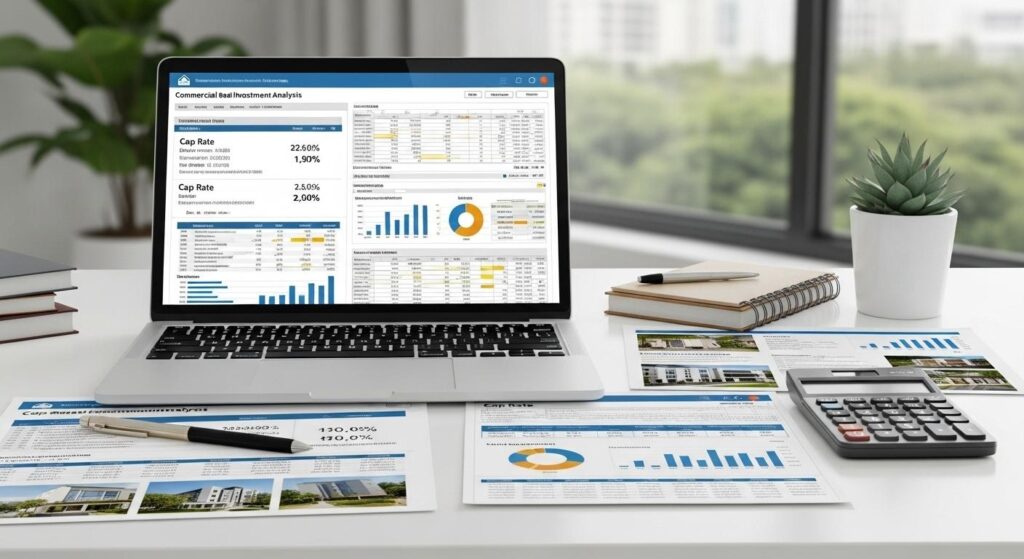
Capitalization rate is typically NOI divided by property value or purchase price. An illustrative property generating $120,000 in annual NOI at a 6% cap rate would indicate a value of $2 million under that simple income approach. Real valuations also depend on income quality, future costs, local conditions, and market evidence.
Vacancy and lease rollover show how much space or income could be at risk. Physical vacancy measures empty space; economic vacancy accounts for lost rental income. Near-term expirations can matter even when current occupancy appears high.
Debt-service coverage ratio (DSCR) compares income available for debt service with required debt payments. Its precise calculation and acceptable level depend on the lender and financing structure.
Read these metrics together. A seemingly attractive cap rate can mask costly deferred maintenance, weak tenant credit, or an unrealistic projected NOI.
Using AssetLyst to Research Commercial Properties
A searchable platform can make early-stage research more efficient by organizing scattered property facts and comparable sales. AssetLyst describes its Data Engine as a tool for address or assessor parcel number searches and countywide comparable-property research. Its product page states that users can search a database of more than 27 million properties and explore more than 200 data points per property; these are the company’s stated coverage figures, not independently audited guarantees.
Professionals exploring commercial real estate data can review AssetLyst’s Data Engine alongside its property marketplace, CRM, and property-management offerings. This may be useful when research, deal tracking, and day-to-day workflows need to connect. Before relying on any platform, confirm coverage in your specific counties, the freshness of recorded transactions, relevant export options, subscription terms, and any gaps in lease data.
The right platform should reduce research friction without discouraging verification from original records.
Common Mistakes That Distort Analysis
One common error is treating asking prices as completed sales. Another is comparing office, retail, and industrial properties without adjusting for their different income drivers. Investors also overlook how tax reassessments, insurance costs, tenant improvements, and major equipment replacements affect actual cash flow.
Avoid using a single cap rate for every building in a city. Be cautious with modeled owner information, incomplete transaction dates, and estimates that cannot be traced to a source. Most importantly, do not confuse large datasets with accurate conclusions. A short, well-verified set of comparable properties can be more useful than hundreds of weak matches.
Frequently Asked Questions
What is included in a commercial real estate database?
Depending on the provider, it can contain parcel and ownership records, property characteristics, sale transactions, active listings, lease information, and market analytics. Coverage and update schedules differ, so confirm the fields relevant to your property type and location.
Where can I find free commercial property data?
Start with county assessor and recorder websites, local zoning portals, Census data, and BLS employment statistics. Some commercial listing sites also provide limited public information. Full sales histories, standardized comps, or advanced analytics may require paid access.
How accurate are commercial real estate comps?
Comps are only as useful as their underlying records and similarity to the subject property. Check sale verification, dates, location, condition, use, occupancy, and unusual deal terms before relying on the resulting valuation range.
Is commercial real estate data updated in real time?
Not necessarily. Listing changes may appear quickly, while recorded sales, public assessments, and government economic statistics follow different reporting schedules. Always check the original transaction or publication date.
What data is most important for commercial property valuation?
Start with verified property size and condition, comparable sales, current leases, NOI, operating expenses, vacancy, and expected capital needs. The relative importance changes with property type, lease structure, and valuation method.
Can demographic data predict a retail property’s success?
Demographics can help assess a trade area, but they do not predict individual store performance. Visibility, access, competition, tenant concept, customer behavior, and operating execution also matter. Use demographic indicators as supporting evidence, not a sales forecast.
How do I choose a commercial real estate data provider?
Test it with properties and transactions you already know. Compare county coverage, source transparency, update frequency, filtering, customer support, and total subscription cost. Make sure its features solve your actual research problem rather than simply offering more fields.
Conclusion
Effective commercial real estate analysis starts with the right question and a disciplined verification process. Property records, sales comps, lease documents, financial statements, and neighborhood indicators each reveal part of the picture. Combining them helps buyers, brokers, owners, and lenders identify opportunities while recognizing the limits of available information.
Whether you rely on public sources or a specialized platform, treat commercial real estate data as evidence to evaluate, not an automatic answer. Better decisions come from relevant comparisons, transparent assumptions, and careful due diligence.

Written by Twastia Editorial Team
Twastia Editorial Team shares practical insights about website design, SEO services, Google Ads, content marketing, social media, conversion rate optimization, and digital marketing strategy.
Last updated: Oct 16, 2026
Related posts from Twastia
Explore more useful articles from twastia.com about digital marketing, SEO, websites, ads, content, and growth strategy.