Fiberroad Technology: Industrial Networking Solutions Explained
Modern industrial systems depend on reliable communication. Factories, transportation networks, utilities, surveillance systems, smart cities, and other critical infrastructure increasingly […]
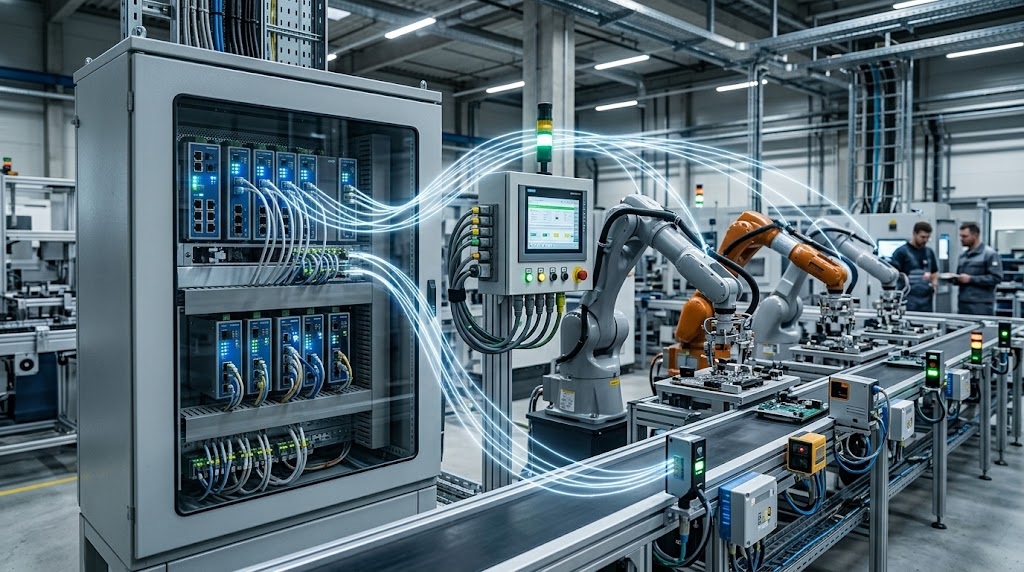
Modern industrial systems depend on reliable communication. Factories, transportation networks, utilities, surveillance systems, smart cities, and other critical infrastructure increasingly connect machines, sensors, cameras, controllers, and edge devices through Ethernet and fiber networks.
That is where Fiberroad Technology comes in. The company develops industrial networking and connectivity products designed for demanding environments, including industrial Ethernet switches, fiber media converters, Power over Ethernet (PoE) equipment, optical transport systems, and network management solutions. Its current website also highlights Time-Sensitive Networking (TSN), smart-city infrastructure, industrial automation, transportation, and energy applications.
For organizations building or upgrading an industrial network, understanding the different technologies offered by Fiberroad Technology can make it easier to identify the equipment that fits a particular application.
What Is Fiberroad Technology?
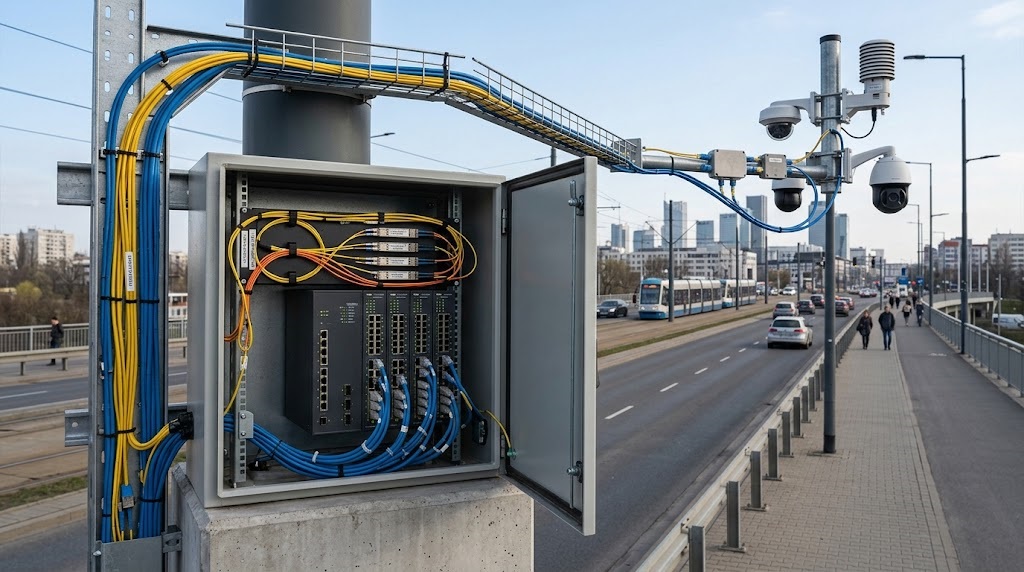
Fiberroad Technology is a networking equipment manufacturer focused on industrial Ethernet and fiber-optic connectivity. According to the company’s current website, its products are intended for utilities, transportation, industrial automation, security and surveillance, smart-city infrastructure, and other mission-critical networks.
The company’s product portfolio covers several layers of industrial connectivity rather than concentrating on one type of hardware.
Its 2026 product catalog includes:
- Fiber and Ethernet media converters
- Managed and unmanaged Ethernet switches
- Industrial automation Ethernet switches
- Time-Sensitive Networking products
- PoE and PoE++ solutions
- Optical transport systems
- SFP modules
- Network management software
- FIRO Cloud Management
- WebGUI and network management systems
This broad portfolio allows network designers to combine copper Ethernet, fiber connectivity, PoE, redundancy, routing, and network management within larger industrial architectures.
Why Industrial Networking Is Different
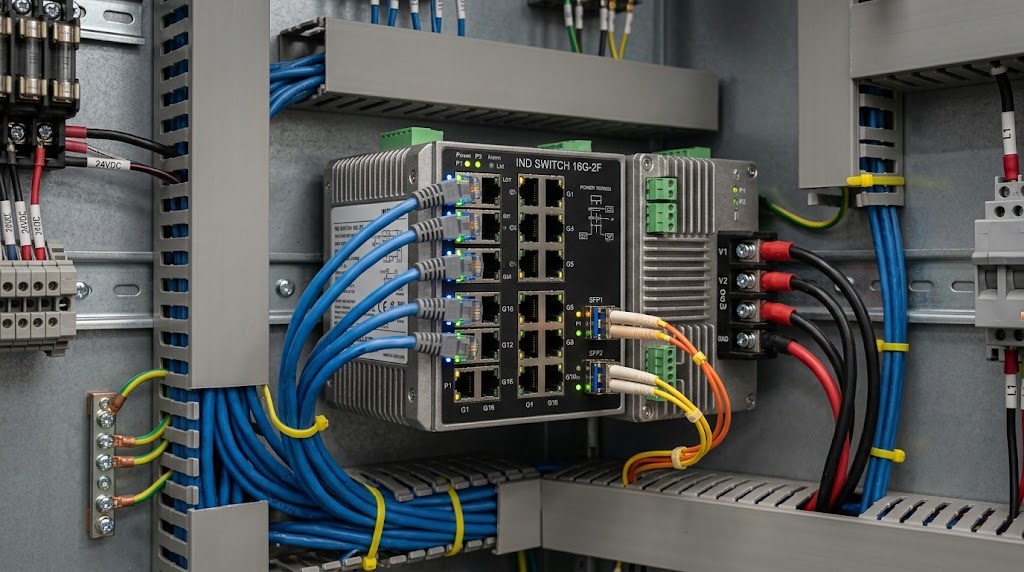
A conventional office network and an industrial network can have very different operating requirements.
Office equipment generally operates in controlled indoor conditions. Industrial networking equipment may instead be installed in factories, roadside cabinets, transportation infrastructure, utility facilities, outdoor locations, or other environments where temperature, electromagnetic interference, vibration, power availability, and network downtime can become significant concerns.
Fiberroad’s industrial switch portfolio includes models with wide operating-temperature ranges, redundant power inputs, DIN-rail mounting, fiber uplinks, and other industrial-oriented characteristics. Several current models are specified for operation from -40°C to 75°C.
This type of hardware is designed around the idea that the network itself is part of the operational infrastructure.
Reliability Matters
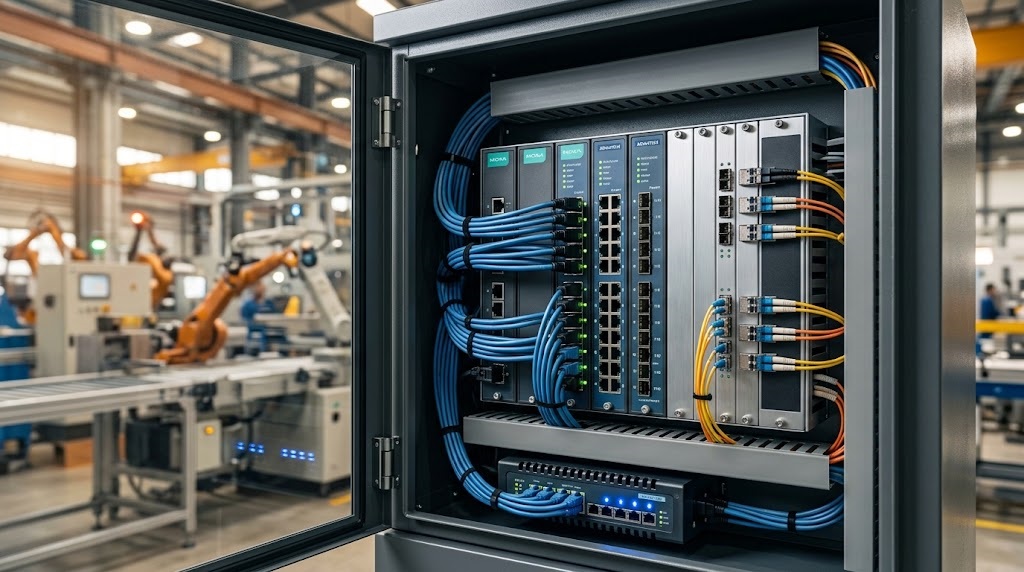
If a network connection fails in an office, employees may lose access to applications temporarily. In an industrial environment, network failure can potentially affect monitoring, automation, surveillance, transportation systems, or other operational processes.
That is why industrial Ethernet equipment commonly incorporates redundancy and recovery mechanisms alongside basic switching.
Fiberroad Industrial Ethernet Switches
Industrial Ethernet switches form one of Fiberroad Technology’s major product categories.
The current industrial network switch portfolio includes managed, lite-managed, and unmanaged models, with configurations ranging from compact switches to high-port-count rack-mounted equipment. The catalog includes copper Ethernet ports, SFP fiber ports, PoE options, redundant power configurations, and operating-temperature options suited to different environments.
Managed switches are particularly useful when a network needs greater visibility and control.
Managed Ethernet Switches
A managed industrial switch can provide features such as VLAN configuration, Quality of Service, network monitoring, redundancy protocols, and access controls.
Fiberroad’s WebGUI management platform supports functions including STP, RSTP, MSTP, ERPSv2, OSPF, VLAN, IGMP, QoS, RMON, port mirroring, bandwidth management, SNTP, and firmware upgrades on supported managed switch series.
These features allow network administrators to control traffic, separate network segments, monitor equipment, and design more resilient network architectures.
Unmanaged Ethernet Switches
Unmanaged switches are generally simpler to deploy because they do not require extensive configuration.
Fiberroad lists unmanaged industrial switches for applications where straightforward Ethernet connectivity is the priority. Its industrial automation range includes unmanaged PROFINET switches with redundant DC power inputs and operating-temperature ratings extending to -40°C to 75°C.
For a simple production line or machine network, this approach can reduce configuration complexity.
Fiber Media Converters
Fiber media converters solve an important networking problem: connecting copper Ethernet equipment with fiber-optic infrastructure.
Fiberroad describes its media converters as devices that convert copper Ethernet connections into fiber-optic connections for long-distance communication and industrial environments. Its current range includes managed and unmanaged products, with 100M, Gigabit, and 10G options depending on the model.
Fiber can be particularly valuable when a network needs longer transmission distances or greater resistance to electromagnetic interference.
Why Convert Ethernet to Fiber?
Fiber connectivity can provide several advantages in industrial environments.
It can help connect geographically separated facilities, extend communication beyond typical copper Ethernet distances, and reduce concerns associated with electrical interference.
Fiber media converters also make it possible to integrate existing copper-based equipment into a larger fiber backbone without replacing every network device.
Power over Ethernet Solutions
Power over Ethernet allows compatible devices to receive electrical power and network connectivity through Ethernet cabling.
Fiberroad’s PoE portfolio includes PoE media converters, managed and unmanaged PoE switches, PoE++ equipment, injectors, relays, splitters, and other peripherals. The company’s current PoE portfolio includes configurations supporting IEEE 802.3af/at and higher-power IEEE 802.3bt implementations.
PoE can simplify installations involving devices such as IP cameras, wireless access points, VoIP equipment, sensors, and other powered network endpoints.
Industrial PoE
Industrial PoE becomes especially useful when cameras or other powered devices must be deployed in locations where installing separate electrical infrastructure would add complexity.
Fiberroad’s industrial PoE products include DIN-rail models with redundant DC power inputs and wide-temperature operating specifications. Some current models support PoE++ and are designed for operation from -40°C to 75°C.
Time-Sensitive Networking
One of the more advanced areas in Fiberroad Technology’s portfolio is Time-Sensitive Networking, commonly called TSN.
TSN is a collection of IEEE standards designed to make Ethernet communication more deterministic. Instead of relying entirely on conventional best-effort Ethernet behavior, TSN can provide mechanisms for precise synchronization, scheduled traffic, and predictable communication.
Fiberroad’s TSN solution combines TSN technologies with IEEE 1588 Precision Time Protocol to support real-time industrial communication. The company’s solution page identifies standards including IEEE 802.1AS, IEEE 802.1Qbv, IEEE 802.1Qbu, IEEE 802.1Qcc, and IEEE 802.1Qav.
Why TSN Matters for Automation
Industrial automation can involve machines and controllers that need to exchange information within predictable timing windows.
Fiberroad’s TSN switches are designed for applications requiring low latency, low jitter, time synchronization, and scheduled traffic. The company specifically identifies industrial automation, IIoT, automotive, and other time-sensitive applications as use cases.
Its current FR-TSN4208, for example, is an L3 managed TSN Ethernet switch supporting IEEE 1588 synchronization, redundancy protocols, QoS, and multiple TSN-related standards.
Fiberroad for Industrial Automation
Industrial automation increasingly depends on communication between PLCs, machines, sensors, controllers, cameras, and IIoT devices.
Fiberroad’s smart-manufacturing solution focuses on connecting machines, PLCs, sensors, and IIoT equipment through rugged industrial Ethernet infrastructure. The company identifies legacy-system integration, reliable communication, electrical interference, stable data transmission, and scalable deployment as key challenges in smart manufacturing.
Connecting Machines and IIoT Devices
The network can serve as the communication layer connecting physical industrial equipment to monitoring and control systems.
A suitable network architecture may combine copper Ethernet at the machine level with fiber uplinks between network cabinets or production areas. Managed switches can then provide VLANs, QoS, monitoring, redundancy, and other network controls.
The exact architecture depends on the automation equipment, topology, bandwidth, environmental conditions, and required availability.
Smart City Networking
Smart-city infrastructure contains many distributed devices.
Traffic cameras, environmental sensors, smart lighting, utility systems, wireless equipment, parking systems, and other connected infrastructure all require communication networks.
Fiberroad’s smart-city solution describes industrial networking for sensors, edge devices, control systems, and centralized management platforms. It also highlights applications including intelligent transportation, utility tunnels, energy management, and environmental monitoring.
Network Redundancy for Smart Infrastructure
A smart-city network may cover large geographic areas, so network failure in one section should not necessarily bring down the entire system.
Fiberroad’s smart-city solution references ERPS, RSTP, and MSTP for network recovery and redundancy, along with fiber connectivity for long-distance communication.
This type of architecture can help infrastructure operators build networks that are easier to monitor and recover.
Transportation and Traffic Networks
Transportation infrastructure is another important application for industrial networking.
Fiberroad’s traffic-control solution is designed around communication between traffic controllers, cameras, sensors, V2X roadside equipment, RFID readers, and other roadside devices. The company emphasizes reliable connectivity, PoE deployment, real-time communication, and fast network recovery.
Its broader transportation material also explores TSN, 5G, Wi-Fi, V2X, LiDAR, cameras, and edge computing for intelligent roadways.
This demonstrates how industrial Ethernet is increasingly becoming part of transportation infrastructure rather than being limited to factories.
Energy and Renewable Infrastructure
Energy systems can involve equipment distributed across substations, solar installations, wind facilities, hydropower sites, and other remote locations.
Fiberroad’s renewable-energy networking solution focuses on communication between energy equipment, monitoring systems, control systems, and energy-management platforms. It highlights rugged operation, network redundancy, secure management, and scalable connectivity as requirements for renewable-energy infrastructure.
For these applications, network equipment may need to operate reliably in locations where maintenance access is more difficult than in a conventional office environment.
Network Management
Hardware is only one part of a modern industrial network. Administrators also need tools for configuration, monitoring, troubleshooting, and maintenance.
Fiberroad offers several management approaches, including FIRO Cloud Management, Network Management System tools, and WebGUI management.
The company’s WebGUI platform provides browser-based access to supported managed networking hardware. Features include network discovery, system information, remote monitoring, bandwidth management, loopback and PRBS testing for supported media converters, and network-switch management functions.
Why Centralized Management Helps
As the number of switches and connected devices grows, manually configuring each device becomes increasingly difficult.
Centralized management can provide a single operational view of the network, making it easier to identify devices, monitor status, apply configuration changes, and troubleshoot connectivity problems.
The appropriate management platform depends on the size and architecture of the deployment.
Security Features
Industrial networks also need to consider cybersecurity.
Fiberroad’s current industrial networking portfolio includes management and security-related functions such as ACL, VLAN, HTTPS, SSH, SNMP, and 802.1X on supported products and solutions. Its smart-city solution specifically references ACL and 802.1X alongside secure management capabilities.
Its current FR-TSN4412 is also described as incorporating advanced ACL cybersecurity at the industrial edge.
Security requirements should nevertheless be evaluated as part of the complete network architecture rather than assuming that a particular switch alone provides complete cybersecurity.
How to Choose a Fiberroad Product
The large number of industrial networking options can make product selection complicated. A structured approach helps.
Start With the Application
First identify whether the equipment will be used for factory automation, surveillance, transportation, utilities, smart-city infrastructure, or another application.
The environment and communication requirements will influence the product category.
Determine Port Requirements
Count the devices that need Ethernet connections and allow room for future expansion.
A small installation may need only a few copper ports and one or two fiber uplinks, while a larger infrastructure project may require 16, 24, 48, or more ports.
Decide Between Managed and Unmanaged
Choose unmanaged hardware when simple connectivity is sufficient.
Choose managed hardware when the network requires VLANs, QoS, monitoring, redundancy, routing, access controls, or centralized administration.
Consider Fiber Requirements
Determine whether you need multimode or single-mode fiber, the required transmission distance, fiber-port speed, and SFP compatibility before selecting a media converter or switch.
Check Environmental Specifications
Verify operating temperature, mounting style, power-input requirements, enclosure characteristics, and other environmental specifications against the actual installation site.
Consider Redundancy
For critical systems, look at the available redundancy architecture. Fiberroad’s current industrial portfolio includes technologies such as ERPS, RSTP, MSTP, and redundant power options on supported products.
Quality and Product Support
Fiberroad states that it is ISO 9001 certified and that its products have passed CE, FCC, and RoHS certifications. The company’s FAQ also states that products are tested before shipment and reports an RMA rate of less than 1%.
Its FAQ further states that warranty periods range from one to five years depending on the product, with lifetime technical support, and identifies a five-year warranty for certain industrial Ethernet products. Customers should confirm the warranty applicable to the exact product they are purchasing.
Frequently Asked Questions
What does Fiberroad Technology manufacture?
Fiberroad Technology offers industrial networking equipment including Ethernet switches, fiber media converters, PoE solutions, optical transport systems, SFP modules, and network management software.
What industries does Fiberroad serve?
Its current solution portfolio covers industrial automation, smart cities, intelligent transportation, security and surveillance, energy and utilities, and renewable-energy infrastructure.
What is an industrial Ethernet switch?
An industrial Ethernet switch connects network devices in environments where additional requirements such as wide temperature ranges, redundant power, rugged mounting, fiber connectivity, or network redundancy may be important.
Does Fiberroad offer PoE switches?
Yes. Fiberroad offers managed and unmanaged PoE switches, PoE media converters, PoE++ products, injectors, splitters, and other PoE peripherals.
What is a fiber media converter?
A fiber media converter converts between copper Ethernet and fiber-optic communication, allowing copper-based devices to communicate through a fiber network. Fiberroad offers managed and unmanaged versions across several speed categories.
What is TSN used for?
Time-Sensitive Networking is designed for deterministic, time-synchronized Ethernet communication. Fiberroad identifies industrial automation, IIoT, automotive, and other time-critical applications for its TSN solutions.
Does Fiberroad offer network management software?
Yes. Its portfolio includes FIRO Cloud Management, Network Management System tools, and WebGUI management for supported networking hardware.
Are Fiberroad switches suitable for outdoor industrial environments?
Many products are designed for demanding industrial environments, and numerous current models specify wide operating-temperature ranges such as -40°C to 75°C. However, suitability should always be confirmed against the exact environmental requirements of the installation.
Does Fiberroad offer redundant networking?
Yes. Supported products and solutions include technologies such as ERPSv2, RSTP, MSTP, redundant power inputs, and other protection mechanisms depending on the model.
Conclusion
Fiberroad Technology has developed a broad industrial networking portfolio covering the connectivity requirements of modern factories, transportation systems, smart cities, utilities, surveillance infrastructure, and other demanding environments.
Its product range extends from straightforward unmanaged Ethernet switches and compact fiber media converters to managed Layer 2+/Layer 3 switches, industrial PoE equipment, optical transport systems, and advanced TSN platforms.
The right solution depends on the application. A small industrial installation may require a simple unmanaged switch, while a large transportation or automation network may require managed switching, fiber uplinks, PoE, redundancy, cybersecurity features, and centralized management.
For organizations evaluating industrial networking equipment, the most important step is therefore not simply choosing a brand or the highest-specification switch. It is matching the network architecture to the application’s bandwidth, environmental, reliability, security, and management requirements.
With that approach, Fiberroad’s range of industrial Ethernet, fiber, PoE, TSN, and network-management technologies can provide building blocks for scalable and resilient industrial connectivity.

Written by Twastia Editorial Team
Twastia Editorial Team shares practical insights about website design, SEO services, Google Ads, content marketing, social media, conversion rate optimization, and digital marketing strategy.
Last updated: Oct 16, 2026
Related posts from Twastia
Explore more useful articles from twastia.com about digital marketing, SEO, websites, ads, content, and growth strategy.