front-end web developer: The Best Guide to Skills and Career Growth
In the digital age, a company’s website is its ultimate storefront, brand ambassador, and primary customer touchpoint. Whether an enterprise […]
In the digital age, a company’s website is its ultimate storefront, brand ambassador, and primary customer touchpoint. Whether an enterprise is a massive Fortune 500 corporation, a thriving e-commerce retailer, or a scrappy tech startup, its online presence must be visually stunning, lightning-fast, and intuitively accessible across every conceivable device.
Behind every pixel, animation, interactive button, and seamless page transition stands a skilled professional dedicated to translating complex code into captivating user experiences. Choosing to pursue a career as a front-end web developer or hiring one for your growing digital business is one of the most impactful decisions you can make in the modern technology landscape.
The role of a front-end web developer has evolved dramatically over the past decade. Gone are the days when building a website simply meant writing static HTML files and basic CSS styling. Today’s client-side engineering requires a deep mastery of advanced JavaScript frameworks,
state management libraries, performance optimization techniques, and rigorous accessibility standards. As web applications increasingly rival native desktop and mobile software in complexity, the demand for talented engineers who can bridge the gap between creative UI/UX design and heavy backend logic has skyrocketed across the United States technology sector.
In this comprehensive guide, we will explore the core responsibilities of a modern front-end web developer, examine the essential technology stack required to succeed in the industry, outline the educational and professional pathways to breaking into the field, and answer the most frequently asked questions about building a rewarding career in web engineering.
Understanding the Core Role of a front-end web developer

Before diving into specific technical stacks and coding languages, it is important to clearly define what separates client-side engineering from backend development.
The Bridge Between Design and Backend Logic

While backend developers build databases, server-side business logic, and API endpoints, a front-end web developer focuses entirely on what the user sees, touches, and interacts with in their web browser. When a user visits a website, every color gradient, typography choice, responsive layout grid, dropdown menu, and form validation error message is meticulously crafted by a client-side engineer. You serve as the vital bridge between the graphic designer’s creative vision and the raw data managed by the server. Your primary goal is to ensure that the user interface (UI) is not only visually breathtaking but also functionally flawless, performant, and accessible to individuals with disabilities.
Key Daily Responsibilities in the Workplace

The day-to-day routine of a professional front-end web developer involves a dynamic mix of creative problem-solving and rigorous coding. Common daily tasks include:
- Translating Figma, Sketch, or Adobe XD design wireframes into clean, semantic HTML and CSS.
- Building dynamic, interactive user interfaces using modern JavaScript frameworks like React, Vue, or Angular.
- Ensuring cross-browser compatibility so that web applications render identically across Google Chrome, Apple Safari, Mozilla Firefox, and Microsoft Edge.
- Optimizing website assets, images, and scripts to guarantee lightning-fast loading speeds on both high-end desktop computers and budget mobile smartphones.
- Collaborating closely with backend developers to consume RESTful APIs and GraphQL data streams smoothly.
The Essential Technology Stack for Modern Engineers
To excel in the competitive USA job market, a practicing front-end web developer must master a specific trio of foundational programming languages, supplemented by advanced tooling and frameworks.
The Holy Trinity: HTML, CSS, and JavaScript
Every professional website on the internet is built upon three foundational pillars:
- HyperText Markup Language (HTML): HTML provides the fundamental structural skeleton of a web page, defining headings, paragraphs, images, links, and form fields using semantic elements.
- Cascading Style Sheets (CSS): CSS controls the visual presentation, styling, layout, and responsive design of the HTML elements, allowing developers to create stunning color schemes, flexible grid layouts (Flexbox and CSS Grid), and smooth transition animations.
- JavaScript: JavaScript is the powerhouse programming language that brings web pages to life. A front-end web developer uses JavaScript to handle user events, manipulate the Document Object Model (DOM) dynamically, validate form inputs, and communicate asynchronously with server databases without requiring full page reloads.
Modern Frameworks and Component-Based Architecture
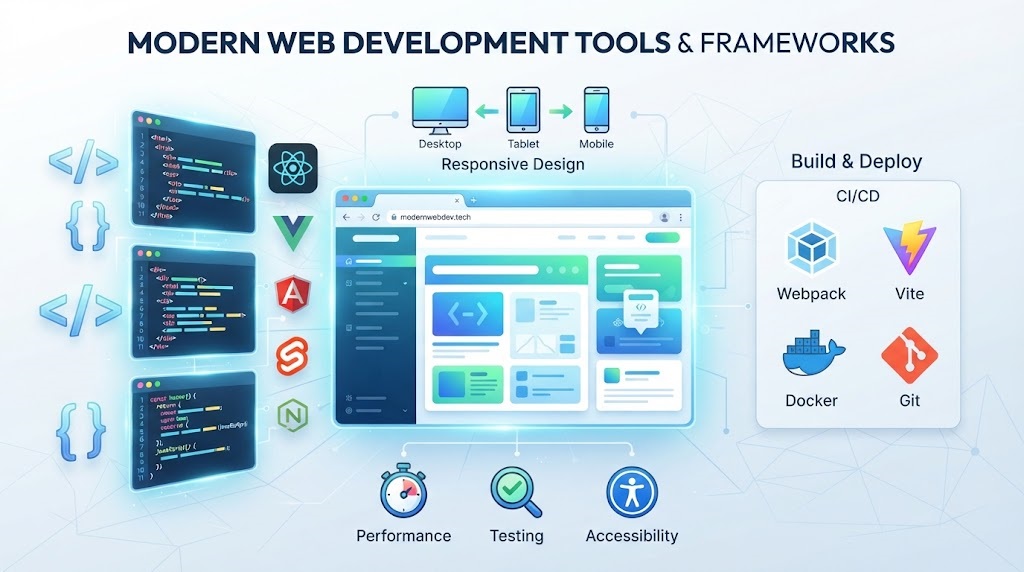
While vanilla HTML, CSS, and JavaScript are sufficient for simple static sites, modern web applications are far too complex for basic scripting. Today’s industry standards rely heavily on component-based frameworks. Learning React (developed by Meta), Vue.js, or Angular is an absolute career requirement for any ambitious front-end web developer. These frameworks allow engineers to break complex user interfaces down into reusable, isolated components—such as navigation bars, user profile cards, and interactive data tables—drastically speeding up development velocity and code maintainability.
Essential Best Practices: Performance and Accessibility
Writing code that simply “works” is no longer enough. Professional client-side engineers must prioritize performance optimization and inclusive design.
Web Performance and Core Web Vitals
In an era where consumer attention spans are measured in seconds, website speed directly impacts business revenue. If a web page takes more than three seconds to load, users will abandon it in frustration, driving up bounce rates and destroying e-commerce conversion metrics. A skilled front-end web developer constantly analyzes performance metrics known as Google Core Web Vitals. They implement code splitting, lazy loading of images, tree-shaking unused JavaScript packages, and content delivery network (CDN) caching to ensure optimal rendering speeds.
Web Accessibility (a11y) Standards
The internet is a public utility, and web applications must be usable by everyone, including individuals with visual, auditory, or motor impairments. Adhering to WCAG (Web Content Accessibility Guidelines) is both an ethical imperative and, in many cases, a legal requirement for US corporate websites. A professional front-end web developer utilizes semantic HTML landmarks, proper ARIA (Accessible Rich Internet Applications) attributes, high-contrast color palettes, and full keyboard navigation support so that screen readers and assistive technologies can interpret web applications accurately.
Career Paths, Salaries, and Professional Growth
The economic outlook for technology professionals in the United States remains exceptionally strong, offering diverse employment models and lucrative compensation packages.
Employment Models: Full-Time, Remote, and Freelance
One of the greatest perks of working as a front-end web developer is the incredible career flexibility. While countless tech companies in major hubs like San Francisco, New York, and Austin offer high-paying full-time staff positions, the industry has widely embraced remote work. Many talented engineers choose to work as freelance consultants or independent contractors, building custom websites for small businesses, local agencies, and international enterprises on their own schedules.
Earning Potential and Career Progression
Compensation in the tech sector scales rapidly with demonstrated skill and experience. Junior engineers typically start their careers earning competitive entry-level salaries, while mid-level professionals command substantial mid-six-figure incomes. Senior engineers, technical leads, and principal architects who guide entire engineering teams and design complex cloud-scale architectures enjoy exceptionally lucrative compensation packages, often supplemented by stock options and performance bonuses. Continuous learning—such as mastering TypeScript, Next.js, and automated testing tools—accelerates career progression significantly.
Frequently Asked Questions
What is the difference between front-end and back-end development?
Front-end development focuses entirely on the client-side user interface—everything the user sees and interacts with in their browser. Back-end development focuses on server-side logic, database management, security authentication, and API architecture that powers the application behind the scenes.
Do I need a computer science degree to become a front-end web developer?
No. While a formal computer science degree provides valuable theoretical foundations, the tech industry places immense value on practical portfolios and demonstrated coding skills. Countless successful engineers are self-taught or graduates of intensive coding bootcamps.
Which JavaScript framework should I learn first?
React is currently the most widely adopted and in-demand JavaScript framework in the United States job market, boasting a massive community, extensive documentation, and countless enterprise-level job opportunities, making it an ideal starting point.
How important is responsive design in modern web development?
Crucial. With mobile devices accounting for over half of all global web traffic, every website built by a front-end web developer must be fully responsive, scaling fluidly and maintaining usability across smartphones, tablets, laptops, and massive desktop monitors.
What is version control and why is it essential?
Version control systems, specifically Git and platforms like GitHub or GitLab, allow developers to track code changes, collaborate seamlessly with team members, revert to previous stable versions if bugs occur, and manage multiple feature branches without breaking production code.
How can a beginner build a strong portfolio to land their first job?
Aspiring developers should build 4 to 5 unique, fully responsive web applications from scratch, deploy them live on the internet using platforms like Vercel or Netlify, and publish clean, documented source code repositories on GitHub to showcase their technical capabilities to prospective employers.
Is front-end web development a stable and growing career?
Yes. As global commerce, entertainment, and communication continue to migrate entirely to digital platforms, the demand for skilled professionals who can build and optimize user-facing web applications remains exceptionally high.
Conclusion
Stepping into the world of web engineering opens the door to an exciting, dynamic, and financially rewarding career path that blends creative artistic design with logical problem-solving. Whether you are building intuitive user interfaces for cutting-edge software-as-a-service (SaaS) platforms or crafting high-converting e-commerce stores, the impact of a talented front-end web developer is felt across every corner of the modern digital economy.
By mastering foundational HTML, CSS, and JavaScript, embracing modern component-based frameworks like React, and committing to lifelong learning in performance and accessibility, you position yourself as an invaluable asset in the tech industry. Take the time to build your portfolio, practice clean coding habits, and start shaping the future of the internet today.

Written by Twastia Editorial Team
Twastia Editorial Team shares practical insights about website design, SEO services, Google Ads, content marketing, social media, conversion rate optimization, and digital marketing strategy.
Last updated: Oct 23, 2026
Related posts from Twastia
Explore more useful articles from twastia.com about digital marketing, SEO, websites, ads, content, and growth strategy.