Get an idea of your home’s value: The Best Guide to Real Estate Pricing
For the vast majority of families and individuals across the United States, purchasing residential real estate represents the single largest […]
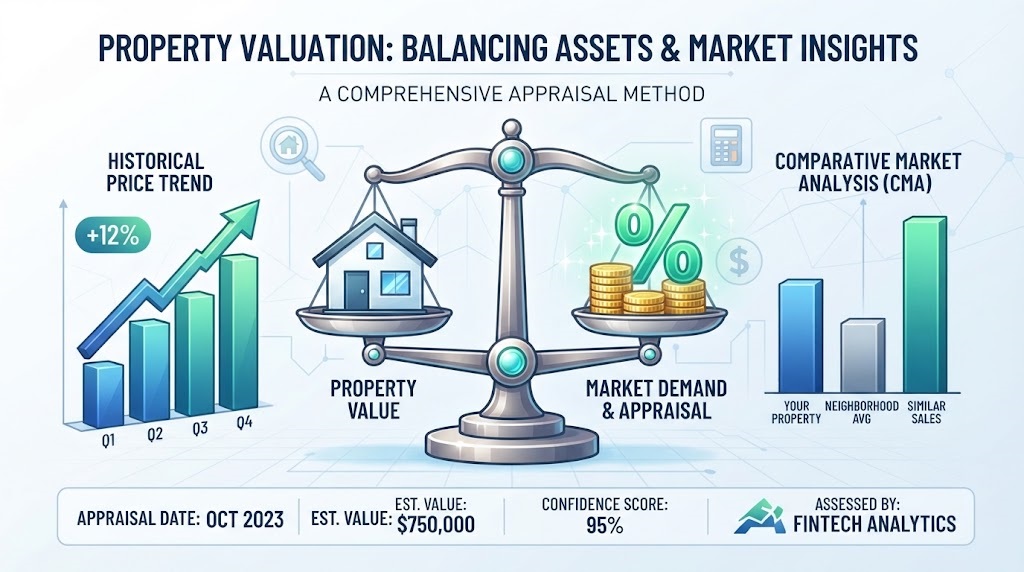
For the vast majority of families and individuals across the United States, purchasing residential real estate represents the single largest and most consequential financial investment of their entire lives. A house is much more than simply a roof over your head; it is a foundational pillar of generational wealth, long-term economic stability, and profound personal accomplishment.
Because the American housing market is incredibly dynamic—constantly influenced by fluctuating federal interest rates, shifting demographic trends, and local economic developments—it is absolutely essential to stay informed about your property’s current worth. To properly manage this massive financial asset, you must proactively
Get an idea of your home’s value at regular intervals, rather than waiting until the exact moment you decide to put a “For Sale” sign in the front yard. By understanding your equity position today, you empower yourself to make intelligent, data-driven decisions about your financial future tomorrow.
The process of determining accurate real estate pricing can often feel overwhelming, especially for first-time homeowners who are unfamiliar with the intricacies of comparative market analysis, neighborhood absorption rates, and algorithmic valuation models. Many property owners incorrectly assume that the price they originally paid, plus the exact cost of any renovations they have completed over the years, automatically equals the current market price.
Unfortunately, real estate economics do not operate on a simple addition formula. A property is ultimately worth whatever a qualified, willing buyer is prepared to pay for it in the current open market, influenced heavily by regional supply and demand. To successfully Get an idea of your home’s value without falling victim to unrealistic expectations or emotional biases, you must approach the evaluation process objectively, utilizing a combination of digital resources, professional expertise, and hard neighborhood data.
In this comprehensive, in-depth guide, we will explore the multifaceted world of residential real estate valuation in the United States. We will examine the most effective strategies for calculating your current financial equity, break down how algorithmic online estimates function (and where they frequently fall short), and discuss the critical differences
between a real estate agent’s comparative market analysis and a certified professional appraisal. Furthermore, we will highlight the specific physical and geographical factors that exert the greatest influence on your property’s marketability, and answer the most frequently asked questions about residential pricing strategies. By the end of this extensive guide, you will possess a complete roadmap for navigating the complexities of the modern housing market with absolute confidence.
The Financial Importance of Monitoring Your Property’s Equity

Homeownership in the USA is a journey that involves constant financial evolution. While many people only think about property prices when they are actively preparing to move across the country or upgrade to a larger house, maintaining a clear, updated picture of your asset’s worth is a fundamental component of holistic wealth management.
Whenever you take the time to Get an idea of your home’s value, you are effectively checking the balance of your largest, most lucrative savings account. This vital knowledge opens doors to numerous financial opportunities that can significantly improve your overall quality of life and long-term financial security.
Leveraging Equity for Major Life Expenses

Equity is formally defined as the difference between what your property is currently worth on the open market and the outstanding financial balance remaining on your mortgage. As you make steady monthly mortgage payments over the years, and as local market appreciation naturally drives property prices upward, your equity consistently grows. By taking the time to carefully
Get an idea of your home’s value, you can determine if you have accumulated enough established equity to confidently apply for a Home Equity Line of Credit (HELOC) or a traditional home equity loan. These powerful financial instruments offer much lower interest rates than high-yield credit cards, allowing you to seamlessly fund major life expenses—such as college tuition for your children, emergency medical bills, or transformative home renovation projects—without destabilizing your daily cash flow.
Refinancing and Eliminating Mortgage Insurance

Another critical reason to continuously monitor your asset’s worth involves optimizing your current mortgage terms. If you initially purchased your property with less than a twenty percent down payment, your lending institution likely required you to pay Private Mortgage Insurance (PMI) every single month, adding a substantial, non-tax-deductible expense to your overall housing budget.
However, once your loan-to-value ratio naturally drops below eighty percent due to market appreciation and principal paydown, you can petition your mortgage servicer to remove this costly insurance requirement. Therefore, utilizing digital or professional tools to Get an idea of your home’s value is the very first proactive step in determining whether you are eligible to cancel PMI, potentially saving you thousands of dollars annually that can be redirected toward retirement or other investments.
Online Valuation Tools and Algorithmic Estimates
We live in a golden age of digital information, and the real estate sector has been thoroughly revolutionized by big data and predictive analytics. Decades ago, discovering property prices required physically visiting a local county assessor’s office, digging through paper archives, or consulting a printed property registry. Today, powerful automated platforms have democratized this information for the general public, making it instantly accessible from a smartphone.
How Real Estate Algorithms Function
Major real estate platforms like Zillow (with its famous proprietary Zestimate), Redfin, and Realtor.com utilize incredibly complex, proprietary algorithms to calculate instant property estimates. These Automated Valuation Models (AVMs) constantly scrape vast amounts of public data, including recent neighborhood sales, county tax assessments, historical price trends, and basic structural
characteristics like total square footage and overall lot size. For modern homeowners seeking instant financial gratification, using these platforms is an incredibly convenient way to Get an idea of your home’s value in a matter of seconds. The sophisticated algorithms continuously update their mathematical calculations as new closing data enters the regional Multiple Listing Service (MLS), providing a dynamic, constantly shifting financial baseline for the general public.
The Limitations and Blind Spots of Digital Estimates
Despite their incredible convenience, user-friendly interfaces, and widespread popularity, AVMs possess significant, inherent limitations that every responsible homeowner must understand. An algorithmic computer program can only analyze public, digitized county data; it cannot physically walk through your front door to inspect the premises.
Therefore, it has absolutely no way of knowing that you just spent eighty thousand dollars completely remodeling your master bathroom, installing a new architectural shingle roof, or upgrading to high-end stainless steel kitchen appliances. Conversely, it also cannot detect severe foundational cracks, water damage, or outdated electrical systems hidden behind the drywall. Consequently, when relying solely on an internet algorithm to Get an idea of your home’s value, you must treat the resulting number as a broad, generalized starting point rather than a definitive, highly accurate appraisal.
The Role of Comparative Market Analysis (CMA)
When you are ready to transition from a generalized, computer-generated algorithmic estimate to a highly accurate, tailored pricing strategy, it is time to consult a human real estate expert. Real estate professionals utilize a detailed, manual process known as a Comparative Market Analysis (CMA) to pinpoint exactly where your unique property fits within the current local landscape.
Partnering with Local Real Estate Experts
A licensed, experienced local real estate agent brings invaluable, hyper-local context to the evaluation process that no national internet algorithm could ever hope to replicate. An elite agent intimately understands the nuanced, micro-economic factors that drive buyer behavior in your specific subdivision, school district, or zip code. Engaging a professional to
Get an idea of your home’s value usually involves inviting them to physically tour your property in person. During this comprehensive walkthrough, they meticulously evaluate the unique historical charm, interior layout flow, natural lighting, and overall physical condition of your residence, heavily factoring these subjective, human elements into their final, customized pricing recommendation.
Analyzing Neighborhood Sales Data Effectively
The core foundation of any successful CMA involves carefully analyzing “comps”—recently sold properties in your immediate neighborhood that closely resemble your residence in terms of size, age, and architectural style. A skilled real estate agent will deliberately select three to five highly relevant comps that have successfully closed within the last three to six months to ensure the data is fresh.
They will then make meticulous financial adjustments based on specific property differences. For example, if a comparable home sold for a high price but completely lacked your custom outdoor kitchen and swimming pool, the agent will adjust your estimated listing price upward accordingly. This rigorous, highly data-driven approach guarantees you Get an idea of your home’s value that reflects current market reality rather than speculative wishful thinking.
The Importance of Professional Home Appraisals
While a Comparative Market Analysis provided by a real estate agent is an excellent, highly effective tool for establishing a competitive listing price, it is not an official, legally binding financial document. When a prospective buyer requires a mortgage loan to purchase your property, the lending institution will strictly mandate a formal evaluation conducted by an independent, state-licensed professional to ensure the asset serves as adequate collateral.
When to Hire a Licensed Appraiser Yourself
In most traditional residential real estate transactions, the buyer’s lending institution orders and financially covers the cost of the appraisal. However, there are numerous legal and financial scenarios where a homeowner should proactively hire an appraiser independently. If you are navigating a complex divorce settlement,
finalizing detailed estate planning documents, or attempting to appeal an unfairly high county property tax assessment, an official appraisal is strictly required by law. Hiring an independent, state-licensed appraiser to Get an idea of your home’s value provides an unbiased, meticulously documented legal report detailing exact square footage measurements, structural integrity, and neighborhood zoning compliance, offering the absolute highest level of valuation accuracy available in the industry.
Key Factors That Influence Real Estate Pricing
Regardless of the specific method or tool you choose to evaluate your residential property, certain universal factors will always exert a massive, undeniable influence on the final numerical outcome. Understanding these specific variables helps you identify which elements you can actively improve through renovations and which elements are entirely out of your control.
Location, Condition, and Square Footage
The oldest, most repeated cliché in the real estate industry—location, location, location—remains absolutely, unequivocally true today. A modest, aging ranch house situated in a highly desirable, top-rated suburban school district will almost always command a premium price over a massive luxury mansion located directly next to a noisy industrial park or a busy commercial highway. Beyond regional geography, the usable, livable square footage of the residence and its overall structural condition play paramount roles in pricing.
Modern buyers willingly pay a premium for turnkey, move-in-ready properties that do not require immediate, costly repairs or massive renovations. Therefore, when attempting to Get an idea of your home’s value, you must objectively evaluate how your property’s current condition compares directly to the highest standard currently available in your local competitive marketplace.
Frequently Asked Questions
Why should you monitor your property’s worth during a stable real estate market?
Monitoring your asset during a stable or flat market is still incredibly crucial for effective long-term financial planning. It allows you to track your equity growth steadily, ensuring you are adequately prepared for future life events like retirement downsizing, securing a HELOC for major renovations, or adjusting your homeowner’s insurance coverage to accurately reflect current replacement costs.
Are digital online real estate estimates completely inaccurate?
No, they are not completely inaccurate, but they are often imprecise. AVMs are excellent tools for tracking general neighborhood trends and providing a broad ballpark figure. However, because algorithms cannot physically see the interior condition of your property or account for recent custom upgrades, their estimates can sometimes be off by five to twenty percent.
Does a messy house negatively affect a professional appraisal?
While a state-licensed appraiser is specifically trained to look past everyday household clutter and focus strictly on permanent structural elements, square footage, and fixed fixtures, excessive messiness that obscures physical access to vital systems (like the HVAC unit or the main electrical panel) can seriously hinder the inspection process. It is always best to present a clean, highly accessible space.
How much does a professional residential appraisal cost in the USA?
In the United States, the out-of-pocket cost of a standard residential property appraisal typically ranges from $350 to $600, depending heavily on the physical size of the property, the complexity of the local real estate market, and the region’s overall cost of living. Large luxury estates or remote rural properties may cost significantly more to evaluate.
Will adding a swimming pool definitively increase my property’s worth?
The overall financial return on investment for a swimming pool is highly dependent on your specific geographic location. In warm, year-round climates like Florida, Texas, or Arizona, a pool can add significant buyer appeal and boost pricing. In colder northern climates, many buyers view pools as expensive maintenance liabilities, potentially decreasing overall marketability.
Conclusion
Owning a piece of American residential real estate is a remarkable achievement that provides immense personal stability and exceptional financial leverage for you and your family. However, maximizing the true potential of this massive financial asset requires active, informed, and continuous management. Relying on outdated purchase prices or deep emotional attachments to your home will ultimately lead to poor financial decisions and missed economic opportunities.
By utilizing instant digital algorithms for broad monitoring, collaborating with experienced local real estate agents for detailed comparative analysis, and employing state-licensed appraisers for official legal documentation, you can effectively master the complexities of property valuation. The most proactive and intelligent financial step you can take today is to Get an idea of your home’s value so that you are fully prepared to capitalize on whatever the future housing market holds for you and your growing wealth.

Written by Twastia Editorial Team
Twastia Editorial Team shares practical insights about website design, SEO services, Google Ads, content marketing, social media, conversion rate optimization, and digital marketing strategy.
Last updated: Oct 23, 2026
Related posts from Twastia
Explore more useful articles from twastia.com about digital marketing, SEO, websites, ads, content, and growth strategy.