Roller Conveyor Guide: Types, Uses, Benefits, Design, and Buying Considerations
Moving products efficiently is one of the most important challenges in manufacturing, warehousing, packaging, distribution, and logistics. As production volumes […]
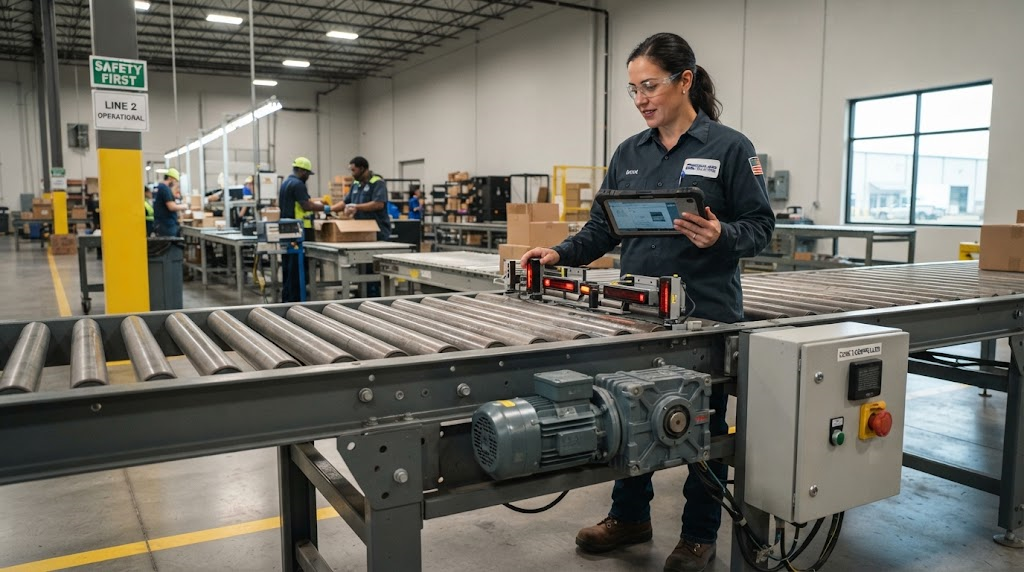
Moving products efficiently is one of the most important challenges in manufacturing, warehousing, packaging, distribution, and logistics.
As production volumes increase, manually carrying boxes, parts, containers, or pallets from one workstation to another becomes slow, expensive, and physically demanding. Material handling systems solve this problem by creating predictable paths for products to move through a facility.
One of the most widely used solutions is the roller conveyor.
Roller conveyors use a series of cylindrical rollers mounted inside a frame to transport products from one point to another. Depending on the system, products may move through gravity, electric motors, mechanical drives, or automated controls.
These systems are commonly found in warehouses, assembly lines, shipping departments, manufacturing plants, and distribution centers throughout the United States.
This guide explains how roller conveyors work, the main types available, common applications, design considerations, maintenance requirements, and how to determine whether they are right for your operation.
What Is a Roller Conveyor?
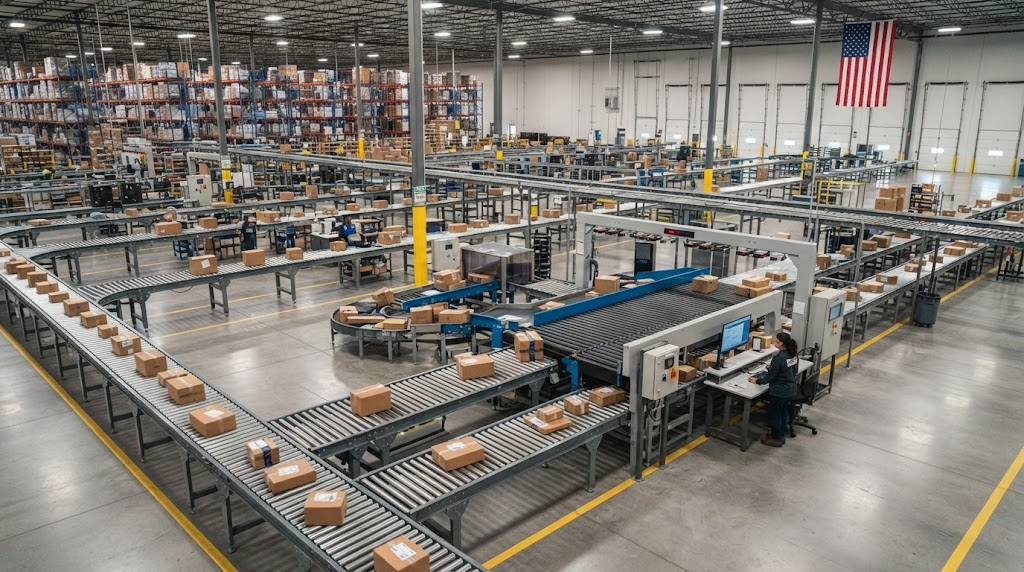
A roller conveyor is a material handling system that uses multiple rotating rollers to support and move products.
The rollers are mounted parallel to one another inside a structural frame.
Products rest on top of the rollers and move along the conveyor path.
Depending on the design, movement may be created by:
- Gravity
- Electric motors
- Chains
- Belts
- Line shafts
- Individual powered rollers
Roller conveyors are most effective for products with flat, rigid bottoms.
Common examples include:
- Cardboard cartons
- Plastic totes
- Trays
- Containers
- Pallets
- Metal parts
- Packaged goods
Products with uneven, flexible, or very small bottoms may require a different conveyor design.
How Does a Roller Conveyor Work?
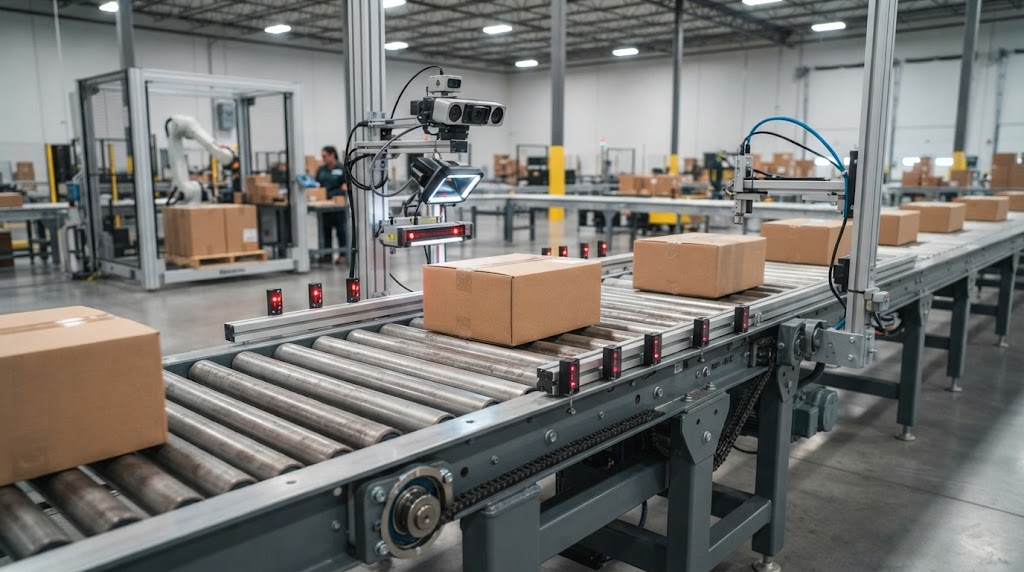
The operating principle is relatively simple.
The product is supported across multiple rollers.
As those rollers rotate, friction between the product and rollers moves the item forward.
The exact mechanism depends on the conveyor type.
Gravity-Based Movement
In a gravity conveyor, rollers rotate freely.
The conveyor may be installed on a slight downward slope so gravity moves products forward.
Workers can also manually push items.
Powered Movement
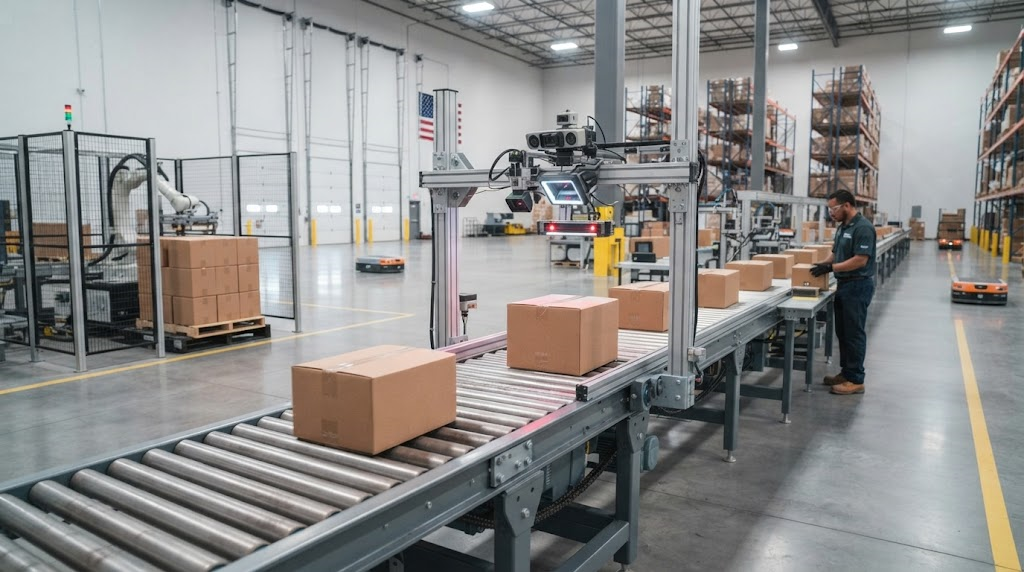
Powered systems use motors to rotate the rollers.
This provides greater control over speed and direction.
Powered conveyors can also integrate with sensors and automation systems.
Main Types of Roller Conveyors
Different applications require different conveyor configurations.
Understanding the main types is the first step in selecting the right system.
Gravity Roller Conveyor
A gravity roller conveyor does not require a motor.
Products move either by gravity or manual force.
This is one of the simplest conveyor designs.
Common Uses
Gravity conveyors are frequently used for:
- Shipping areas
- Packing stations
- Loading docks
- Order fulfillment
- Temporary production lines
- Manual assembly
Advantages
Benefits include:
- Low equipment cost
- Minimal energy consumption
- Simple maintenance
- Easy installation
- High reliability
The primary limitation is control.
Because products move freely, gravity systems are less suitable when precise speeds or automatic product spacing are required.
Powered Roller Conveyor
Powered roller conveyors use motors to move products.
These systems are commonly used in automated facilities.
They can provide:
- Controlled speed
- Product accumulation
- Automatic stopping
- Direction changes
- Integration with sensors
Powered systems are more complex than gravity conveyors but provide significantly greater control.
Motorized Roller Conveyor
Some modern systems use individual motorized rollers.
The motor is contained inside the roller itself.
These powered rollers may drive adjacent rollers using belts.
A major advantage is zone control.
Different conveyor sections can operate independently.
For example, one zone can stop while another continues moving.
This is particularly useful in automated warehouses.
Chain-Driven Roller Conveyor
Chain-driven roller conveyors use chains to rotate the rollers.
They are often designed for heavier products.
Common applications include:
- Pallets
- Metal components
- Automotive parts
- Heavy containers
These systems are generally stronger than lightweight carton conveyors.
However, they may require more maintenance because of the chains and mechanical drive components.
Belt-Driven Roller Conveyor
A belt underneath the rollers creates the driving force.
As the belt contacts the rollers, the rollers rotate.
This design can provide quiet and smooth operation.
Belt-driven systems are frequently used for medium-duty products.
Pallet Roller Conveyor
Pallet conveyors are designed specifically for heavy palletized loads.
They use larger, stronger rollers and heavier frames.
They may be integrated with:
- Forklifts
- Palletizers
- Robotic systems
- Stretch wrappers
- Automated storage systems
Load capacity is one of the most important design factors for pallet conveyors.
Roller Conveyor vs. Belt Conveyor
Roller and belt conveyors are both widely used, but they serve different purposes.
Roller Conveyor
Best suited for products with:
- Flat bottoms
- Rigid containers
- Stable shapes
Roller conveyors may be easier to maintain because individual rollers can often be replaced.
Belt Conveyor
Belt conveyors use a continuous belt.
They work better for:
- Small items
- Loose products
- Irregular shapes
- Soft packages
The belt provides continuous support across the product.
The choice depends on the product being moved.
Common Applications of Roller Conveyors
Roller conveyors are used across many industries.
Warehousing and Distribution
Distribution centers depend heavily on conveyor systems.
Roller conveyors can move cartons through:
- Picking zones
- Packing areas
- Sorting systems
- Shipping stations
Automated facilities may combine conveyors with barcode scanners and sorting technology.
Manufacturing
Factories use conveyors to move parts between production stages.
Applications include:
- Assembly
- Inspection
- Testing
- Packaging
- Quality control
The conveyor helps create consistent production flow.
E-Commerce Fulfillment
E-commerce warehouses process large numbers of individual customer orders.
Roller conveyors can connect:
- Picking areas
- Packing stations
- Labeling systems
- Sortation equipment
- Shipping docks
Automation can significantly increase throughput.
Automotive Industry
Automotive manufacturing requires movement of both small components and heavy parts.
Heavy-duty roller conveyors may transport:
- Engines
- Assemblies
- Frames
- Components
Specialized conveyors can also operate inside automated production cells.
Food and Beverage Operations
Food manufacturing and packaging facilities use conveyors for cartons, containers, bottles, and packaged products.
In these environments, hygiene and cleaning requirements can influence material selection.
Stainless steel may be used where corrosion resistance is important.
Airports and Logistics Terminals
Material handling systems also support movement of luggage, parcels, and cargo.
Depending on product shape, roller conveyors may be combined with belt conveyors.
Advantages of Roller Conveyors
Roller conveyors offer several practical advantages.
Improved Efficiency
Products can move continuously between workstations.
This reduces time spent manually carrying items.
Reduced Manual Handling
Heavy or repetitive lifting can contribute to fatigue and workplace injuries.
Conveyors reduce unnecessary product handling.
Scalability
Conveyor systems can often be expanded as production grows.
Additional sections, curves, transfers, or automation may be added.
Flexibility
Roller conveyors can be configured in:
- Straight lines
- Curves
- Inclines
- Declines
- Multiple zones
This makes them adaptable to many facility layouts.
Automation Compatibility
Powered roller systems can integrate with:
- Sensors
- PLCs
- Barcode readers
- Robotic systems
- Warehouse management software
This allows products to move automatically based on system instructions.
Limitations of Roller Conveyors
Although versatile, roller conveyors are not suitable for every application.
Product Shape Restrictions
Items generally need a stable bottom.
Products with flexible bags, irregular bases, or very small dimensions may fall between rollers.
Noise
Some heavy-duty systems can generate noticeable noise.
Roller material and drive design can influence sound levels.
Maintenance
Powered conveyors contain motors, bearings, belts, chains, and sensors that require maintenance.
Fixed Layout
Once installed, large systems can be more difficult to relocate than manual handling equipment.
Planning the layout carefully is important.
Roller Spacing Matters
One of the most important design principles is roller spacing.
A product should normally be supported by multiple rollers at all times.
If the gap between rollers is too large, smaller products may become unstable or fall between them.
The correct spacing depends on:
- Product length
- Product weight
- Product bottom shape
- Roller diameter
A conveyor supplier should calculate appropriate spacing based on the smallest product being handled.
Load Capacity
Every conveyor has a maximum load rating.
Designers must consider:
- Weight per product
- Number of products on the conveyor
- Total conveyor load
- Impact loading
A carton conveyor designed for lightweight packages should not be used for heavy pallets.
Overloading can damage:
- Rollers
- Bearings
- Frames
- Motors
Always design with an appropriate safety margin.
Conveyor Speed
Powered systems can operate at different speeds.
The ideal speed depends on the process.
For example, a packaging line may require slower movement than a high-volume distribution center.
Excessive speed can create problems such as:
- Product collisions
- Unstable loads
- Worker safety risks
- Sorting errors
Speed should be matched to operational requirements.
Accumulation Conveyors
Accumulation allows products to stop temporarily without shutting down the entire conveyor.
This is extremely useful in automated operations.
For example, products may need to wait before:
- Packaging
- Inspection
- Labeling
- Robotic processing
Zero-pressure accumulation systems prevent products from pushing tightly against one another.
Sensors detect when a zone is occupied and stop the upstream product.
Conveyor Curves and Transfers
Facilities rarely have perfectly straight layouts.
Conveyor systems can use curves to change product direction.
Transfer devices can move products between different conveyors.
Common transfer methods include:
- Pop-up transfers
- Side transfers
- Turntables
- Lift systems
Each method serves different product and layout requirements.
Sensors and Controls
Modern conveyors often use sensors to detect products.
Photoelectric sensors are commonly installed along the line.
They can determine:
- Product presence
- Product spacing
- Conveyor congestion
- Position
Sensors send information to a control system.
A PLC, or programmable logic controller, can then decide whether each conveyor zone should run or stop.
Safety Considerations
Conveyors can improve workplace safety by reducing lifting, but moving machinery also introduces hazards.
Potential risks include:
- Pinch points
- Moving rollers
- Chains
- Belts
- Motors
- Unexpected startup
Safety measures may include:
- Guards
- Emergency stops
- Warning signs
- Lockout/tagout procedures
- Operator training
Workers should never reach into moving conveyor mechanisms.
Roller Conveyor Maintenance
Regular maintenance improves reliability.
Inspect Rollers
Check for:
- Damage
- Excessive wear
- Binding
- Unusual noise
Damaged rollers should be replaced.
Check Bearings
Bearings allow rollers to rotate smoothly.
Worn bearings can increase friction and noise.
Inspect Drive Components
Powered systems may contain:
- Chains
- Belts
- Sprockets
- Motors
These parts should be checked according to manufacturer recommendations.
Keep the System Clean
Dust, packaging debris, and dirt can interfere with rollers and sensors.
Regular cleaning reduces problems.
Test Safety Equipment
Emergency stop systems and guards should be inspected regularly.
Signs a Conveyor Needs Service
Warning signs include:
- Products moving unevenly
- Loud noises
- Slipping
- Jerky movement
- Frequent jams
- Damaged rollers
- Motor overheating
- Sensor failures
Ignoring these symptoms can lead to larger breakdowns.
How to Choose the Right Roller Conveyor
Start with the product.
You need to know:
- Dimensions
- Weight
- Bottom surface
- Production volume
- Required speed
Then evaluate the process.
Ask These Questions
Where does the product start?
Where does it need to go?
Does it need to stop?
Does it need to accumulate?
Will workers interact with it?
Will automation be added later?
The answers determine the system design.
Consider Future Expansion
A common mistake is designing a conveyor only for current production volume.
If your operation is growing, consider future requirements.
A modular system may make expansion easier.
Planning ahead can reduce the cost of future changes.
Modular Conveyor Systems
Modular systems use standardized components that can be combined.
Benefits can include:
- Faster installation
- Easier modification
- Reduced engineering time
- Simplified spare parts
This can be valuable for manufacturers that regularly change production layouts.
Conveyor Materials
Rollers and frames can be made from different materials.
Steel
Steel provides high strength and is common in industrial systems.
Stainless Steel
Stainless steel offers corrosion resistance.
It is commonly used in food, pharmaceutical, and washdown environments.
Aluminum
Aluminum is lightweight and corrosion resistant.
It may be useful in modular automation systems.
Plastic Rollers
Plastic can reduce weight and noise in lighter-duty applications.
Material selection depends on operating conditions.
Environmental Conditions
The environment can influence conveyor design.
Consider:
- Temperature
- Humidity
- Dust
- Chemicals
- Water exposure
A conveyor used in a clean electronics facility has very different requirements from one used in a wet food-processing plant.
Cost of a Roller Conveyor
There is no universal price.
Cost depends on:
- Conveyor length
- Width
- Load capacity
- Roller material
- Drive system
- Controls
- Sensors
- Installation
- Custom engineering
Gravity conveyors are generally less expensive than fully automated powered systems.
The lowest purchase price is not always the lowest long-term cost.
Maintenance, energy use, reliability, and productivity should also be considered.
Return on Investment
A conveyor system can produce value by reducing:
- Labor requirements
- Product handling time
- Workplace injuries
- Production delays
- Product damage
It may also increase throughput.
ROI should be calculated based on real operational improvements rather than equipment price alone.
Frequently Asked Questions
What is a roller conveyor?
A roller conveyor is a material handling system that uses rotating cylindrical rollers to move products through a facility.
What products can roller conveyors move?
They are best suited for cartons, totes, pallets, trays, containers, and other products with flat and stable bottoms.
What is the difference between gravity and powered roller conveyors?
Gravity conveyors rely on slope or manual pushing, while powered conveyors use motors to move products automatically.
Can roller conveyors handle pallets?
Yes. Heavy-duty pallet roller conveyors are specifically designed for palletized loads.
How do I determine roller spacing?
Roller spacing depends on the size and shape of the smallest product being transported. Products should remain supported by multiple rollers.
Are roller conveyors energy efficient?
Gravity conveyors require no electricity. Powered systems consume energy, but zone-based controls can reduce unnecessary operation.
How long do roller conveyors last?
Service life depends on equipment quality, load conditions, maintenance, environment, and operating hours. Well-maintained industrial systems can operate for many years.
Can roller conveyors be automated?
Yes. Powered systems can integrate with sensors, PLCs, scanners, robots, and warehouse automation software.
Are roller conveyors safe?
They can be operated safely when properly designed, guarded, maintained, and used by trained workers.
How often should a conveyor be maintained?
Maintenance frequency depends on usage and manufacturer recommendations. High-volume systems should be inspected regularly for wear, noise, alignment, and safety issues.
Conclusion
A roller conveyor is one of the most versatile tools in industrial material handling.
From basic gravity systems in shipping departments to highly automated conveyors inside modern distribution centers, the underlying objective remains the same: move products efficiently, consistently, and safely.
The right conveyor can reduce manual labor, improve production flow, increase throughput, and support automation.
But successful implementation depends on proper design.
Product dimensions, weight, roller spacing, load capacity, speed, accumulation requirements, controls, and facility layout all need to be considered.
A conveyor that is perfect for lightweight cartons may be completely unsuitable for pallets or irregular products.
Before purchasing a system, start with the process rather than the equipment.
Understand what needs to move, how quickly it needs to move, where it needs to stop, and how workers or automated equipment will interact with it.
Then select a conveyor design that supports those requirements while allowing room for future growth.
When the system is properly engineered and maintained, roller conveyors can become a reliable backbone for manufacturing, warehousing, packaging, and distribution operations.

Written by Twastia Editorial Team
Twastia Editorial Team shares practical insights about website design, SEO services, Google Ads, content marketing, social media, conversion rate optimization, and digital marketing strategy.
Last updated: Oct 8, 2026
Related posts from Twastia
Explore more useful articles from twastia.com about digital marketing, SEO, websites, ads, content, and growth strategy.