What Is the Purpose of an Attic Fan? Benefits, Types, Costs, and When You Need One
Attics can become extremely hot during the summer, especially in homes exposed to strong sunlight for many hours a day. […]
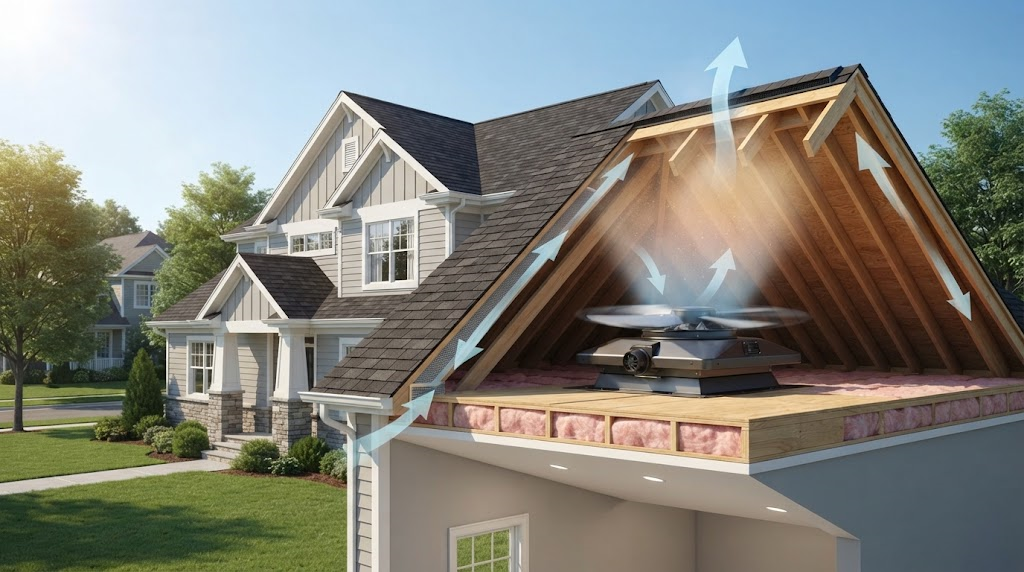
Attics can become extremely hot during the summer, especially in homes exposed to strong sunlight for many hours a day. That trapped heat can raise attic temperatures well above the outdoor temperature and may affect comfort, roofing materials, insulation performance, and cooling demand inside the home.
This is where attic ventilation becomes important.
If you are trying to understand the purpose of attic fan systems, the basic idea is simple: an attic fan helps remove excess heat and, in some cases, moisture from the attic by exhausting air to the outdoors.
However, attic fans are not a universal solution for every home.
Their effectiveness depends on roof design, existing ventilation, insulation, air sealing, climate, fan type, and how the system is installed.
This guide explains how attic fans work, when they help, their limitations, and how to decide whether one makes sense for your home.
What Is an Attic Fan?
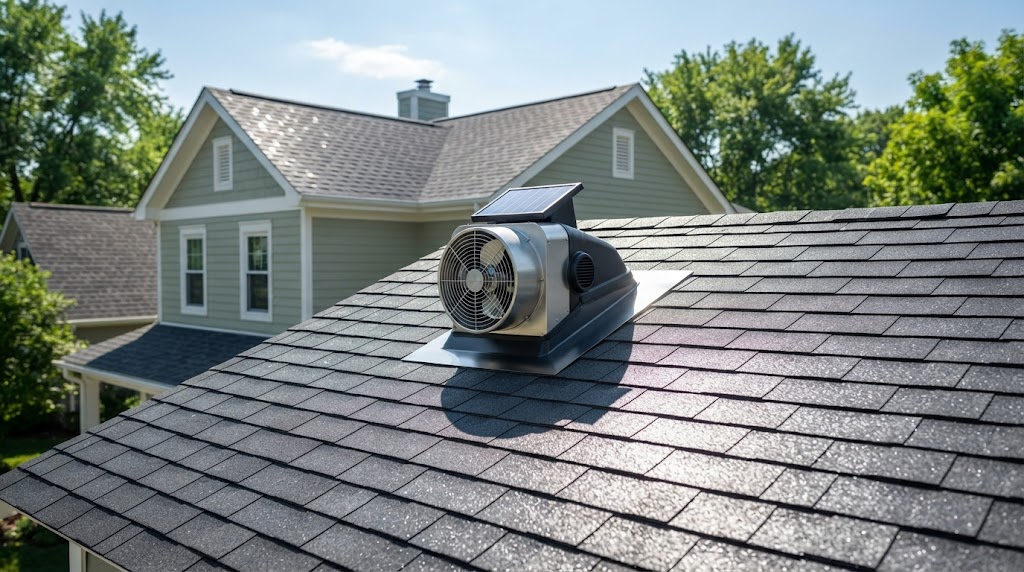
An attic fan is a ventilation device designed to move hot air out of the attic.
It is usually installed on the roof or a gable wall.
As the fan pushes attic air outside, cooler outdoor air enters through intake vents such as soffit vents.
The system creates continuous airflow through the attic space.
Common types include:
- Roof-mounted attic fans
- Gable-mounted attic fans
- Solar attic fans
- Electric-powered attic fans
Some models operate automatically using thermostats or humidistats.
What Is the Main Purpose of an Attic Fan?
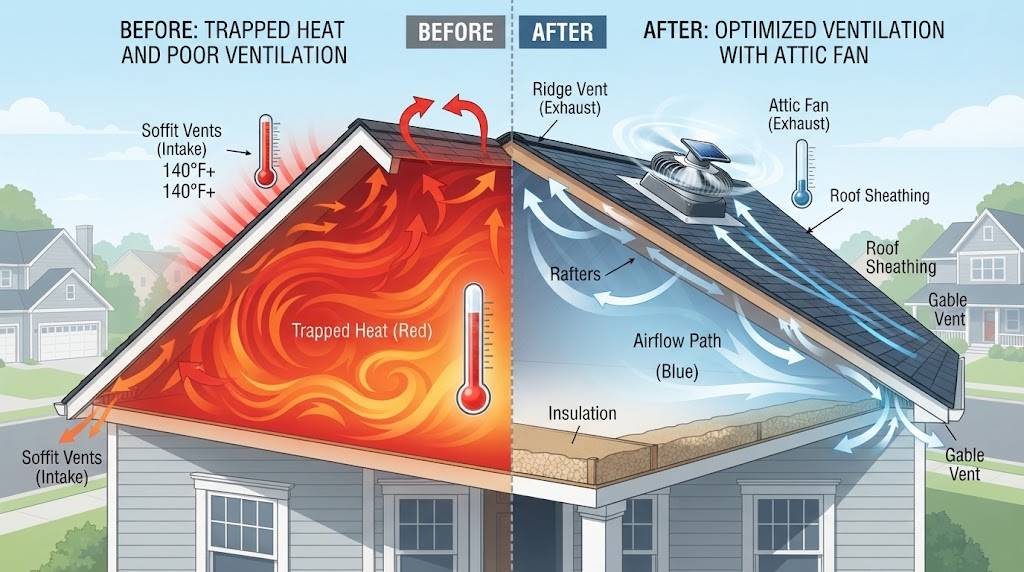
The primary purpose of an attic fan is to reduce excessive heat buildup in the attic.
During hot weather, sunlight heats the roof surface.
That heat transfers into the attic through roofing materials and roof decking.
Without sufficient ventilation, heat can remain trapped.
An attic fan accelerates the movement of hot air out of the attic.
This may help reduce attic temperatures and decrease heat transfer into living spaces below.
A secondary purpose can be moisture control.
In humid conditions, attic fans may help remove moisture-laden air, although proper passive ventilation and air sealing remain important.
Why Attics Get So Hot
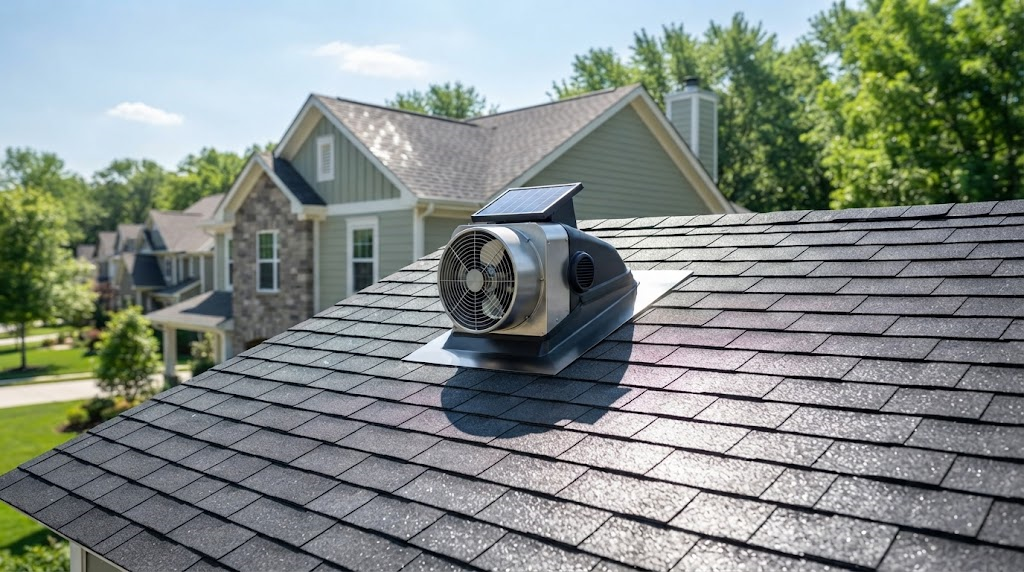
The roof receives direct solar radiation throughout the day.
Dark roofing materials can absorb significant amounts of heat.
That heat moves downward into the attic.
In a poorly ventilated attic, warm air accumulates because it has limited ways to escape.
Several factors can make the problem worse:
- Dark shingles
- Limited roof ventilation
- Poor insulation
- Air leaks from living areas
- High outdoor temperatures
- Large roof surface area
- Minimal shading
In extreme summer conditions, attic temperatures can become much higher than outdoor temperatures.
How an Attic Fan Works
An attic fan works by creating negative pressure inside the attic.
The fan exhausts hot air to the outside.
As air leaves, replacement air enters through intake vents.
A properly designed system should pull replacement air from outside, not from conditioned living spaces.
That distinction is important.
If the attic is poorly sealed from the home below, a powerful fan may pull air-conditioned indoor air into the attic through ceiling gaps.
That can increase cooling costs rather than reduce them.
Attic Fan vs. Passive Ventilation
Many homes already use passive attic ventilation.
Passive systems rely on natural air movement.
Common components include:
- Soffit vents
- Ridge vents
- Gable vents
- Roof vents
Cooler air enters through lower vents, while warmer air exits through higher vents.
This process does not require electricity.
An attic fan actively increases airflow.
Whether powered ventilation is necessary depends on how well the passive ventilation system already works.
In many homes, improving passive ventilation may be more important than adding a fan.
Benefits of an Attic Fan
Attic fans can provide several advantages when used correctly.
Reduced Attic Heat
The most obvious benefit is lower attic temperature.
Removing hot air can reduce the amount of heat stored under the roof.
This can be helpful in warm climates.
Potentially Lower Cooling Load
If less heat enters the conditioned space below, the air-conditioning system may have less heat to remove.
This can improve comfort and potentially reduce cooling demand.
However, savings vary widely.
A fan does not replace insulation or air sealing.
Improved Comfort
Homes with bedrooms directly below hot attic spaces may experience uncomfortable ceiling temperatures.
Reducing attic heat can sometimes make upper floors feel more comfortable.
Moisture Management
Humidity and moisture can create problems in attics.
Possible issues include:
- Mold
- Wood deterioration
- Wet insulation
- Condensation
An attic fan may help remove humid air, depending on climate and ventilation design.
Roof Protection
Excessive attic heat can contribute to harsh conditions under roofing materials.
Proper ventilation may help moderate temperatures around roof decking and shingles.
However, roof lifespan depends on many factors beyond attic temperature.
Limitations of Attic Fans
Attic fans are often marketed as major energy-saving devices, but that claim can be exaggerated.
The actual performance depends on the home.
They Use Energy
Electric attic fans consume electricity.
If the energy used by the fan exceeds the cooling savings, the financial benefit may be small.
Solar fans reduce operating electricity costs, but installation costs still matter.
They Can Pull Conditioned Air From the House
This is one of the most important risks.
If the ceiling is not well sealed, the fan may pull cool indoor air into the attic.
Air can escape through:
- Recessed lights
- Attic hatches
- Wiring penetrations
- Plumbing openings
- Ceiling cracks
This can force the HVAC system to work harder.
They Do Not Replace Insulation
A hot attic does not automatically mean you need a fan.
Poor insulation may be the bigger problem.
Insulation slows heat transfer from the attic into the home.
Without adequate insulation, even a ventilated attic can still increase indoor heat gain.
Attic Fan vs. Whole House Fan
These are often confused, but they serve very different purposes.
Attic Fan
An attic fan ventilates only the attic.
It removes hot attic air and replaces it with outdoor air through roof or soffit vents.
Whole House Fan
A whole house fan ventilates the living area.
It pulls outdoor air into the home through open windows and pushes warm indoor air into the attic and eventually outside.
Whole house fans are typically used during cooler evenings.
They can reduce reliance on air conditioning in certain climates.
Types of Attic Fans
There are several common designs.
Roof-Mounted Attic Fans
These fans are installed directly through the roof.
They exhaust air vertically outdoors.
Because installation requires roof penetration, proper flashing is essential to prevent leaks.
Gable-Mounted Fans
These are installed in gable walls.
They may be easier to install when suitable gable vents already exist.
Solar Attic Fans
Solar attic fans use roof-mounted solar panels to power the fan.
They operate most strongly during sunny periods, which often coincide with peak attic heat.
They do not require household electricity while operating.
Electric Attic Fans
Electric models connect to the home’s electrical system.
They may provide stronger or more consistent airflow than some solar units.
Operating cost depends on motor power and runtime.
Thermostats and Humidistats
Many attic fans are controlled automatically.
Thermostat Control
A thermostat turns the fan on when attic temperature reaches a preset threshold.
The fan shuts off when temperature falls.
This prevents unnecessary operation.
Humidistat Control
A humidistat activates the fan based on humidity levels.
This can help manage moisture, particularly in climates where humidity is a concern.
Some units combine both controls.
How Much Does an Attic Fan Cost?
Costs vary significantly depending on fan type and installation complexity.
Main cost factors include:
- Fan model
- Electrical work
- Roof access
- Roof type
- Gable availability
- Solar equipment
- Labor rates
- Required ventilation upgrades
A simple gable fan may cost less than a roof-mounted or solar-powered installation.
The total project cost can increase if additional intake vents are required.
Does an Attic Fan Save Money?
Possibly, but not always.
An attic fan can reduce attic temperature, but the actual energy savings depend on several conditions.
Potential savings improve when:
- The attic is extremely hot
- Intake ventilation is adequate
- Ceiling air sealing is strong
- Insulation is appropriate
- Air-conditioning demand is high
Savings may be limited when:
- The attic already has good passive ventilation
- The ceiling leaks significant conditioned air
- Insulation is inadequate
- The fan uses substantial electricity
For this reason, attic fans should be considered part of a broader ventilation strategy rather than a guaranteed energy-saving device.
Signs Your Attic May Have a Ventilation Problem
Several warning signs may indicate poor attic ventilation.
Excessive Summer Heat
If the attic becomes extremely hot and the upper floor remains uncomfortable, ventilation may be insufficient.
High Cooling Bills
High summer energy bills can have many causes, but attic heat may contribute.
Moisture or Condensation
Water droplets, damp insulation, or mold growth can indicate moisture problems.
Ice Dams
In cold climates, poor attic conditions can contribute to uneven roof temperatures and ice dam formation.
Premature Roof Damage
Curling or deteriorating shingles may be associated with heat, age, installation quality, or weather exposure.
A professional evaluation can help identify the actual cause.
Attic Ventilation and Insulation Work Together
Ventilation and insulation serve different functions.
Ventilation removes hot or moist air.
Insulation slows heat transfer into the living area.
A home with excellent ventilation but poor insulation may still be uncomfortable.
Likewise, good insulation cannot fully solve attic moisture problems.
The best performance usually comes from combining:
- Proper insulation
- Air sealing
- Balanced ventilation
- Efficient HVAC equipment
Importance of Air Sealing
Air sealing is often overlooked.
Before installing a powerful attic fan, seal openings between the conditioned home and attic.
Common leakage points include:
- Attic access doors
- Recessed lights
- Ceiling fixtures
- Plumbing penetrations
- Duct openings
- Electrical wiring gaps
Proper sealing reduces unwanted airflow.
This helps prevent the attic fan from pulling conditioned air from the house.
How Much Ventilation Does an Attic Need?
Ventilation requirements depend on attic size, roof design, climate, and building codes.
Ventilation is often discussed in terms of net free ventilating area.
The correct balance between intake and exhaust matters.
Too much exhaust without enough intake can create pressure problems.
A qualified contractor can calculate the ventilation needs of your attic.
Should You Run an Attic Fan All Day?
Usually, no.
Most attic fans are controlled automatically.
They run when temperature or humidity exceeds a set threshold.
Continuous operation may waste energy and can create unnecessary airflow.
Thermostatic control is generally more efficient than leaving the fan on constantly.
Can an Attic Fan Cause Problems?
Yes, if installed incorrectly.
Potential problems include:
- Pulling conditioned air from the home
- Increasing energy use
- Creating negative pressure
- Drawing combustion gases from appliances
- Roof leaks
- Excessive noise
- Insufficient replacement air
Homes with atmospheric combustion appliances deserve special attention because pressure differences can create safety concerns.
Professional installation is recommended when these conditions exist.
Solar Attic Fans: Are They Worth It?
Solar attic fans appeal to homeowners because they operate without drawing household electricity.
Advantages include:
- Low operating cost
- Automatic daytime operation
- No dedicated electrical circuit in some installations
- Reduced grid energy use
However, they may cost more upfront.
Performance also depends on sunlight.
Cloudy conditions reduce power output.
The decision should be based on total cost, airflow requirements, and climate.
When an Attic Fan Makes Sense
An attic fan may be worth considering when:
- Summer attic temperatures are extreme
- Passive ventilation is insufficient
- Intake vents are adequate
- The attic is well air-sealed
- Insulation is already reasonably strong
- Moisture problems exist
- A qualified contractor recommends powered ventilation
The key is solving the correct problem.
Installing a fan without diagnosing the attic can waste money.
When You May Not Need an Attic Fan
You may not need one if:
- Ridge and soffit ventilation already works well
- Attic insulation is excellent
- Heat transfer into living areas is minimal
- Energy bills are reasonable
- No moisture problems exist
In some cases, improving passive ventilation provides better value.
Questions to Ask an HVAC or Roofing Contractor
Before installing an attic fan, ask:
- Is my attic currently under-ventilated?
- Are my intake vents adequate?
- Is my ceiling properly air-sealed?
- Is my insulation sufficient?
- What fan size do I need?
- Should I use roof-mounted or gable-mounted equipment?
- Would passive ventilation be enough?
- Could the fan affect combustion appliances?
- What warranty is included?
- How much electricity will the fan use?
A contractor should be able to explain why a fan is recommended.
Common Attic Fan Mistakes
Installing Too Large a Fan
Bigger is not always better.
An oversized fan can create excessive negative pressure.
Ignoring Intake Ventilation
Exhaust fans need adequate replacement air.
Without it, airflow may come from inside the house.
Skipping Air Sealing
Air leaks can undermine efficiency.
Expecting Huge Energy Savings
An attic fan is not a substitute for proper insulation or efficient air conditioning.
Installing Without Diagnosing the Problem
Heat, moisture, and high energy bills can have multiple causes.
Frequently Asked Questions
What is the main purpose of an attic fan?
The main purpose of an attic fan is to remove excess heat and, in some cases, moisture from the attic.
Does an attic fan cool the whole house?
Not directly. It cools the attic space. This may reduce heat transfer into the living area.
Is an attic fan the same as a whole house fan?
No. An attic fan ventilates the attic, while a whole house fan moves air through the living space.
Do attic fans reduce air-conditioning costs?
They may reduce cooling load in some homes, but savings depend on insulation, air sealing, climate, fan efficiency, and ventilation design.
Should I run my attic fan in winter?
Some systems may operate based on humidity rather than temperature. Winter ventilation requirements depend on climate and moisture conditions.
Are solar attic fans better?
Solar attic fans have low operating costs but may provide less consistent airflow depending on sunlight. They are not automatically better for every home.
Can an attic fan damage my roof?
A properly installed fan should not damage the roof. Poor installation or flashing can create leaks.
How long do attic fans last?
Lifespan varies by product quality, climate, usage, and maintenance. Motors and controls may eventually require replacement.
Do I need an attic fan if I have ridge vents?
Possibly not. A well-designed ridge-and-soffit ventilation system may provide adequate airflow without powered ventilation.
Conclusion
The purpose of attic fan systems is straightforward: move excess heat and moisture out of the attic.
The decision to install one, however, should not be automatic.
Attic fans work best when they are part of a properly designed system that includes adequate intake ventilation, insulation, and air sealing.
When installed correctly, they can reduce attic heat, improve ventilation, support moisture control, and potentially reduce cooling demand.
When installed poorly, they can pull conditioned air out of the home and increase energy costs.
Before buying a fan, evaluate the attic as a complete system.
Check insulation levels, passive ventilation, air leaks, roof condition, and moisture levels.
If these areas are already performing well, a powered attic fan may provide limited additional value.
If the attic is consistently overheating or holding excess moisture, professional evaluation can help determine whether powered ventilation is appropriate.
The smartest approach is not simply asking whether attic fans work.
The better question is whether your specific attic needs one.

Written by Twastia Editorial Team
Twastia Editorial Team shares practical insights about website design, SEO services, Google Ads, content marketing, social media, conversion rate optimization, and digital marketing strategy.
Last updated: Oct 8, 2026
Related posts from Twastia
Explore more useful articles from twastia.com about digital marketing, SEO, websites, ads, content, and growth strategy.