Carbon Brush Replacement: The 25% Rule for Industrial Motor Maintenance
Carbon brush replacement is a critical aspect of industrial maintenance, and navigating the best time to swap out worn brushes is […]
Carbon brush replacement is a critical aspect of industrial maintenance, and navigating the best time to swap out worn brushes is surprisingly straightforward. The simplest rule: if the brush is worn down to roughly a quarter of its original length, it is time to change them. Industry maintenance guides put the same threshold in slightly different words, but they all converge on the same number. Adhering to this carbon brush replacement standard is essential for protecting your electric motors, ensuring asset reliability, and preventing catastrophic downtime. In this comprehensive guide, we will explore the engineering logic behind the 25% rule, the dangers of waiting too long, and how modern condition monitoring can help you optimize your maintenance schedule.
Understanding the Carbon Brush Replacement Rule
Electric motors rely on carbon brushes to conduct electrical current between the stationary wiring and the rotating commutator or slip ring. Because these brushes maintain physical contact while the rotor spins at high speeds, friction causes them to wear down over time.
Determining the exact moment to replace them is a fundamental skill in reliability engineering. Replace them too early, and you waste material and unnecessary maintenance hours. Replace them too late, and you risk severe damage to the motor.
Why Industry Converges on the 25% Length Threshold
The simplest rule: if the brush is worn down to roughly a quarter of its original length, it is time to change them. Industry maintenance guides put the same threshold in slightly different words, but they all converge on the same number. But why exactly 25%?
The answer lies in the mechanics of the brush holder and spring tension. Carbon brushes are held against the commutator by a constant-force spring. As the brush wears down, the spring extends to maintain pressure. However, springs have an effective operating range. Once the brush wears past the 75% mark (leaving only 25% of its original length), the spring approaches the end of its travel.
At this point, spring tension drops off dramatically. Without adequate pressure, the brush begins to bounce and chatter against the commutator. This breaks the electrical connection, causing severe electrical arcing, pitting, and rapid heat buildup. By setting the replacement threshold at 25% of the original length, maintenance teams ensure the spring always operates within its optimal tension range.
Risks of Delaying Carbon Brush Replacement
Failing to observe the 25% rule triggers a cascade of failures that can destroy a motor’s most expensive components. Understanding these risks highlights why industrial maintenance protocols are so strict about this threshold.
Commutator Damage and Costly Downtime
When a brush wears below the critical length and loses spring tension, the resulting electrical arcing generates intense heat. This heat rapidly degrades the smooth surface of the commutator. Over time, arcing pits the copper bars and burns the mica insulation between them.
Once the commutator is damaged, it must be resurfaced or “turned down” on a lathe, which requires completely disassembling the motor. In severe cases, the commutator must be replaced entirely. This transforms a routine, low-cost maintenance task into a major capital expense and causes extensive unplanned downtime.
Brush Holder Wear and Overheating
A worn brush that is chattering inside its holder does not just damage the commutator. The erratic movement also scores and damages the interior walls of the brush holder itself. Once the holder is worn out of tolerance, it can no longer guide the replacement brush smoothly, forcing you to replace the entire brush holder assembly. Furthermore, reduced contact area increases electrical resistance, causing the brush to overheat and potentially crack or shatter.
Jeopardizing Asset Reliability and Performance Management
In modern manufacturing and processing plants, electric motors are the workhorses of production. A single motor failure can halt an entire production line. Ignoring the carbon brush replacement threshold directly undermines broader asset performance management initiatives. It shifts a plant from a proactive maintenance culture to a reactive one, where equipment failures dictate the schedule rather than planned outages.
How to Monitor Brush Wear for Maintenance Optimization
You cannot manage what you cannot measure. Effectively tracking brush wear is vital for maintenance optimization. There are several ways to determine when brushes are approaching that critical 25% length.
Visual Inspection and Measurement
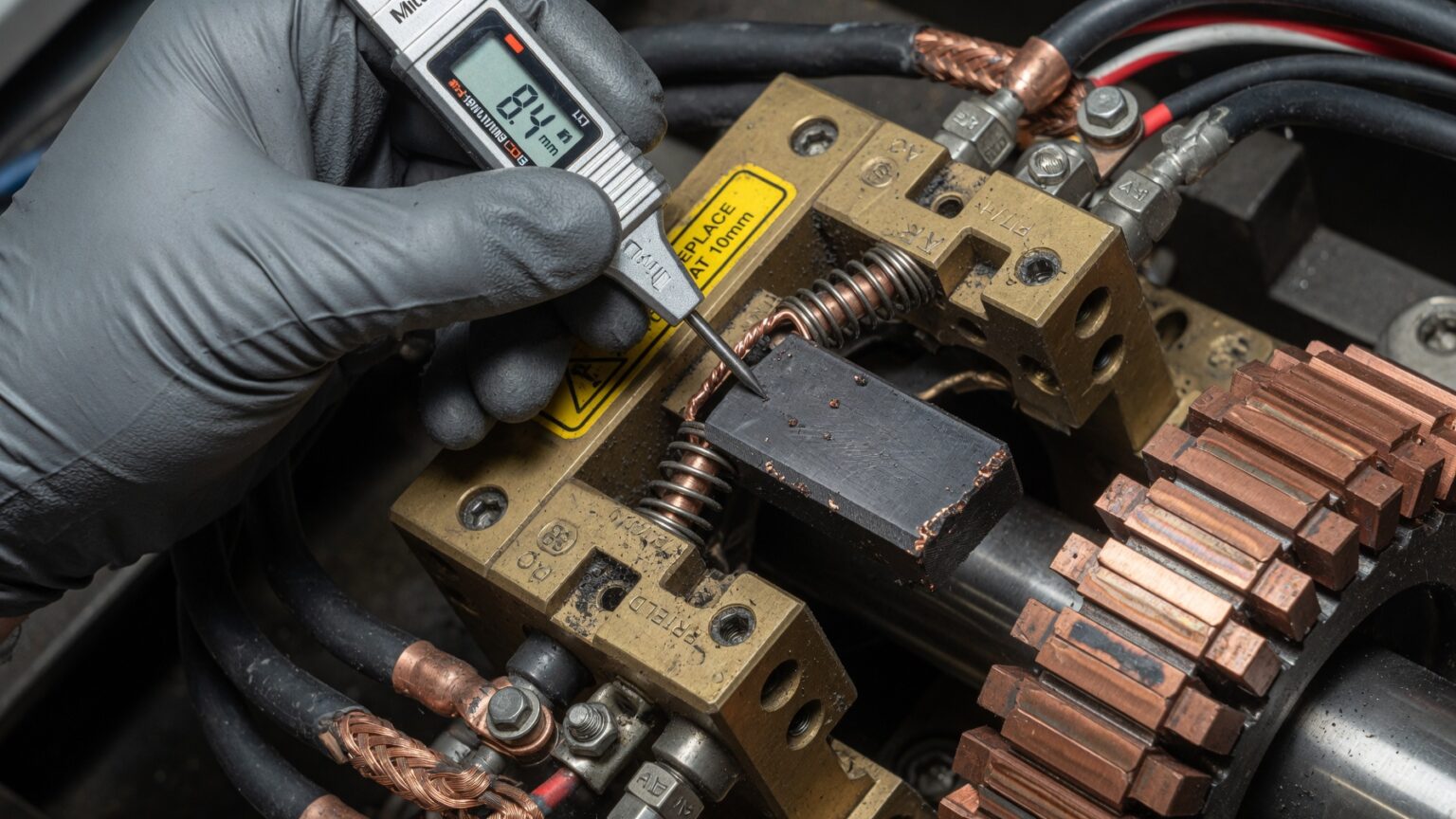
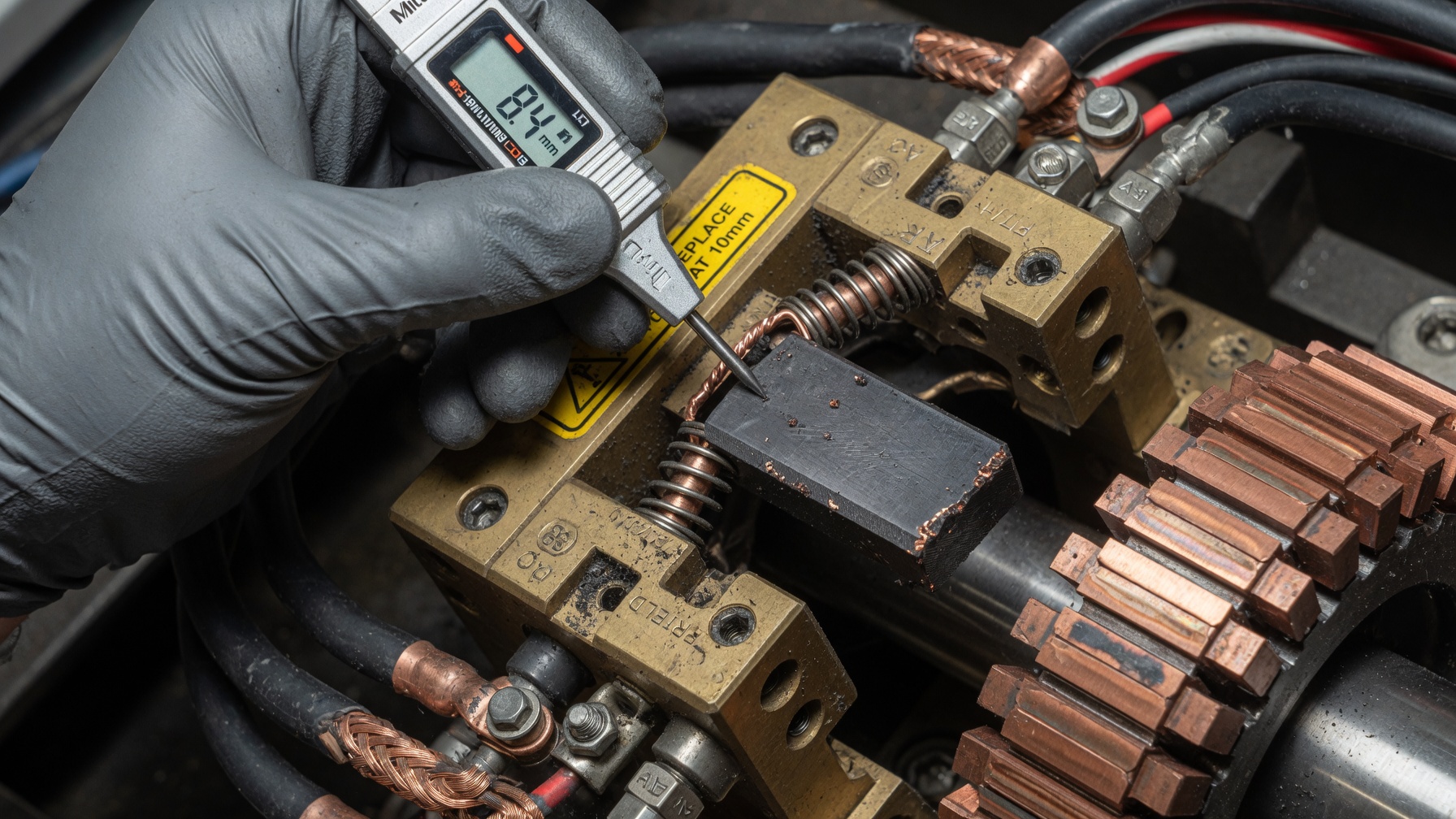
The most traditional method of equipment monitoring is visual inspection. Technicians use a specialized depth gauge or a simple ruler inserted into the brush holder to measure the remaining brush length. This data is compared against the original length to calculate the wear percentage.
For accessible motors, this is a straightforward task during routine walk-downs. However, it requires the motor to be de-energized and the inspection covers removed, which limits how frequently it can be done.
Brush Wear Indicators (Flags and Pins)
To simplify inspections, many industrial motors are equipped with mechanical brush wear indicators. These are small pins or colored flags attached to the brush spring that move outward as the brush wears down. When the indicator extends to a predefined mark on the brush holder, the technician knows the brush has reached its replacement threshold without needing to measure it directly. This allows for quick, visual condition monitoring even while the motor is running.
Predictive Maintenance Technologies for Brushes
Advanced facilities are moving beyond manual inspections toward true predictive maintenance. By continuously monitoring the electrical and mechanical signatures of a motor, sensors can detect the early warning signs of brush degradation.
- Electrical Signature Analysis (ESA): As brushes wear and spring tension decreases, subtle changes occur in the motor’s current waveform. ESA systems can detect the high-frequency transients caused by micro-sparking or arcing long before physical damage occurs.
- Vibration Analysis: Brush chatter produces a distinct, high-frequency vibration pattern. Vibration sensors equipped with enveloping or demodulation algorithms can identify this specific frequency, alerting reliability engineers that brush tension is dropping.
- Thermal Imaging: Infrared cameras can identify hot spots at the brush holder or commutator, indicating increased resistance due to poor brush contact.
Integrating these condition monitoring tools allows teams to estimate brush remaining useful life and schedule replacements precisely when needed, maximizing brush utilization without crossing the danger zone.
Carbon Brush Replacement Best Practices in Industrial Maintenance
Executing the actual replacement requires careful attention to detail. Simply sliding a new brush into a worn holder can still result in poor performance. Follow these reliability engineering best practices to ensure a successful installation.
Replace Brushes as a Set
If one brush has worn down to the 25% mark, the others in the same motor are likely close behind. Because brushes share the current load equally, installing a single new brush alongside older, shorter brushes causes unequal current distribution. The new brush will carry a disproportionate amount of the load, causing it to overheat and wear out prematurely. Always replace all brushes on the same circuit or pole at the same time.
Seating and Bedding in New Brushes
New brushes have a flat surface, but the commutator they press against is slightly curved. If you install a new brush flat against a curved commutator, only a tiny fraction of the surface will make contact. This high current density in a small area will cause immediate sparking and burning.
Brushes must be “bedded in” or contoured to match the commutator’s radius. This is done using specialized abrasive seating stones or fine grit sandpaper wrapped around the commutator. The motor is turned slowly, and the abrasive wears the brush face into a perfect matching curve. Proper seating ensures 100% surface contact from the moment the motor goes back into full-speed operation.
Verify Spring Tension and Holder Clearance
When replacing brushes, always inspect the brush holders. Clear out any carbon dust or debris that could restrict brush movement. Verify that the brush slides freely in the holder without sticking. Additionally, use a spring scale to verify that the spring tension matches the manufacturer’s specification. Incorrect spring tension—whether too loose or too tight—is a primary cause of premature brush wear.
Documenting Wear Patterns for Reliability Engineering
Do not just throw away the old brushes. Examine them carefully. The wear patterns on a discarded brush tell a story about the motor’s health.
- Chipped or fractured edges often indicate vibration or poor spring tension.
- Grooved wear suggests debris trapped under the brush or a damaged commutator.
- Discoloration or heat marks point to electrical overloading or poor seating.
Documenting these findings and tracking the run-hours between replacements is a core practice in asset performance management. This data allows reliability engineers to adjust motor loads, improve operating environments, and extend equipment life.
The Impact of the Operating Environment on Brush Wear
While the 25% rule remains constant, the speed at which brushes reach that threshold varies wildly depending on the operating environment. High humidity, altitude, and ambient temperature all affect the friction coefficient and the microscopic film layer on the commutator.
The Commutator Film and Humidity
A healthy commutator develops a thin, dark, shiny film of copper oxide and carbon graphite. This film provides lubrication, reducing friction and wear. If the environment is too dry, this film cannot form properly, leading to a “dry commutator” scenario where brushes wear out incredibly fast and dusting occurs. Conversely, excessive moisture or contamination can make the film too thick or streaky, also accelerating wear. Maintaining a controlled environment is a crucial part of industrial maintenance for DC machinery.
Chemical Contamination
In processing plants, airborne chemical vapors can react with the commutator film. Chlorine, sulfur, and acidic environments can strip the protective film or create corrosive layers that aggressively grind down the carbon brushes. In such cases, reaching the 25% carbon brush replacement threshold may happen much faster than in a clean environment, requiring more frequent condition monitoring.
Conclusion: Optimizing Carbon Brush Replacement for Peak Performance
Adhering to the standard threshold for brush wear is a non-negotiable practice in motor upkeep. The rule is simple but rooted in deep mechanical logic: if the brush is worn down to roughly a quarter of its original length, it is time to change them. Industry maintenance guides put the same threshold in slightly different words, but they all converge on the same number. Obeying this carbon brush replacement rule ensures that spring tension remains optimal, preventing the electrical arcing and commutator damage that ruin asset reliability. By pairing this 25% rule with advanced condition monitoring, proper seating techniques, and diligent wear pattern analysis, your facility can achieve true maintenance optimization. Protect your motors, safeguard your production lines, and maximize your asset performance management by making the carbon brush replacement rule a cornerstone of your reliability engineering program.
Frequently Asked Questions (FAQs)
1. When should carbon brushes be replaced?
Carbon brushes should be replaced when they have worn down to roughly 25% (one quarter) of their original length, as spring tension drops off significantly beyond this point.
2. What happens if carbon brushes are too short?
If carbon brushes are too short, the spring can no longer apply adequate pressure, causing the brush to chatter, arc, overheat, and severely damage the commutator.
3. Can I replace just one carbon brush in a motor?
No, you should always replace all the brushes on the same circuit or pole as a set to ensure equal current distribution and prevent the new brush from overloading.
4. How do you check carbon brush wear?
Brush wear can be checked by measuring the remaining brush length with a depth gauge, observing mechanical wear indicator pins, or using predictive maintenance tools like electrical signature analysis.
5. Why do carbon brushes need to be seated?
New brushes have flat surfaces and must be seated or contoured to match the curved surface of the commutator to ensure 100% contact and prevent immediate sparking.
6. Does the operating environment affect carbon brush life?
Yes, factors like low humidity, high altitude, and chemical contamination can degrade the protective commutator film, significantly accelerating carbon brush wear.

Written by Twastia Editorial Team
Twastia Editorial Team shares practical insights about website design, SEO services, Google Ads, content marketing, social media, conversion rate optimization, and digital marketing strategy.
Last updated: Aug 11, 2026
Related posts from Twastia
Explore more useful articles from twastia.com about digital marketing, SEO, websites, ads, content, and growth strategy.